
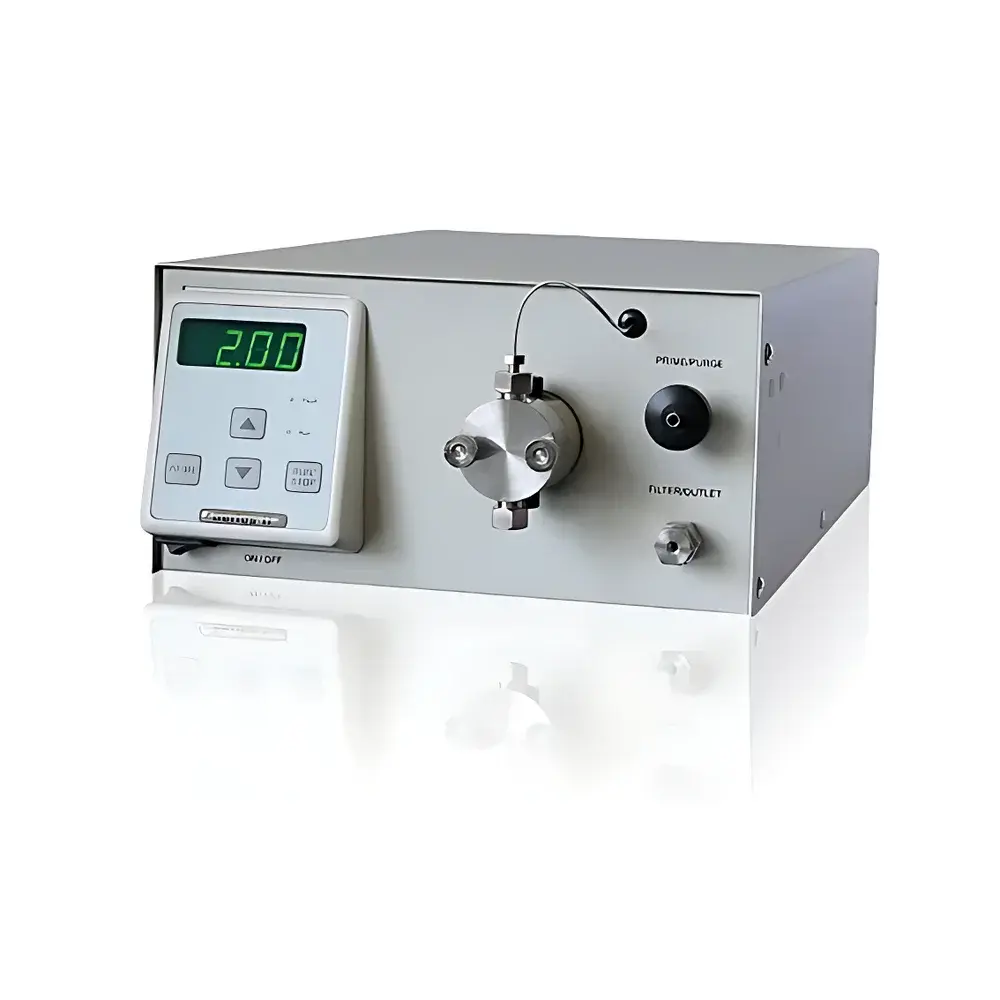
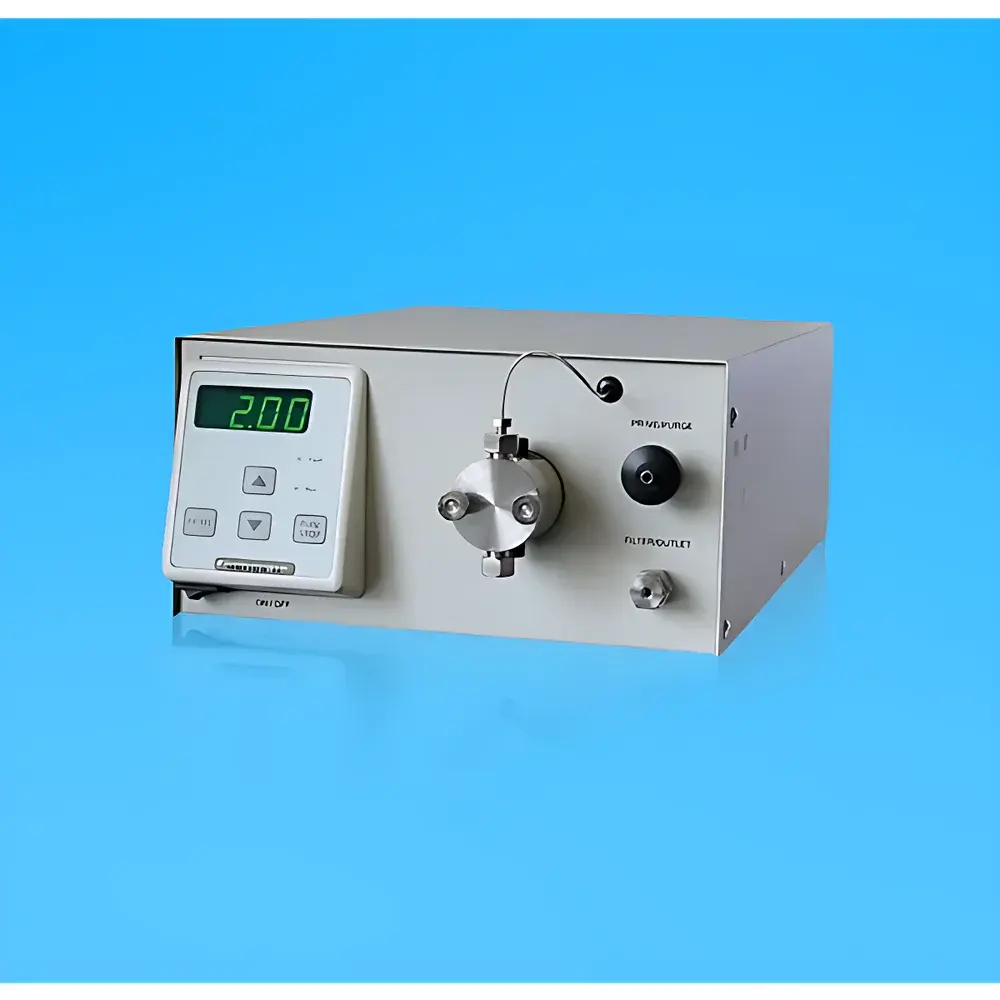
SSI Series II Constant Flow High-Pressure Liquid Chromatography Pump
| Brand | SSI |
|---|---|
| Model | Series II |
| Flow Rate | 0.001–5 mL/min, 0.01–10 mL/min, or 0.1–40 mL/min (selectable ranges) |
| Maximum Pressure | 6000 psi (316 stainless steel), 5000 psi (PEEK), 1500 psi (low-pressure configuration) |
| Accuracy | ±2% |
| Flow Precision | ≤0.2% RSD |
| Pulse Damping | Integrated low-dead-volume pulsation damper |
| Auto-Cleaning System | On-column solvent-assisted seal flush with weekly aqueous solution replenishment |
| Seal Replacement | Tool-free, completed in <5 minutes |
| Flow Path Materials | Optional 316 stainless steel or PEEK (biocompatible) |
| Remote Control Interface | Analog voltage input, frequency input, RS232 digital communication |
| Dimensions | 140 H × 254 W × 432 D mm |
| Weight | 11 kg |
| Power Supply | 115 V / 230 V, 50 / 60 Hz |
Overview
The SSI Series II Constant Flow High-Pressure Liquid Chromatography Pump is an engineered solution for precise, pulse-free solvent delivery in analytical and semi-preparative liquid chromatography systems. Based on a single-plunger positive displacement architecture, it operates under the principles of volumetric displacement control—where flow rate is directly governed by plunger stroke volume and stepping motor-driven actuation frequency. Its design eliminates reliance on feedback-based pressure compensation, instead achieving high reproducibility through mechanical precision and integrated fluidic damping. The pump delivers stable, low-pulsation flow across three user-selectable ranges—0.001–5 mL/min, 0.01–10 mL/min, and 0.1–40 mL/min—making it suitable for capillary, analytical, and early-stage preparative LC applications. With maximum pressure ratings up to 6000 psi (414 bar) for stainless steel configurations and 5000 psi (345 bar) for PEEK fluidic paths, the Series II meets the operational demands of modern reversed-phase, HILIC, and ion-pairing separations.
Key Features
- Single-plunger architecture with digitally controlled stepper motor ensures consistent volumetric delivery without closed-loop pressure modulation
- Integrated low-dead-volume pulsation damper minimizes flow ripple (<0.1% peak-to-peak), critical for baseline stability in UV and MS detection
- On-column automatic seal cleaning system utilizes mobile phase flow to flush particulates from the plunger seal interface; requires only weekly replacement of deionized water reservoir
- Tool-free plunger seal replacement—completed in under five minutes—reduces maintenance downtime and technician training requirements
- Dual fluid path material options: electropolished 316 stainless steel for general organic/aqueous compatibility, or PEEK for metal-sensitive applications including biomolecule analysis and chelating mobile phases
- One-touch prime/purge/degas functionality supports rapid mobile phase switching and system equilibration without manual syringe priming
- RS232 serial interface and analog/digital remote inputs enable seamless integration into legacy and modern LC control architectures
Sample Compatibility & Compliance
The Series II pump accommodates a broad range of solvents—including acetonitrile, methanol, water, THF, and dilute acids/bases—when configured with appropriate wetted materials. PEEK fluidic paths provide inertness for acidic, basic, and chelating mobile phases used in peptide mapping, oligonucleotide purification, and metal-catalyzed reaction monitoring. Stainless steel versions comply with ASTM F899 for surgical-grade alloy performance and meet ISO 13485 requirements for medical device manufacturing environments. All configurations support GLP/GMP workflows via audit-trail-capable controller logs (when paired with compliant host software) and satisfy foundational elements of FDA 21 CFR Part 11 for electronic records when deployed in validated systems.
Software & Data Management
While the Series II operates as a standalone instrument with front-panel parameter entry, its RS232 port enables bidirectional communication with third-party chromatography data systems (CDS), including Thermo Chromeleon, Waters Empower, and Agilent OpenLab. Command protocols support real-time flow rate adjustment, pressure monitoring, valve triggering, and status reporting. Analog voltage (0–10 V) and frequency inputs allow analog integration with custom PLC-based control platforms. Internal firmware stores method parameters and runtime logs—including total solvent volume dispensed, seal flush cycles executed, and overpressure events—for traceability in regulated laboratories. No proprietary software license is required for basic operation or remote control.
Applications
- Analytical-scale reversed-phase HPLC for pharmaceutical impurity profiling per ICH Q2(R2) guidelines
- Semi-preparative purification of synthetic intermediates under cGMP pilot-scale conditions
- Capillary LC-MS coupling where low-flow stability and minimal carryover are essential
- Method development workflows requiring rapid mobile phase screening across pH and organic modifier gradients
- Quality control testing of excipients and APIs where metal leaching must be excluded (PEEK configuration)
- Long-duration stability-indicating assays with >72-hour unattended operation enabled by robust seal life and auto-flush reliability
FAQ
What flow rate ranges are factory-configurable on the Series II pump?
The pump is available in three fixed-range variants: 0.001–5 mL/min, 0.01–10 mL/min, and 0.1–40 mL/min. Range selection is hardware-determined at time of order and cannot be modified post-purchase.
Can the Series II replace older SSI or Gilson 305/306 pumps without mechanical adaptation?
Yes—the mounting footprint, solvent inlet/outlet port locations, and electrical connectors are dimensionally and electrically compatible with legacy SSI Series I and common third-party analytical LC pumps, enabling drop-in replacement in most existing racks.
Is the auto-seal-flush function compatible with aggressive solvents like TFA or HFIP?
The flush reservoir must contain aqueous-compatible solvent (e.g., water or water/methanol). Aggressive modifiers should not be routed through the flush circuit; the primary flow path remains fully solvent-compatible per selected wetted materials.
Does the pump support gradient formation internally?
No—the Series II is a single-channel constant-flow unit. Gradient elution requires external low-pressure mixing (e.g., binary or quaternary solvent selection valves) upstream of the pump head.
How is flow accuracy verified during IQ/OQ qualification?
Accuracy and precision are validated using gravimetric measurement per USP and ASTM D3244, with certified flow meters or calibrated balance systems recording mass change over timed intervals at multiple setpoints across the operating range.



