
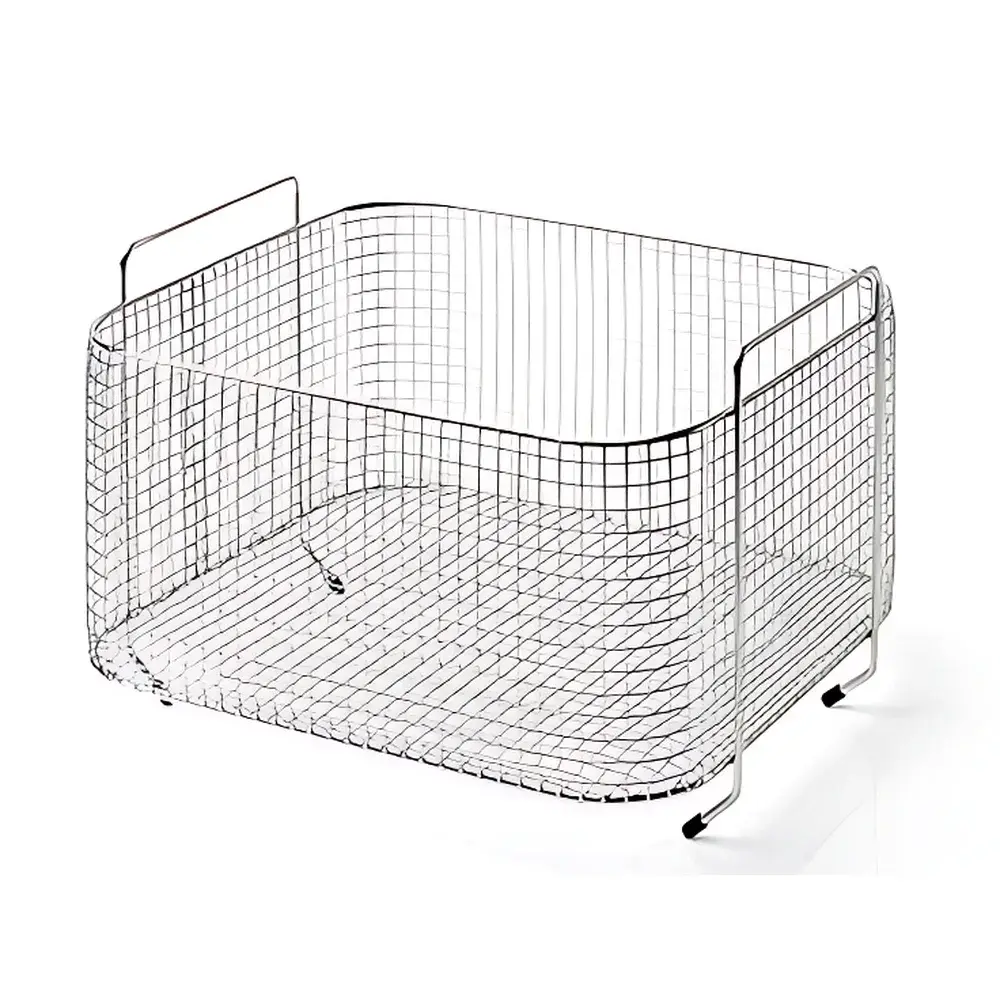
Stainless Steel Basket
No specifications available.
Overview
The Stainless Steel Basket is a precision-engineered laboratory and industrial handling component designed for robust, corrosion-resistant sample containment, filtration, or suspension in controlled environments. Constructed from high-grade austenitic stainless steel (typically AISI 304 or 316), it leverages the material’s inherent resistance to oxidation, chlorides, and acidic or alkaline media—making it suitable for applications ranging from pharmaceutical dissolution testing (per USP and ) to catalyst recovery in chemical synthesis and thermal processing fixtures in furnace-based material testing.
Key Features
- Material compliance: Fabricated from certified 304 or 316 stainless steel with full mill test reports (MTRs) available upon request, ensuring traceability to ASTM A240/A480 standards.
- Electropolished surface finish: Optional electropolishing (Ra ≤ 0.4 µm) minimizes particle adhesion and facilitates cleaning validation under ISO 14644-1 Class 5 cleanroom protocols.
- Structural integrity: Reinforced rim and welded seam construction provide dimensional stability under repeated thermal cycling (–20 °C to +500 °C) and mechanical loading.
- Customizable geometry: Standard configurations include cylindrical, conical, and flat-bottom designs; custom aperture size (mesh range: 20 µm to 5 mm), basket depth, handle orientation, and mounting interface (e.g., threaded rod, flange, or suspension hook) are available per client specification.
- Non-reactive performance: Passivated per ASTM A967 to remove free iron and optimize chromium oxide layer formation—critical for GMP-compliant manufacturing and analytical workflows where metal leaching must be excluded.
Sample Compatibility & Compliance
This basket supports solid-phase handling of powders, granules, tablets, catalyst pellets, and ceramic substrates without compromising sample integrity. It is routinely deployed in dissolution apparatus Type I (basket) and Type II (paddle) assemblies compliant with USP Chapter , EP 2.9.3, and JP 17. All units undergo visual inspection and dimensional verification against drawing tolerances (±0.2 mm linear, ±0.5° angular). For regulated environments, documentation packages—including equipment qualification templates (IQ/OQ), material certificates, and cleaning validation support files—can be supplied to align with FDA 21 CFR Part 11, EU Annex 11, and ISO/IEC 17025 requirements.
Software & Data Management
As a passive mechanical component, the Stainless Steel Basket does not incorporate embedded electronics or firmware. However, it integrates seamlessly into automated dissolution systems (e.g., Sotax AT7smart, Distek 2500) and data acquisition platforms that comply with 21 CFR Part 11 audit trail and electronic signature requirements. When used with validated dissolution vessels, its consistent geometry ensures reproducible hydrodynamic conditions—directly supporting data integrity in method transfer and stability-indicating assays.
Applications
- Pharmaceutical dissolution testing for immediate-release and modified-release dosage forms.
- Chemical engineering: Solid catalyst containment during fixed-bed or slurry-phase reaction monitoring.
- Materials science: Sample support during TGA, DSC, or sintering cycles where inert, non-warping fixtures are essential.
- Food & beverage QA/QC: Filtration and draining of particulate samples prior to rheological or compositional analysis.
- Environmental testing: Retention of sorbent media (e.g., activated carbon, zeolites) in column leaching or batch extraction studies.
FAQ
Is this basket compatible with USP Apparatus 1 (basket method)?
Yes—designed to meet USP dimensional specifications (e.g., 10 cm height, 2.8 cm internal diameter, 0.40 mm mesh aperture) when configured as a standard dissolution basket.
Can I request material certification for GMP documentation?
Yes—mill test reports (ASTM A240/A480), passivation validation records, and RoHS/REACH declarations are provided with each shipment upon request.
What temperature range is supported during continuous use?
AISI 304 baskets are rated for continuous operation up to 870 °C in oxidizing atmospheres; AISI 316 variants extend usable service life above 925 °C and offer superior resistance to sulfidation and pitting in chloride-rich environments.
Do you offer cleaning validation support?
Yes—we supply residue limit calculation templates, swab recovery study protocols, and recommended cleaning agents (e.g., phosphoric acid-based passivators, low-foaming alkaline detergents) aligned with PDA TR29 and ISPE Baseline Guide Volume 4.
Is custom machining available for integration into proprietary equipment?
Yes—engineering drawings, GD&T specifications, and prototype validation (including CMM inspection reports) are supported for OEM integration projects.
Related Products



