
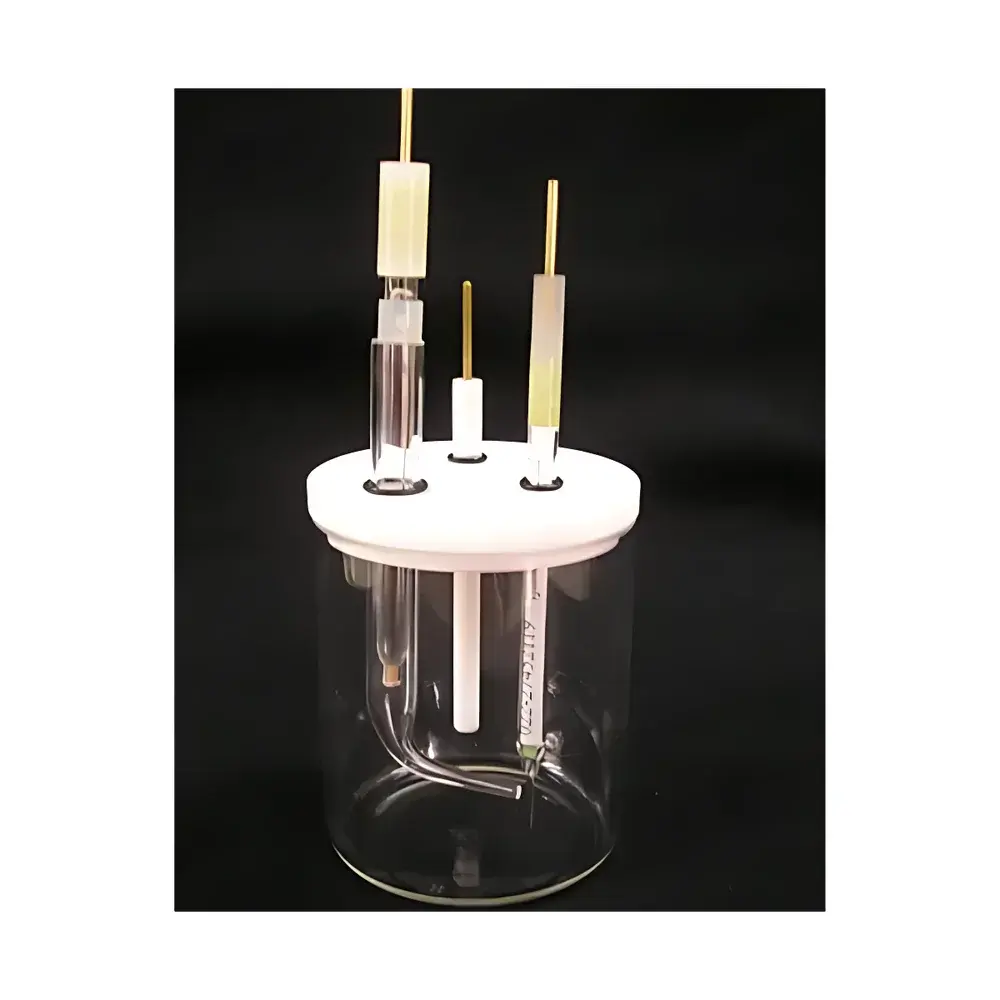
Standard Electrolytic Cell
| Brand | CME (Zhongjiao Jinyuan) |
|---|---|
| Origin | Beijing, China |
| Manufacturer Type | Direct Manufacturer |
| Origin Category | Domestic |
| Model | Standard Electrolytic Cell |
| Pricing | Upon Request |
Overview
The Standard Electrolytic Cell is a fundamental electrochemical measurement platform engineered for controlled, reproducible galvanostatic and potentiostatic experiments in research laboratories and quality control environments. Designed around classical three-electrode configuration principles—working electrode, counter electrode, and reference electrode—the cell enables precise investigation of redox kinetics, corrosion behavior, electrodeposition mechanisms, and battery material characterization. Its modular glass body construction ensures optical transparency for in situ observation and compatibility with UV-Vis spectroelectrochemistry, while the chemically inert PTFE lid provides secure mounting for electrodes and gas-tight adaptability (when used with optional O-ring seals). The cell operates under ambient atmospheric conditions and is not rated for pressurized or vacuum applications.
Key Features
- Optically transparent borosilicate glass body for real-time visual monitoring and spectroelectrochemical integration
- Chemically resistant polytetrafluoroethylene (PTFE) lid with precision-machined ports for standardized electrode insertion (6 mm OD standard)
- Modular volume options: 15 mL, 30 mL, 50 mL, 100 mL, 200 mL, 300 mL, and 500 mL—each calibrated to ±1% volumetric tolerance at 20 °C
- Threaded PTFE-to-glass interface ensures mechanical stability and minimizes leakage risk during extended operation
- No built-in sealing mechanism; designed for open-cell or optionally sealed configurations using supplementary O-rings and compression fittings
- Compatible with standard Luggin capillaries, reversible hydrogen electrodes (RHE), Ag/AgCl reference systems, and carbon- or metal-based working electrodes
Sample Compatibility & Compliance
The Standard Electrolytic Cell supports aqueous and non-aqueous electrolyte systems—including sulfuric acid, potassium hydroxide, lithium hexafluorophosphate (LiPF6) in carbonate solvents, and ionic liquids—within temperature ranges of 5–40 °C. It complies with general laboratory safety standards for Class I chemical handling (per ISO 15190:2020) and meets dimensional specifications aligned with ASTM D1148-18 for electrochemical test cell geometry. While not certified for GLP or GMP environments out-of-the-box, its traceable manufacturing origin (Beijing-based ISO 9001-certified production facility) supports audit readiness when integrated into validated workflows. Documentation includes material certificates of conformance for both borosilicate glass (DIN ISO 3585) and virgin PTFE (ASTM D4894).
Software & Data Management
This passive electrochemical cell does not incorporate embedded electronics or firmware. It functions as a physical interface between the electrochemical workstation (e.g., BioLogic SP-300, Gamry Interface 5000P, or Metrohm Autolab PGSTAT302N) and the sample. All data acquisition, parameter control, and analysis are performed externally via the host potentiostat’s native software suite. The cell’s geometry and volume calibration support accurate current density normalization (A·cm−2) and Faradaic efficiency calculations per ASTM E2750-21. When used within regulated environments, full traceability is maintained through instrument logs, manual batch records, and electronic lab notebook (ELN) integration—fully compatible with 21 CFR Part 11-compliant systems when paired with appropriate access controls and audit trails.
Applications
- Electrocatalyst evaluation for oxygen reduction (ORR), hydrogen evolution (HER), and CO2 reduction reactions
- Cyclic voltammetry and chronoamperometry studies of battery electrode materials (e.g., NMC, LFP, silicon anodes)
- Corrosion rate quantification via polarization resistance and electrochemical impedance spectroscopy (EIS)
- Electrodeposition process optimization for thin-film metallization and nanomaterial synthesis
- Teaching laboratories for foundational electrochemistry principles (Nernst equation, diffusion-controlled currents, Tafel analysis)
- In situ UV-Vis-NIR spectroelectrochemistry for monitoring redox-state transitions in molecular catalysts
FAQ
Is this cell suitable for high-temperature operation above 40 °C?
No. The PTFE lid has a continuous service limit of 260 °C, but thermal expansion mismatch with borosilicate glass and electrolyte volatility make sustained operation above 40 °C inadvisable without custom engineering.
Can it be used under inert atmosphere?
Yes—when fitted with a PTFE O-ring and connected to a glovebox antechamber or Schlenk line, the cell supports argon- or nitrogen-purged experiments.
Does it include electrodes or cables?
No. Electrodes, leads, and connectors must be selected separately based on experimental requirements and potentiostat interface standards.
What cleaning protocol is recommended between experiments?
Rinse thoroughly with deionized water, followed by acetone or ethanol; air-dry vertically. Avoid ultrasonic cleaning of assembled units to prevent PTFE thread wear.
Is volume calibration NIST-traceable?
Volumetric markings are factory-verified against ISO/IEC 17025-accredited reference standards; full calibration certificates are available upon request.



