
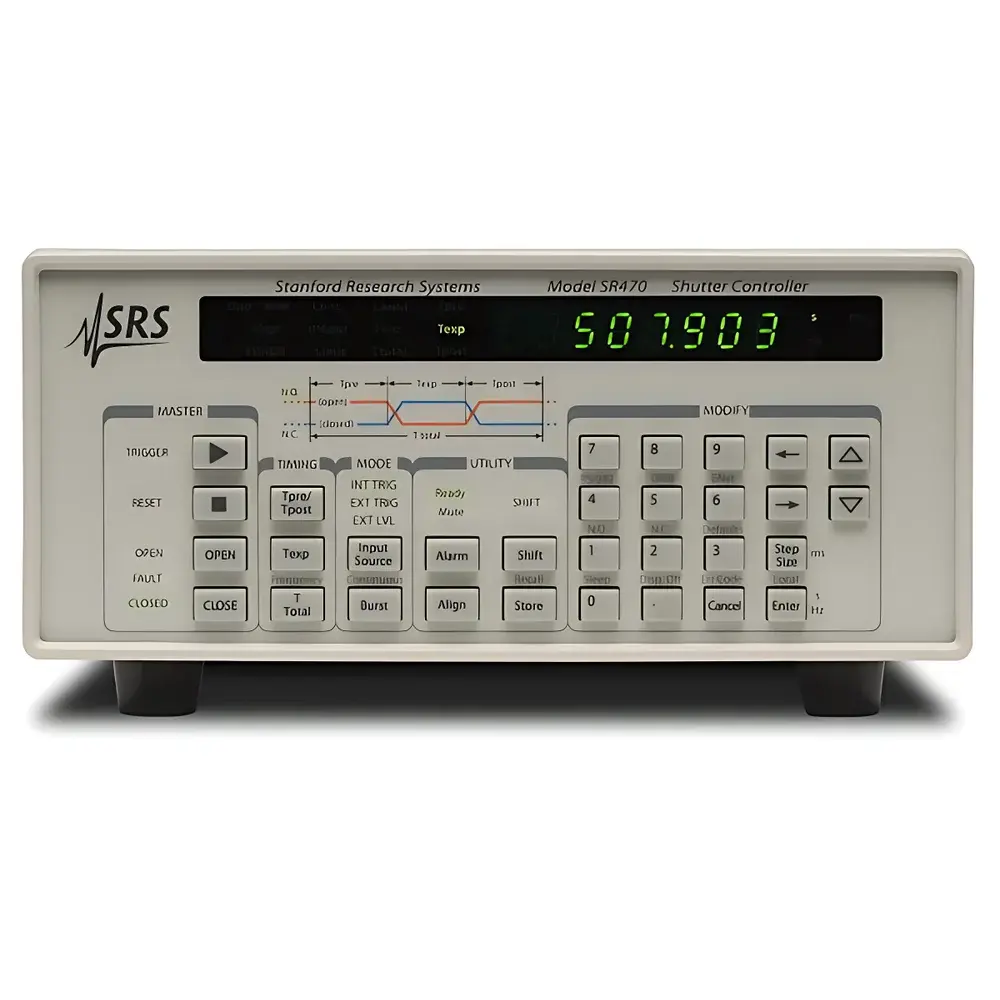
Stanford Research Systems SR470 Series Ultra-Low-Vibration Laser Shutter Control System
| Brand | Stanford Research Systems (SRS) |
|---|---|
| Origin | USA |
| Model | SR470 |
| Channel Configuration | Single-channel (SR470), Quad-channel (SR474), Shutter Head Options: SR475/SR476 |
| Operating Lifetime | >10⁷ cycles |
| Actuation Time | 4 ms – 10,000 s |
| Time Resolution | 100 µs |
| Trigger Modes | Internal, External (TTL/CMOS), Front-Panel Manual |
| Bearing Type | Sapphire Jewel Bearings |
| Control Architecture | Closed-Loop DSP Positioning |
| Mechanical Isolation | Non-magnetic, Zero-Coil Electromechanical Actuation |
Overview
The Stanford Research Systems SR470 Series Ultra-Low-Vibration Laser Shutter Control System is a precision-engineered electromechanical shutter platform designed for applications demanding minimal optical path disturbance and long-term mechanical stability. Unlike conventional solenoid- or voice-coil–actuated shutters—which generate measurable magnetic fields, acoustic noise, and mechanical recoil—the SR470 series employs a non-magnetic, closed-loop digital signal processor (DSP)-controlled actuation mechanism that positions the shutter blade with sub-microradian repeatability without physical end-stop contact. This architecture eliminates bounce, overshoot, and settling transients common in open-loop electromagnetic systems, making it suitable for ultra-stable interferometry, quantum optics experiments, single-photon detection setups, and laser-based metrology where even nanometer-scale stage vibration or microsecond-level timing jitter can compromise measurement integrity.
Key Features
- Ultra-low mechanical disturbance: Zero-coil design eliminates magnetic field emission and Lorentz-force-induced platform vibration—critical for active optical tables, cryogenic mounts, and femtosecond laser environments.
- Closed-loop DSP positioning: Real-time feedback from integrated position sensors enables precise, repeatable blade placement at fully open, fully closed, and intermediate states—without reliance on mechanical limit switches or spring-return mechanisms.
- High-cycle durability: Shutter blades are pivot-mounted on synthetic sapphire jewel bearings, reducing static friction to 10⁷ operational cycles with consistent timing performance and positional fidelity.
- Programmable exposure control: Exposure duration adjustable from 4 milliseconds to 10,000 seconds (up to ~2.78 hours) with 100 µs time resolution; supports both absolute timing and relative gating sequences.
- Multi-mode triggering: Supports TTL/CMOS-compatible external trigger inputs (5 V logic, negative/positive edge selectable), internal oscillator-based gating, and front-panel push-button/manual override—all configurable via local keypad or remote interface.
- Modular system architecture: SR470 (single-channel controller), SR474 (quad-channel controller), and interchangeable shutter heads (SR475 standard aperture, SR476 high-speed variant) allow scalable integration into multi-laser or multi-path beam delivery systems.
Sample Compatibility & Compliance
The SR470 series is compatible with standard Ø1″, Ø1.5″, and Ø2″ optical mounts and integrates seamlessly with Thorlabs, Newport, and Standa kinematic platforms. Shutter heads feature SM1 (1.035″-40) threading and vacuum-compatible variants (SR475-V) are available for UHV environments (<1×10⁻⁹ Torr). All units comply with CE marking requirements for EMC Directive 2014/30/EU and Low Voltage Directive 2014/35/EU. While not certified for IEC 61000-4-2 ESD immunity beyond industrial-grade thresholds, the controller’s isolated digital I/O and shielded analog reference paths ensure robust operation in Class 1000 cleanroom and ISO 14644-1 compliant laboratories. Firmware supports audit-trail logging when used with SRS’s optional LabVIEW or Python API drivers under GLP/GMP-aligned workflows.
Software & Data Management
The SR470 series communicates via RS-232 (standard) or optional USB-to-serial interface, supporting ASCII command protocol for full parameter control—including trigger source selection, dwell time setting, auto-retrigger enable/disable, and status query (e.g., “SHUT?”, “TIME?”). Native drivers are provided for LabVIEW (2015+), MATLAB (Instrument Control Toolbox), and Python (PySerial + SRS-specific wrapper). All firmware versions maintain backward compatibility and support non-volatile storage of up to 16 user-defined exposure presets. Remote operation preserves timestamped execution logs (date/time, command string, response code) — a prerequisite for FDA 21 CFR Part 11–compliant validation when paired with third-party electronic lab notebook (ELN) systems.
Applications
- Time-gated fluorescence lifetime imaging (FLIM) and pump-probe spectroscopy requiring precise laser blanking between excitation pulses.
- Optical nulling interferometers (e.g., LIGO-style beam paths) where coil-induced magnetic perturbations must be eliminated near superconducting sensors.
- Automated laser safety interlocks in Class IV laser enclosures meeting ANSI Z136.1-2022 requirements for fail-safe shutter response.
- Multiplexed laser ablation systems using SR474 + SR476 heads to route beams across four independent sample positions without cross-talk or timing skew.
- Calibration labs performing ISO/IEC 17025-accredited radiometric measurements, where shutter repeatability contributes directly to Type A uncertainty budgets.
FAQ
What is the maximum recommended beam diameter for SR475 shutter heads?
The SR475 is rated for collimated beams up to 12 mm clear aperture; overfilling may cause diffraction artifacts or mechanical interference.
Can the SR470 operate in vacuum environments?
Standard units are not vacuum-rated; however, the SR475-V variant features stainless-steel housing, ceramic insulators, and outgassing-tested lubricants for operation down to 1×10⁻⁹ Torr.
Is there galvanic isolation between trigger input and controller ground?
Yes—external trigger inputs are opto-isolated with >1 kV DC withstand rating, preventing ground loops in mixed-signal experimental racks.
Does the closed-loop DSP system require periodic calibration?
No; factory-trimmed position sensors and self-zeroing routines eliminate need for user calibration. Lifetime drift is <±0.02° over 5 years per MIL-STD-883H accelerated aging tests.
How does SR470 compare to piezoelectric shutters in terms of switching speed?
Piezo shutters achieve faster rise times (<100 ns) but lack absolute position repeatability and suffer from hysteresis; SR470 prioritizes deterministic positioning and million-cycle reliability over nanosecond agility.




