
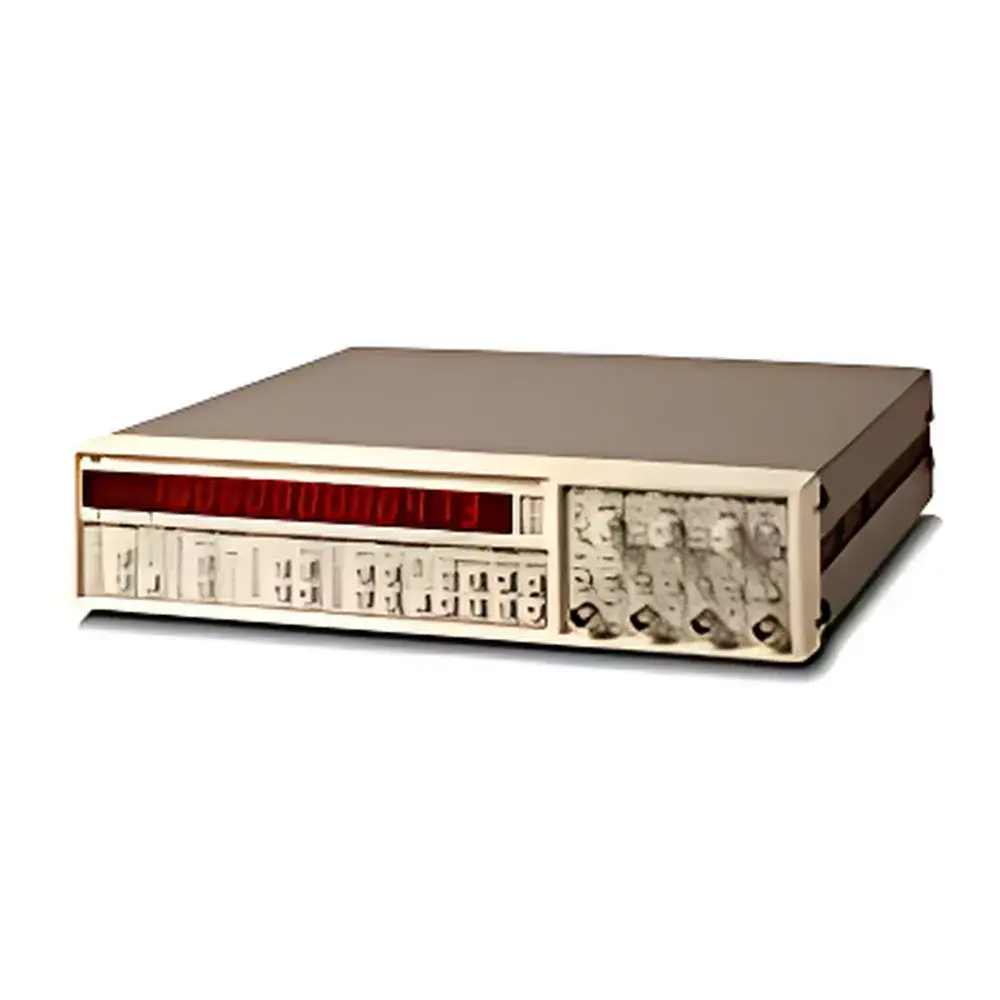
Stanford Research Systems SR620 High-Precision Time Interval and Frequency Analyzer
| Brand | SRS/Stanford Research Systems |
|---|---|
| Origin | USA |
| Manufacturer Type | Authorized Distributor |
| Origin Category | Imported |
| Model | SR620 |
| Price | Upon Request |
| Single-Shot Time Resolution | 25 ps |
| Frequency Range | DC to 1.3 GHz |
| Time Interval Resolution | 25 ps |
| Display Resolution | 11 digits (at 1 s gate time) |
| Output Interfaces | GPIB (IEEE-488.2), RS-232 |
| Data Output | XY Plot Mode, Statistical Analysis (Allan Deviation, Histogram, Mean/Std Dev), Real-Time Serial Streaming |
Overview
The Stanford Research Systems SR620 is a high-precision, dual-function time interval analyzer and frequency counter engineered for metrology-grade timing measurements in research laboratories, quantum optics setups, laser synchronization systems, and precision electronics validation. Unlike conventional frequency counters, the SR620 implements a time-stamping architecture based on interpolating time-to-digital conversion (TDC), enabling sub-nanosecond resolution without reliance on high-speed reference clocks. It measures time intervals between start/stop events with 25 ps single-shot resolution—traceable to NIST-calibrated standards—and computes frequency by reciprocal counting or continuous time-stamp analysis over user-defined gate periods. Its design adheres to fundamental principles of time-domain metrology, supporting both deterministic signal characterization (e.g., pulse delay, jitter, period stability) and stochastic analysis (e.g., Allan deviation, phase noise estimation via time-difference statistics).
Key Features
- 25 ps single-shot time interval resolution, achieved via high-linearity analog interpolation and low-jitter trigger circuitry
- DC–1.3 GHz frequency measurement range with automatic range switching and ±0.1 ppm base clock stability (oven-controlled TCXO)
- 11-digit display resolution at 1-second gate time, scalable to 12 digits using averaging modes
- Real-time Allan deviation calculation with τ ranging from 1 ms to 10,000 s; supports overlapping and modified estimators per IEEE Std 959–2017
- Dual-channel operation: independent start/stop inputs with programmable edge polarity (rising/falling), hysteresis control, and 50 Ω/1 MΩ input impedance selection
- GPIB (IEEE-488.2) and RS-232 interfaces compliant with SCPI command syntax; full remote control including histogram acquisition and statistical export
- XY plot mode for direct visualization of time interval vs. event number or frequency drift over time
- On-board memory buffer (up to 16,384 time-stamp pairs) for burst-mode acquisition without host PC dependency
Sample Compatibility & Compliance
The SR620 interfaces directly with TTL, ECL, and CMOS logic-level signals without external conditioning, supporting standard laboratory signal sources including function generators, photodetector outputs, RF synthesizers, and pulsed laser drivers. Input sensitivity is adjustable from 10 mVpp to 5 Vpp with programmable trigger thresholds. All measurements are traceable to international time standards through NIST-traceable calibration certificates available upon request. The instrument complies with IEC 61000-4 electromagnetic compatibility requirements and meets CE marking directives for laboratory equipment. While not certified for clinical or process-critical environments, its performance aligns with ISO/IEC 17025 guidelines for accredited calibration labs performing time-domain parameter verification.
Software & Data Management
The SR620 operates autonomously but integrates seamlessly into automated test environments via standard SCPI commands. Native support includes data streaming over GPIB or RS-232 at up to 1 kHz timestamp rate, with ASCII or binary packet formats. Optional SR620 Control Software (Windows/Linux/macOS) enables real-time plotting, histogram generation, Allan deviation curve fitting, and export to CSV, MATLAB (.mat), or HDF5 formats. Audit trail functionality logs all configuration changes, measurement triggers, and calibration events—supporting GLP/GMP-aligned documentation where required. Data files include embedded metadata (timestamp, gate time, input settings, firmware version) to ensure full measurement provenance.
Applications
- Characterization of oscillator short-term stability (Allan variance, modified Allan variance, Hadamard deviation)
- Time-of-flight measurements in ultrafast spectroscopy and particle detection systems
- Jitter and phase noise analysis in RF and optical clock distribution networks
- Verification of timing accuracy in FPGA-based digital systems and ASIC test benches
- Calibration of delay generators, pulse pattern generators, and arbitrary waveform generators
- Quantum computing infrastructure: qubit gate timing validation, coherence time correlation studies
- Gravitational wave detector auxiliary timing subsystem diagnostics
FAQ
What is the difference between reciprocal counting and time-stamp mode on the SR620?
Reciprocal counting measures average frequency over a fixed gate time using period accumulation; time-stamp mode records absolute arrival times of each edge, enabling post-acquisition analysis of jitter, drift, and statistical distributions.
Can the SR620 measure time intervals shorter than its 25 ps resolution?
No—the 25 ps specification represents the RMS single-shot uncertainty under optimal conditions (low-noise signals, proper termination); sub-25 ps features require averaging or external time-interval analyzers with higher interpolation fidelity.
Does the SR620 support USB connectivity?
No native USB interface is provided; however, GPIB-to-USB or RS-232-to-USB adapters compliant with NI-VISA or FTDI drivers are widely used in practice.
Is firmware upgrade capability available?
Yes—firmware updates are distributed by Stanford Research Systems and installed via GPIB or RS-232 using documented bootload procedures; version history and release notes are publicly archived.
How is calibration maintained over time?
The internal 10 MHz oven-controlled crystal oscillator (OCXO) provides long-term stability of ±5 × 10⁻⁹/month; annual recalibration against a primary frequency standard is recommended for metrology applications requiring ISO/IEC 17025 compliance.




