
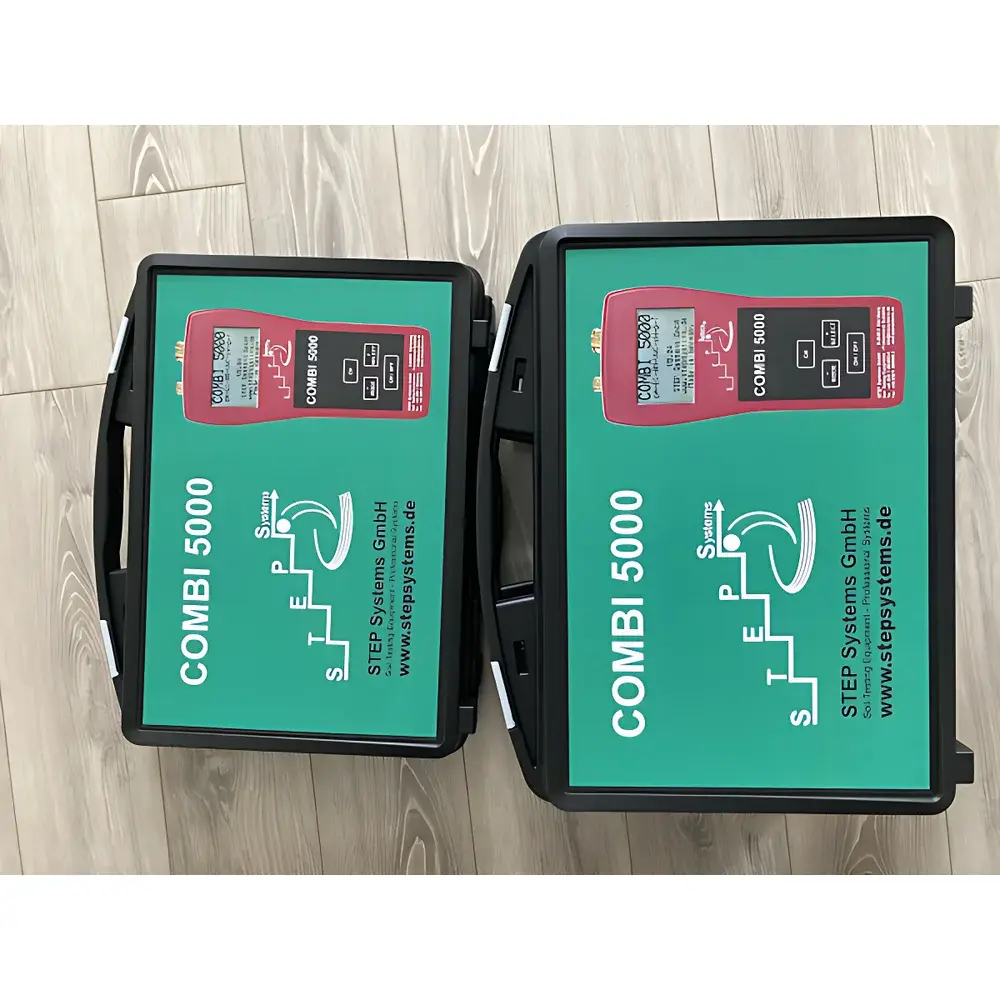
STEPS EC5000 Portable Soil Electrical Conductivity Meter
| Origin | Germany |
|---|---|
| Manufacturer Type | Authorized Distributor |
| Origin Category | Imported |
| Model | EC5000 |
| Instrument Type | Multi-Parameter Soil Analyzer |
| EC Range | 0–20 mS/cm and 0–200 mS/cm |
| Resolution | 0.1 mS/cm |
| Accuracy | ±2% of reading |
| Temperature Range | 0–60 °C |
| Probe | Dual-ring platinum-coated glass sensor with integrated Pt1000 temperature sensor |
| Housing | IP67-rated rugged waterproof enclosure |
| Dimensions | 180 × 85 × 50 mm |
| Weight | 280 g |
| Power | 9 V alkaline battery (≥4000 measurements per set) |
| Connector | 5-pin LEMO-type interface |
| Calibration Standards Included | 1.4 mS/cm and 111.8 mS/cm KCl reference solutions (50 mL each) |
| Accessories | Soil suspension beaker, aluminum transport case |
Overview
The STEPS EC5000 Portable Soil Electrical Conductivity Meter is a field-deployable, precision-grade instrument engineered for rapid, reliable measurement of electrical conductivity (EC) in soil extracts, nutrient solutions, irrigation water, and hydroponic media. Based on the fundamental principle of two-electrode conductometry—where an alternating current is applied across dual-ring platinum electrodes to minimize polarization effects—the EC5000 delivers stable, low-drift readings across a wide dynamic range (0–20 mS/cm and 0–200 mS/cm). Its integrated Pt1000 temperature sensor enables real-time, automatic temperature compensation (ATC) according to DIN EN 27888 and ISO 7888 standards, ensuring traceable EC values referenced to 25 °C. Designed for operational continuity in horticultural and agronomic settings, the device requires no routine maintenance or electrode polishing due to its inert, electroplated platinum sensor geometry and chemically resistant glass body.
Key Features
- Rugged IP67-rated housing with shock-absorbing polymer casing and sealed 5-pin LEMO connector for field durability and moisture resistance
- Dual-range EC measurement (0–20 / 0–200 mS/cm) with 0.1 mS/cm resolution and ±2% full-scale accuracy per ISO 11265:2020
- Integrated Pt1000 temperature sensor enabling automatic temperature compensation compliant with ASTM D1125 and USP
- Self-contained 9 V alkaline power system supporting ≥4000 consecutive measurements without recharge or replacement
- Factory-calibrated at accredited STEPS calibration laboratory (DAkkS-certified traceability to PTB standards); user recalibration optional but not required under normal operating conditions
- Preconfigured for direct use with common soil suspension protocols (e.g., 1:5 soil:distilled water ratio), delivering EC values directly convertible to total dissolved solids (TDS) via standardized conversion factors (e.g., 0.64–0.71)
Sample Compatibility & Compliance
The EC5000 is validated for use with aqueous extracts derived from mineral soils, organic substrates (e.g., peat, coir, compost), rockwool, perlite, and hydroponic nutrient reservoirs. It meets the physical and metrological requirements for field-portable EC instrumentation specified in ISO 11265:2020 (Soil quality — Determination of electrical conductivity) and supports GLP-compliant data acquisition when used with optional STEPS DataLink software. All included reference standards (1.4 mS/cm and 111.8 mS/cm KCl) are certified to NIST-traceable specifications and supplied with individual CoA documentation. The instrument’s design conforms to IEC 61000-6-2 (immunity) and IEC 61000-6-3 (emissions) for electromagnetic compatibility in agricultural environments.
Software & Data Management
While the EC5000 operates as a standalone meter, it is fully compatible with STEPS DataLink v3.2 (Windows/macOS), enabling timestamped data export (CSV/Excel), batch calibration logging, and audit-trail generation compliant with FDA 21 CFR Part 11 requirements. The software supports configurable measurement templates aligned with common horticultural workflows—including irrigation water screening, fertigation tank verification, and substrate salinity profiling—and allows annotation of sample IDs, operator names, GPS coordinates (via paired Bluetooth module), and environmental metadata. All stored records include embedded sensor diagnostics and temperature-compensation coefficients for full analytical transparency.
Applications
- Real-time monitoring of nutrient solution strength in recirculating hydroponic systems (NFT, DWC, ebb-and-flow), where EC stability is critical due to absence of buffering capacity
- Salinity assessment of irrigation sources—particularly groundwater in coastal or arid regions—to prevent Na⁺/Cl⁻ accumulation in root zones
- Quality control during substrate manufacturing (e.g., peat-based growing media), ensuring consistent EC profiles prior to packaging
- Benchtop verification of EC in laboratory-prepared soil suspensions (1:2 or 1:5 w/v ratios) per ISO 11265 methodology
- On-site diagnostics for ornamental horticulture operations—including bonsai nurseries and greenhouse propagation units—where rapid EC feedback informs fertigation scheduling
- Field validation of remediation efforts in saline-sodic soils, supporting long-term monitoring against FAO irrigation water quality guidelines
FAQ
Does the EC5000 require regular recalibration?
No—each unit undergoes multi-point factory calibration against primary KCl standards and retains calibration stability for ≥12 months under typical field use. Recalibration is only recommended after mechanical impact, exposure to extreme pH (12), or when traceability documentation is required for regulatory audits.
Can the EC5000 measure EC in undiluted fertilizer concentrates?
Yes—the 0–200 mS/cm range enables direct measurement of stock solutions up to 200 mS/cm (equivalent to ~120 g/L NaCl), eliminating need for dilution and associated error propagation.
Is the probe suitable for long-term immersion in nutrient solutions?
The platinum-coated dual-ring sensor is corrosion-resistant and designed for repeated immersion; however, prolonged static submersion (>72 h) is discouraged to prevent biofilm adhesion—routine rinsing with deionized water between uses is sufficient maintenance.
How does temperature compensation work?
The integrated Pt1000 sensor continuously measures solution temperature and applies a linear compensation factor (β = 2.0 %/°C) per ISO 7888, converting raw conductance to EC25°C in real time without user intervention.
What accessories are included for soil suspension analysis?
The standard kit includes a calibrated 50 mL polypropylene suspension beaker, pre-measured reference solutions, and step-by-step SOP cards aligned with ISO 11265 Annex A for reproducible 1:5 soil:water extractions.







