
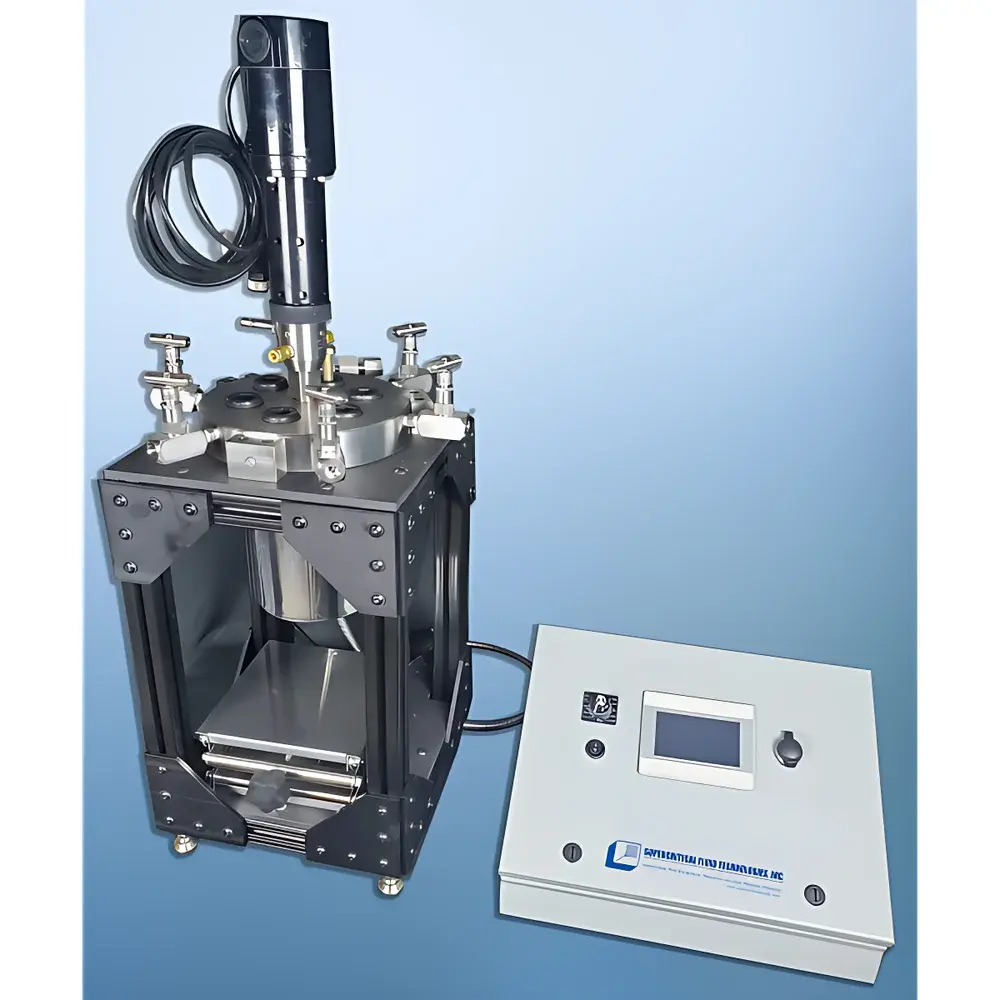
STKJ HPR Series Supercritical High-Pressure Chemical Reaction System
| Brand | STKJ |
|---|---|
| Origin | Beijing, China |
| Manufacturer Type | Authorized Distributor |
| Country of Origin | China |
| Model | HPR |
| Maximum Temperature | 350 °C |
| Pressure Range | Up to 40 MPa (5800 psi) — configurable up to 68.9 MPa (10,000 psi) per ASME-certified vessel variants |
| Vessel Volume | 50 mL to 8 L |
| Number of Reaction Channels | 1–4 |
| Maximum CO₂ or Solvent Flow Rate | 660 mL/min |
| Sample Compatibility | Plant matrices, pharmaceutical actives, natural products, polymers, catalysts |
| Safety Features | ASME-compliant pressure vessels, rupture disc protection, magnetic drive dual-impeller agitation, integrated thermal and overpressure interlocks |
| Control Interface | Color TFT touchscreen with PID temperature control, programmable ramp/soak profiles, real-time pressure monitoring, stirrer speed regulation |
| Data Output | RS-232 serial interface for external logging and GLP-compliant data capture |
Overview
The STKJ HPR Series Supercritical High-Pressure Chemical Reaction System is an engineered platform for controlled experimentation under supercritical and high-pressure thermochemical conditions. Designed around the principles of supercritical fluid chemistry—particularly leveraging CO₂, ethanol, or other tunable solvents above their critical points—the system enables precise manipulation of solvent density, diffusivity, and solvation power via coordinated pressure (up to 68.9 MPa) and temperature (up to 350 °C) regulation. Unlike conventional batch reactors, the HPR series integrates dynamic process control with ASME Section VIII Division 1–certified pressure containment, making it suitable for kinetic studies, catalytic screening, and process intensification in academic, pharmaceutical, and industrial R&D laboratories. Its modular architecture supports both single-vessel benchtop operation and multi-channel parallel synthesis configurations, facilitating reproducible scale-up from discovery to pilot-stage development.
Key Features
- ASME-compliant high-pressure reaction vessels (50 mL–8 L), available in bolted or manually sealed configurations—rated for 2350 psi / 350 °C (bolted) or 10,000 psi / 200 °C (manual seal); custom pressure-rated variants available upon request
- Magnetic drive dual-impeller agitation system ensures homogeneous mixing without dynamic seals, eliminating leakage pathways and enabling continuous operation under supercritical conditions
- Integrated safety architecture: certified rupture disc, redundant pressure transducers, thermal cut-off relays, and real-time overpressure/overtemperature interlock logic
- Full-parameter digital control via 7-inch color TFT touchscreen—supports programmable temperature ramps (0.1–20 °C/min), PID-regulated heating, closed-loop stirrer speed control (0–1200 rpm), and live pressure display with ±0.5% FS accuracy
- RS-232 serial interface compliant with ASTM E1382-17 data logging standards; compatible with third-party SCADA systems and LIMS integration for audit-ready recordkeeping
- Modular accessory support: sight-glass viewport (quartz or sapphire), pre-cooled jacketed cooling coils, automated reagent addition loops, gas/liquid inlet manifolds, and vent-and-purge modules
Sample Compatibility & Compliance
The HPR system accommodates heterogeneous and thermally sensitive feedstocks including botanical extracts, active pharmaceutical ingredients (APIs), metal-organic frameworks (MOFs), polymer precursors, and heterogeneous catalysts. Vessel wetted materials—316L stainless steel, Inconel 718, and Hastelloy C-276—are selected for compatibility with aggressive supercritical solvents (e.g., scCO₂, scCH₃OH, scH₂O) and reactive gases (H₂, O₂, NH₃). All pressure components conform to ASME Boiler and Pressure Vessel Code Section VIII Division 1, PED 2014/68/EU, and ISO 4126-2 for rupture device certification. The system meets baseline requirements for GLP (OECD Principles) and GMP-aligned workflows, with optional 21 CFR Part 11–compliant software add-ons available for electronic signature and audit trail functionality.
Software & Data Management
Control firmware provides native data acquisition at 1 Hz resolution across all primary parameters (T, P, RPM, time). Raw datasets export in CSV or ASCII format via RS-232, supporting traceability under ISO/IEC 17025 and FDA guidance for analytical instrument qualification (AIQ). Optional PC-based software enables remote monitoring, multi-vessel synchronization, and automated report generation—including calibration logs, run summaries, and deviation alerts. All timestamps are NTP-synchronized, and user access levels (operator, engineer, administrator) are enforced through password-protected profiles to satisfy laboratory security protocols.
Applications
- Catalytic hydrogenation and oxidation under supercritical H₂ or O₂ environments
- Continuous-flow depolymerization of lignin and bioplastics using scCO₂-assisted cleavage
- Green synthesis of nanomaterials (e.g., Pt nanoparticles, ZnO quantum dots) via supercritical fluid deposition (SFD)
- Phytochemical extraction and in situ derivatization of terpenoids and alkaloids
- Thermodynamic phase behavior mapping for solvent–solute systems (e.g., p-T-x diagrams)
- Accelerated aging and stability testing of battery electrolytes under elevated pressure/temperature
FAQ
What pressure and temperature ranges are standard for the HPR series?
Standard operation spans 0.1–40 MPa and ambient to 350 °C. Higher-pressure configurations (up to 68.9 MPa) require ASME-certified alternate vessels and are subject to individual risk assessment.
Is the system compatible with corrosive supercritical fluids such as water or ammonia?
Yes—vessels constructed from Hastelloy C-276 or Inconel 718 are available for scH₂O or scNH₃ applications; material compatibility must be verified per NACE MR0175/ISO 15156.
Can multiple HPR reactors operate synchronously?
The 2- and 4-channel configurations support synchronized pressure/temperature ramping and independent stirring control, with shared manifold interfaces for centralized solvent delivery.
Does the system support automated reagent injection during reaction?
Optional syringe pump–integrated reagent addition modules enable timed, pressure-compensated dosing with flow accuracy ±1% of setpoint.
How is calibration traceability maintained?
All pressure transducers are calibrated annually against NIST-traceable deadweight testers; temperature sensors comply with IEC 60751 Class A tolerance, with certificate-of-calibration supplied per unit.
Related Products



