
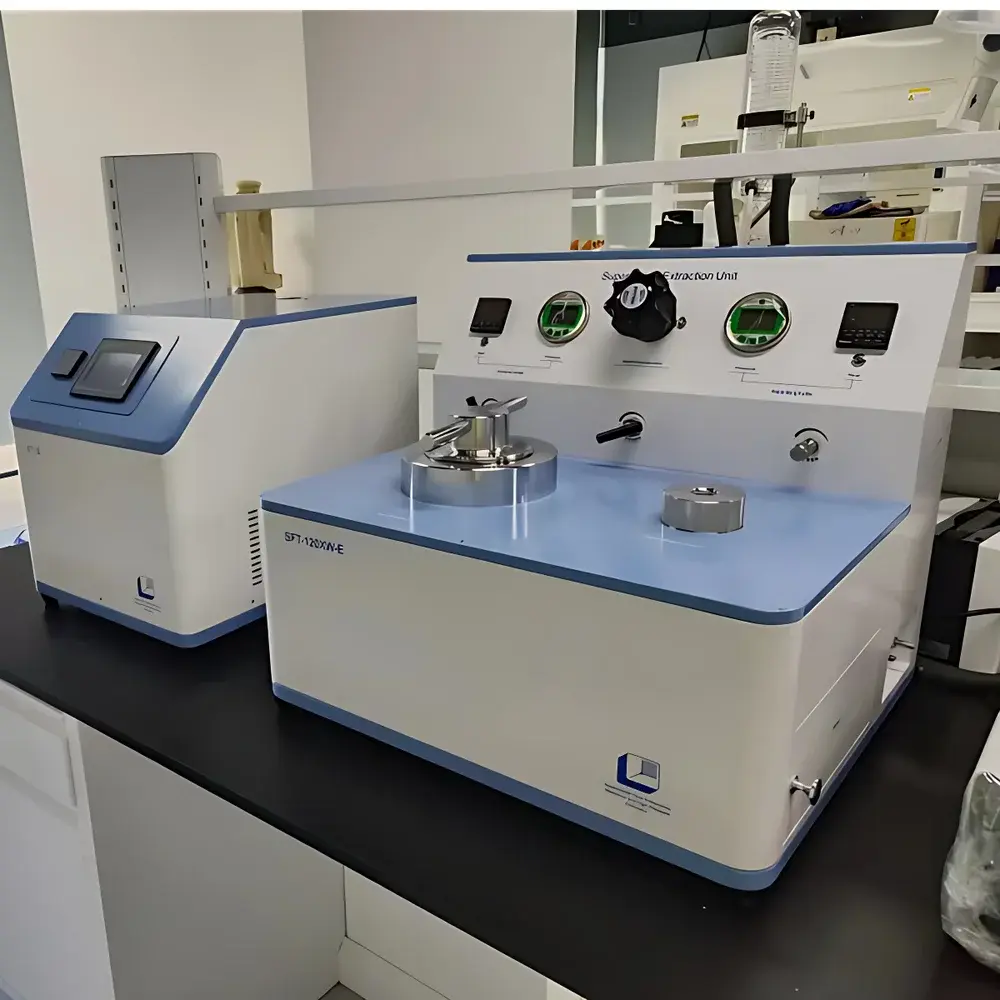
STKJ SFT-120XW-D Supercritical CO₂ Dryer & Cleaning System
| Brand | STKJ |
|---|---|
| Origin | Beijing, China |
| Model | SFT-120XW-D |
| Max Temperature | 250 °C |
| Max Pressure | 48 MPa |
| Extraction Volume Range | 5–1000 mL |
| Flow Control Resolution | 0.01 mL/min |
| Pressure Control Accuracy | ±1–2 psi |
| Pump Speed Range | 0–2500 rpm |
| Cooling Method | Electronic Refrigeration (pump head < −4 °C) |
| Reactor Options | Customizable single- or multi-vessel configurations up to 1000 mL total volume |
Overview
The STKJ SFT-120XW-D Supercritical CO₂ Dryer & Cleaning System is an integrated, fully automated platform engineered for precision supercritical fluid processing—specifically optimized for gentle, residue-free drying and contaminant removal of delicate microstructures, aerogels, MEMS devices, biological tissues, and botanical extracts. Operating exclusively with carbon dioxide as the supercritical solvent, the system leverages the unique physicochemical properties of CO₂ above its critical point (31.1 °C, 7.38 MPa): near-zero surface tension, high diffusivity, tunable solvation power, and complete volatility upon depressurization. Unlike conventional thermal or vacuum drying methods—which risk capillary collapse, shrinkage, or thermal degradation—the SFT-120XW-D enables structural preservation through isothermal, isobaric phase transitions governed by precise thermodynamic control. Its architecture eliminates dependency on external air compressors, cryogenic chillers, or pneumatic actuators, achieving intrinsic operational stability via proprietary electro-mechanical CO₂ pumping and solid-state thermoelectric cooling.
Key Features
- Integrated Dual-Mode CO₂ Pump: Patented slow-intake/fast-discharge dual-piston pump delivers stable flow under both constant-pressure (±1–2 psi) and constant-flow (0.01 mL/min resolution) modes; pump head actively cooled to < −4 °C via electronic refrigeration to prevent CO₂ gas-phase nucleation and ensure liquid-phase delivery.
- Independent Multi-Zone Thermal Management: Three isolated temperature control loops regulate reactor core fluid temperature, dynamic/static valve surfaces, and preheating ring—enabling accurate replication of process thermodynamics across scale-up studies.
- Modular Reactor System: Interchangeable stainless-steel extraction/drying vessels (5–1000 mL) accommodate diverse sample geometries and throughput requirements; total system capacity configurable per user-defined vessel count, capped at 1000 mL aggregate volume.
- Full Safety Architecture: Redundant mechanical safeguards include rupture disk, pressure-relief valve, audible/visual alarm system, and emergency venting circuit compliant with ASME B31.3 piping design criteria and PED 2014/68/EU directives.
- Intuitive Touchscreen Controller: Embedded HMI with real-time PID feedback, programmable multi-step protocols (up to 99 segments), data logging at 1 Hz, and USB export—designed for unattended overnight operation with audit-trail-ready event timestamps.
Sample Compatibility & Compliance
The SFT-120XW-D supports a broad spectrum of thermolabile and structurally sensitive materials—including silica and polymer-based aerogels, freeze-dried pharmaceuticals, plant-derived essential oils, nanostructured catalysts, and microfabricated silicon wafers. Its CO₂-only workflow avoids halogenated solvents or organic co-solvents, aligning with ICH Q5C stability guidelines and USP sterile processing principles. All wetted components conform to ASTM A276 Type 316 stainless steel specifications. Pressure containment design adheres to ISO 13628-6 for subsea equipment safety margins, while temperature calibration traceability follows NIST SP 250-93 protocols. The system meets GLP-compliant data integrity requirements when operated with optional 21 CFR Part 11–enabled software modules (available upon request).
Software & Data Management
Control firmware supports protocol-based batch execution with parameter locking, version-controlled method storage, and operator-level access tiers. Raw sensor data—including pressure (0–60 MPa range, 0.05% FS accuracy), temperature (−10 to 250 °C, ±0.3 °C), and mass flow (0–50 g/min, ±1% reading)—are timestamped and stored internally for ≥30 days. Export formats include CSV and XML for integration with LIMS platforms (e.g., LabVantage, Thermo Fisher SampleManager). Optional Ethernet/IP connectivity enables remote monitoring via secure TLS 1.2–encrypted web interface. Audit trails record all critical events: setpoint changes, manual overrides, safety interlock triggers, and calibration actions—with immutable logs retained for ≥12 months.
Applications
- Aerogel synthesis and monolith drying without skeletal collapse
- MEMS/NEMS device release etching and stiction prevention
- Botanical extraction of volatile terpenes and polyphenols under non-oxidative conditions
- Pharmaceutical lyophilized powder reconstitution and residual solvent removal
- Nanoparticle surface functionalization and ligand exchange in supercritical media
- Archaeological artifact conservation (e.g., waterlogged wood stabilization)
FAQ
What CO₂ purity grade is recommended for optimal performance?
High-purity CO₂ (≥99.995%, certified for laboratory use per ISO 8573-1 Class 1) is required to minimize moisture-induced corrosion and valve fouling. Liquid-phase delivery from dewar or cylinder is mandatory; vapor-phase feeding is incompatible with pump design.
Can the system operate continuously for extended periods (e.g., >72 hours)?
Yes—provided ambient room temperature remains ≤25 °C and ventilation exhausts ≥15 L/s of CO₂-laden air per reactor volume. Continuous operation requires scheduled maintenance every 200 hours per pump module per ISO 13374-1 condition monitoring standards.
Is validation documentation available for GMP environments?
IQ/OQ documentation templates are supplied standard. PQ support—including installation qualification checklists, operational boundary mapping, and repeatability testing reports—can be commissioned separately with third-party metrology partners accredited to ISO/IEC 17025.
How is reactor temperature measured and controlled during supercritical transitions?
A calibrated Pt100 RTD embedded in the reactor wall provides direct wall temperature feedback; secondary thermocouples monitor fluid bulk temperature via immersion sheath. Control algorithms apply cascade PID tuning to decouple heating rate from pressure ramping, ensuring thermodynamic path fidelity per van der Waals equation-of-state predictions.
What maintenance intervals are specified for the electronic refrigeration system?
Thermoelectric cooler modules require biannual visual inspection for condensate accumulation and thermal paste integrity; performance verification (ΔT ≥25 K at rated load) is mandated quarterly per manufacturer service bulletin SB-SFT-2023-04.



