
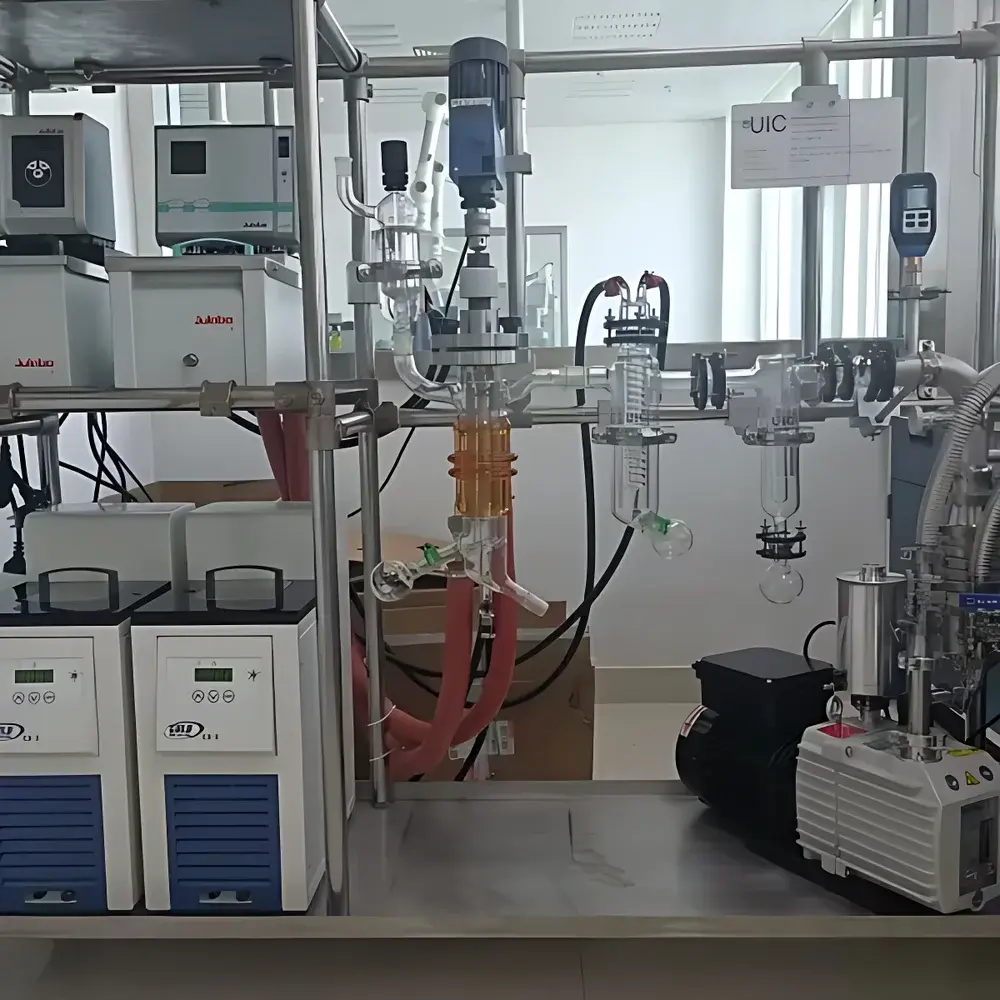
STKJ SPDL1/2 Laboratory Borosilicate Glass Molecular Distillation System
| Brand | STKJ |
|---|---|
| Origin | Beijing, China |
| Model | SPDL1/2 |
| Feed Rate | 50–400 g/h |
| Effective Evaporation Area | 0.017 m² |
| Evaporator Inner Diameter | 120 mm |
| Condensation Area | 0.018 m² |
| Collecting Flasks | 3 (rotatable, continuous fraction collection) |
| Construction Material | Borosilicate Glass 3.3 |
| Max Evaporation Temperature | 250 °C |
| Min Operating Pressure | 0.001 mbar |
| Heating Method | Oil Bath |
| Film Formation | Self-Cleaning Roller Film System |
| Vacuum System | Dual-Stage Rotary Vane Pump with Integrated Vacuum Gauge |
Overview
The STKJ SPDL1/2 is a benchtop-scale molecular distillation system engineered for high-vacuum, short-path separation of thermally sensitive, high-boiling, or low-volatility compounds. It operates on the principle of molecular distillation—where separation occurs under ultra-high vacuum (down to 0.001 mbar), enabling vapor molecules to travel directly from the evaporating surface to the condenser without intermolecular collision. This eliminates conventional boiling and minimizes thermal degradation, making it ideal for isolating labile natural products (e.g., polyunsaturated fatty acids, tocopherols, phospholipids), pharmaceutical intermediates, fragrance compounds, and specialty polymers. Constructed entirely from DIN-certified borosilicate glass 3.3, the system ensures full process visibility, chemical inertness, and compatibility with aggressive solvents or acidic/basic feedstocks. Its compact footprint (bench-mounted configuration) and modular architecture support rapid setup, cleaning, and method transfer—critical for early-stage R&D and feasibility studies in academic labs, contract development organizations (CDOs), and pilot-scale formulation units.
Key Features
- Borosilicate glass 3.3 construction throughout—including evaporator body, internal condenser, external condenser, cold trap, and all fluid-contact components—guarantees optical clarity, thermal shock resistance (up to 250 °C), and compliance with ISO 3585 standards for laboratory glassware.
- Self-cleaning roller film system ensures uniform, thin-film formation (< 0.1 mm thickness) across the 120 mm inner-diameter evaporator surface (0.017 m² effective area), maximizing mass transfer efficiency and minimizing residence time.
- Dual condensation design: integrated internal condenser (0.018 m² surface area) supplemented by an optional external condenser and cryogenic cold trap—enabling efficient capture of volatile fractions and protection of the vacuum pump from condensable vapors.
- Three-position rotatable collector assembly allows uninterrupted, sequential collection of up to three distinct distillate fractions plus residue—eliminating process interruption during multi-step fractionation.
- Integrated dual-stage rotary vane vacuum system with digital vacuum gauge provides stable, controllable pressure down to 0.001 mbar, with real-time monitoring and logging capability via analog output interface.
- Oil-bath heating with PID-controlled temperature regulation (range: ambient to 250 °C) ensures precise, gradient-free thermal input to the evaporator jacket—critical for reproducible film evaporation kinetics.
Sample Compatibility & Compliance
The SPDL1/2 accommodates feedstock viscosities ranging from 5,000 cP (molten waxes or polymer melts), provided pre-heating and degassing are performed off-line. It supports batch and semi-continuous operation modes with feed rates adjustable between 50–400 g/h—optimized for sample sizes from 50 g to 1 kg per run. All wetted surfaces comply with USP Class VI and EU Pharmacopoeia Chapter 3.2.1 for glass materials. The system’s open architecture permits integration into GLP-compliant workflows when paired with validated data acquisition software (e.g., LabVIEW or third-party SCADA platforms). While not pre-certified to FDA 21 CFR Part 11, its vacuum, temperature, and pressure logging outputs support audit-trail implementation for regulated environments.
Software & Data Management
The SPDL1/2 operates as a hardware-integrated platform: vacuum pressure, evaporator temperature, and feed rate (when using optional peristaltic feed control) are monitored via analog signals (0–10 V or 4–20 mA) compatible with standard laboratory DAQ systems. No proprietary firmware or closed-source software is embedded; users retain full control over data acquisition frequency, storage format (.csv, .tdms), and metadata tagging. Optional USB-connected digital vacuum gauges and temperature transmitters enable direct logging into Excel or LIMS-compatible databases. All calibration certificates for sensors (traceable to NIST or CNAS-accredited labs) are supplied with delivery.
Applications
- Purification of omega-3 concentrates (EPA/DHA ethyl esters) from fish oil hydrolysates
- Deacidification and deodorization of crude vegetable oils (e.g., rice bran, camellia, or algae oil)
- Isolation of monoglycerides and diglycerides for food emulsifier development
- Recovery of heat-labile cannabinoids (e.g., CBD, CBG) from ethanol extracts
- Removal of residual solvents and catalysts from synthetic polymer precursors
- Separation of fragrance headspace fractions in perfumery R&D
- Feasibility screening of molecular distillation parameters prior to industrial-scale wiped-film evaporator (WFE) scale-up
FAQ
What is the maximum allowable feed viscosity for stable film formation?
Stable roller film generation is achievable up to ~3,000 cP at 80–120 °C; higher viscosities require pre-heating to reduce shear resistance and ensure uniform spreading.
Can the system be operated under nitrogen or argon purge?
Yes—the vacuum line includes a calibrated gas inlet port compatible with inert gas backfilling for oxygen-sensitive compounds.
Is the glass assembly autoclavable?
No—borosilicate 3.3 glass components are not designed for steam sterilization; cleaning is performed via solvent rinse, ultrasonic bath, or alkaline detergent soak.
What vacuum pump oil is recommended for long-term operation at 0.001 mbar?
A saturated hydrocarbon-based diffusion pump oil (e.g., Dow Corning DC-704) or perfluoropolyether (PFPE) oil is advised to minimize backstreaming and extend pump service life.
Does STKJ provide IQ/OQ documentation packages?
Upon request, STKJ supplies vendor-generated Installation Qualification (IQ) templates and operational checklists; User Requirement Specifications (URS)-driven Operational Qualification (OQ) must be executed by the end user or qualified third party.



