
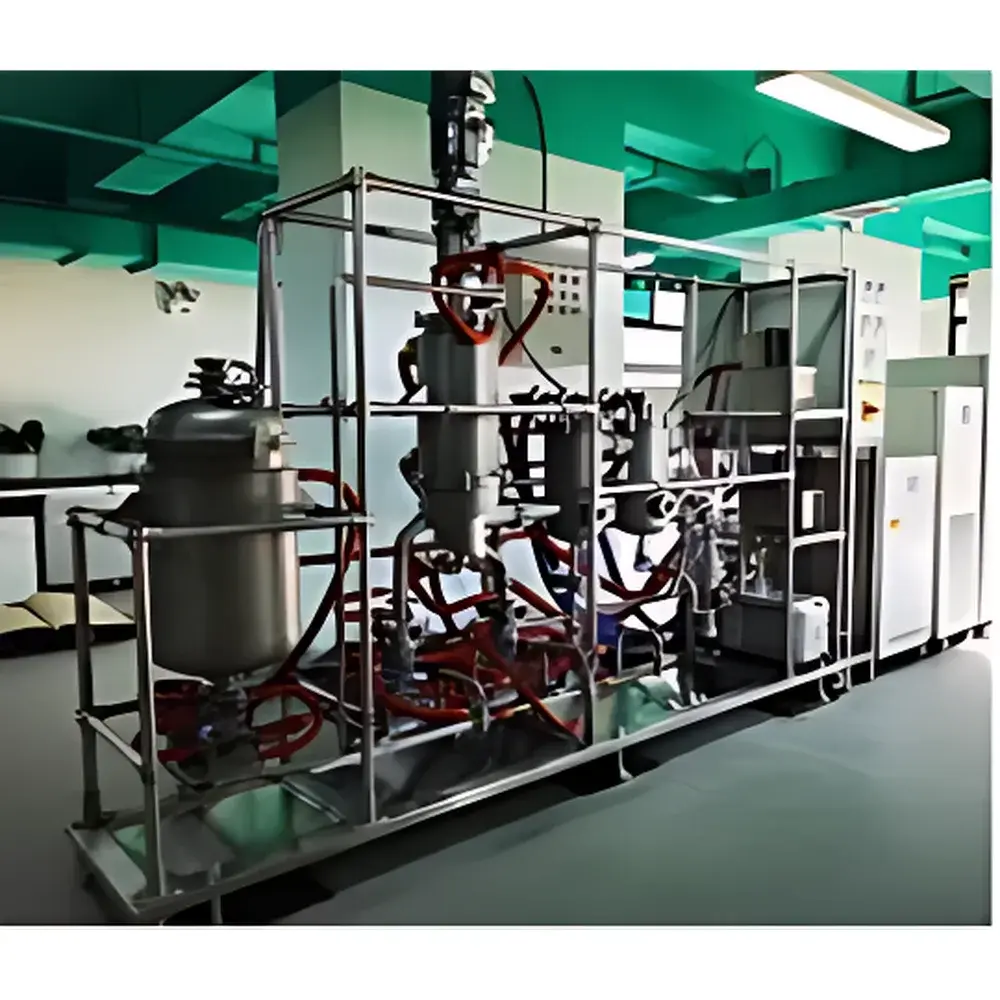
STKJ SPE30 Pilot-Scale Molecular Distillation System
| Brand | STKJ |
|---|---|
| Origin | Beijing, China |
| Manufacturer Type | Authorized Distributor |
| Country of Origin | China |
| Model | SPE30 |
| Feed Rate | 15–45 kg/h |
| Effective Evaporation Area | 30 dm² |
| Evaporator Internal Diameter | 25 cm |
| Condenser Area | 45 dm² |
| Collection Vessels | 2 |
| Construction Material | ASTM A240 UNS S31603 (1.4571) Stainless Steel |
| Maximum Evaporation Temperature | 350 °C |
| Minimum Operating Pressure | 1 mbar |
| Heating Method | Thermostatic Oil Bath |
| Independent Heating Zones | Evaporator Surface, Feed Line, Distillate Outlet |
| Film Formation System | Self-Cleaning Roller-Type Wiper |
Overview
The STKJ SPE30 Pilot-Scale Molecular Distillation System is an engineered solution for high-efficiency thermal separation of thermally sensitive, high-boiling-point, or low-volatility compounds under high vacuum conditions. Operating on the principle of molecular distillation—where separation occurs based on differences in mean free path rather than boiling point—the system enables short-residence-time evaporation at reduced pressures (down to 1 mbar) and controlled surface temperatures (up to 350 °C). Unlike conventional fractional distillation, molecular distillation minimizes thermal degradation by limiting exposure time and eliminating vapor-phase condensation within the evaporator chamber. The SPE30 bridges laboratory feasibility studies and pre-commercial process development, supporting scalable parameter translation from bench-scale trials to pilot production. Its robust stainless steel (1.4571 / UNS S31603) construction ensures compatibility with corrosive feedstocks and meets material traceability requirements common in pharmaceutical, nutraceutical, and fine chemical manufacturing environments.
Key Features
- Self-cleaning roller-type wiper system ensures uniform, stable thin-film formation across the full 30 dm² evaporator surface—critical for consistent heat transfer and reproducible separation efficiency.
- Dual-zone independent heating: precisely regulated oil-bath heating for the evaporator wall, plus auxiliary heating for feed lines and distillate outlets to prevent crystallization or viscosity-induced blockage.
- Externally mounted condenser with 45 dm² active cooling area, optimized for high condensation efficiency and minimal backstreaming under ultra-low pressure operation.
- Modular collection train accommodating two independently temperature-controlled receiving flasks—enabling fractionated collection of light and heavy distillates without system interruption.
- Full vacuum integrity certified to ≤1 mbar base pressure; compatible with secondary vacuum pumps (e.g., diffusion or turbomolecular) for sub-mbar operation when required.
- Evaporator geometry engineered with 25 cm internal diameter to balance film thickness control, residence time distribution, and mechanical stability during continuous feed.
Sample Compatibility & Compliance
The SPE30 handles viscous, heat-labile, or polymer-containing feedstocks including but not limited to fish oil concentrates (EPA/DHA purification), vitamin E acetate, phospholipids, CBD distillates, silicone oils, and specialty polyols. All wetted surfaces conform to ASTM A240 UNS S31603 specifications; optional construction upgrades—including Hastelloy C-276—are available for highly aggressive media. The system supports documentation packages aligned with GLP and GMP frameworks, including IQ/OQ protocols, material certification (EN 10204 3.1), and vacuum leak-test records. While not a Class I medical device, its design facilitates compliance with ISO 9001:2015 quality management systems and provides audit-ready operational logs when integrated with validated data acquisition software.
Software & Data Management
The SPE30 operates via a programmable logic controller (PLC)-based HMI interface with real-time monitoring of key process variables: evaporator surface temperature, condenser temperature, feed rate, vacuum level, and wiper rotational speed. All parameters are timestamped and exportable in CSV format. Optional integration with STKJ’s LabControl Suite enables automated method execution, electronic batch record generation, and 21 CFR Part 11-compliant user access control, audit trails, and electronic signatures—meeting regulatory expectations for QC laboratories in FDA-regulated industries. Raw sensor data is retained locally for ≥30 days and can be archived to network drives or LIMS platforms via Ethernet TCP/IP.
Applications
- Purification of omega-3 fatty acid ethyl esters from crude fish oil hydrolysates, achieving >95% EPA+DHA content with minimal trans-isomer formation.
- Deodorization and tocopherol recovery from de-gummed vegetable oil distillates under oxygen-free nitrogen sweep.
- Removal of residual monomers and catalysts from synthetic polymers (e.g., polyacrylates, polysiloxanes) prior to biomedical qualification.
- Isolation of natural aroma compounds (e.g., linalool, geraniol) from botanical extracts without thermal fragmentation.
- Preparative-scale isolation of cannabinoids (CBD, CBG) from winterized hemp extract while preserving terpene profiles.
FAQ
What vacuum level is required for optimal operation?
The system achieves stable molecular distillation performance at operating pressures between 0.5–5 mbar; a base pressure ≤1 mbar is recommended for most thermally sensitive applications.
Can the system be validated for GMP use?
Yes—when configured with optional IQ/OQ documentation, calibrated sensors, and 21 CFR Part 11-enabled software, the SPE30 supports validation per ASTM E2500 and ISPE GAMP5 guidelines.
Is corrosion resistance available beyond standard stainless steel?
Yes—Hastelloy C-276, Inconel 625, and glass-lined variants are offered for highly acidic or halogenated feedstock processing.
How is feed rate controlled and monitored?
A gravimetric or gear-pump-based feed system (user-selected) delivers 15–45 kg/h with ±1.5% flow repeatability; real-time mass flow feedback is integrated into the HMI.
Does the system support continuous operation over extended cycles?
Yes—the self-cleaning wiper mechanism, redundant thermal protection, and sealed bearing design enable unattended operation for up to 72 hours with scheduled maintenance intervals every 500 operating hours.
Related Products



