
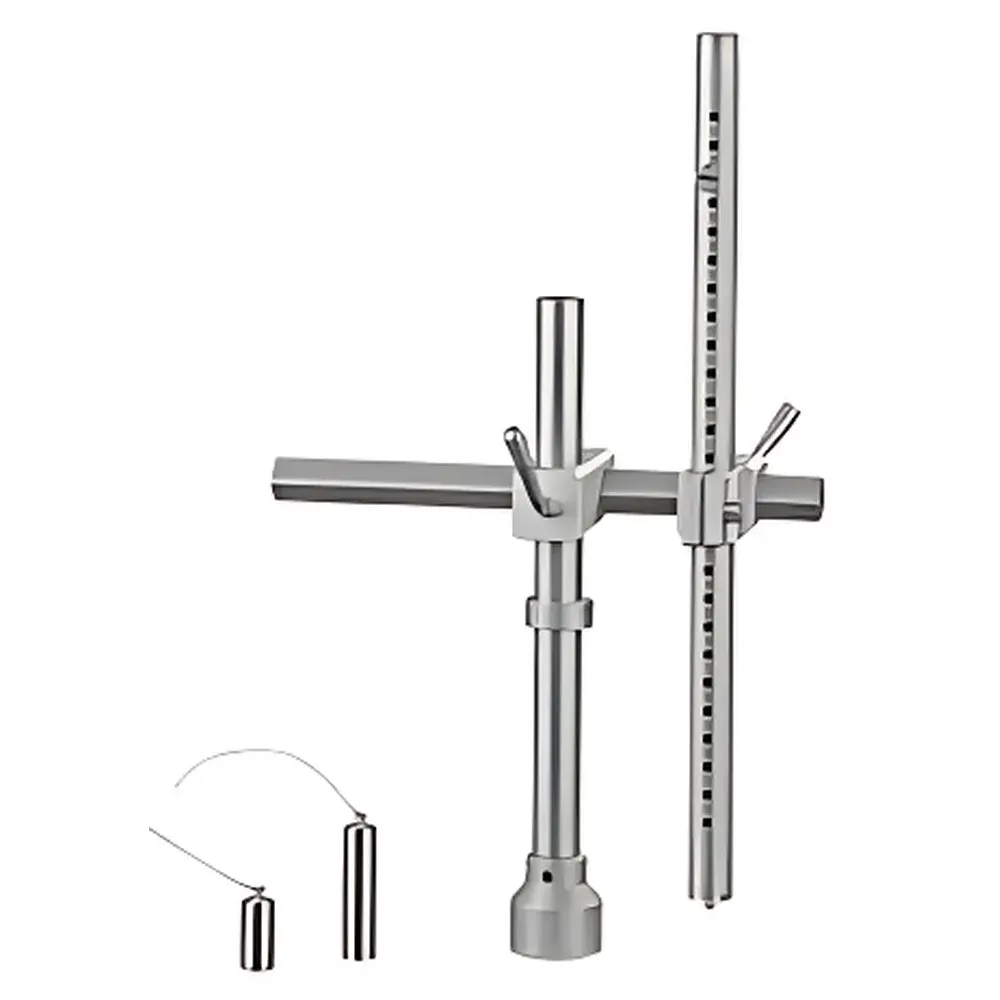
Stoelting 68093 Free-Fall Impact Device for Experimental Traumatic Brain Injury
| Origin | Guangdong, China |
|---|---|
| Manufacturer Type | Authorized Distributor |
| Origin Category | Domestic (PRC) |
| Model | 68093 |
| Pricing | Available Upon Request |
| Impact Rod Diameter | 4.5 mm |
| Impact Rod Height | 20 mm |
| Impact Weights | 20 g and 40 g |
| Guide Tube Height | 30 cm |
| Stereotaxic Adjustment | Manual X-, Y-, Z-axis Translation |
| Compatible Species | Mouse, Rat, Guinea Pig, Rabbit, Cat, Dog |
Overview
The Stoelting 68093 Free-Fall Impact Device is a precision-engineered instrument designed for the reproducible induction of controlled cortical impact (CCI) in preclinical rodent and larger animal models of traumatic brain injury (TBI). Based on the classical free-fall impact principle, this device delivers quantifiable mechanical energy to the exposed dura mater via gravitational acceleration of standardized impact weights along a vertically aligned guide tube. The system integrates seamlessly with standard stereotaxic frames—such as the Stoelting 51600 or equivalent—and enables consistent biomechanical insult delivery under sterile surgical conditions. Its design adheres to widely accepted methodological frameworks described in peer-reviewed TBI literature (e.g., Feeney et al., 1985; Foda & Marambaud, 2004), supporting translational research into secondary injury cascades, neuroinflammation, blood–brain barrier disruption, and therapeutic intervention efficacy.
Key Features
- Modular impact assembly comprising a precision-machined stainless-steel impact rod (4.5 mm diameter, 20 mm height), dual calibrated impact weights (20 g and 40 g), and a rigid 30 cm vertical guide tube ensuring axial alignment and minimal lateral deviation during drop.
- Manual three-axis stereotaxic adjustment (X/Y/Z) compatible with standard small-animal brain atlases (e.g., Paxinos & Watson), enabling precise targeting relative to bregma or anatomical landmarks such as the orbital recess.
- Impact energy calculation based on gravitational potential energy: E = m·g·h (where m = mass in grams, g ≈ 980 cm/s², h = drop height in cm), permitting systematic variation of injury severity (e.g., 40 g × 20 cm = 800 g·cm impact energy).
- Robust metal housing and corrosion-resistant components ensure long-term dimensional stability and compliance with GLP-aligned laboratory maintenance protocols.
- No electronic actuation or software dependency—designed for direct integration into IACUC-approved surgical workflows requiring minimal setup time and maximal procedural transparency.
Sample Compatibility & Compliance
The 68093 device supports craniotomy-based impact delivery across a defined size range of laboratory mammals. Validated use includes C57BL/6 and Sprague-Dawley rats (250–350 g), CD-1 mice (20–30 g), New Zealand White rabbits (2.5–3.5 kg), and domestic cats (2.5–4.0 kg) when adapted with species-specific stereotaxic adapters. All procedures must comply with institutional animal care and use committee (IACUC) protocols, referencing guidelines from the National Institutes of Health (NIH) Office of Laboratory Animal Welfare (OLAW) and Directive 2010/63/EU. While the device itself carries no CE or FDA clearance (as it is a non-invasive research tool per ISO 10993-1:2018 Annex A), its mechanical configuration aligns with ASTM F2907-22 standards for preclinical neurotrauma model reporting consistency.
Software & Data Management
This is a purely mechanical impact system with no embedded electronics, firmware, or proprietary software interface. All experimental parameters—including drop height, weight selection, stereotaxic coordinates, craniotomy dimensions, and post-impact observation timelines—are documented manually in bound laboratory notebooks or electronic lab notebooks (ELNs) compliant with 21 CFR Part 11 requirements (e.g., LabArchives, Benchling). Users are advised to record impact events with synchronized high-speed video (≥500 fps) for independent verification of rod descent velocity and contact dynamics. Audit trails must include operator initials, date/time stamps, animal ID, and calibration verification logs for impact weights (traceable to NIST-traceable mass standards).
Applications
- Establishment of graded focal contusion models for evaluating neuroprotective agents, anti-inflammatory therapeutics, and stem cell transplantation strategies.
- Investigation of axonal injury mechanisms using immunohistochemical markers (e.g., APP, β-amyloid precursor protein) and diffusion tensor imaging (DTI) validation.
- Pharmacokinetic–pharmacodynamic (PK/PD) correlation studies assessing blood–brain barrier permeability changes via Evans Blue extravasation or dynamic contrast-enhanced MRI.
- Validation of biomarker candidates (e.g., UCH-L1, GFAP, NF-L) in cerebrospinal fluid and plasma following standardized impact severity.
- Training platform for neurosurgical residents and graduate students in stereotaxic technique, craniotomy, and acute TBI model execution under supervision.
FAQ
Is the 68093 device compatible with automated stereotaxic systems?
No—it is designed exclusively for manual X/Y/Z positioning. Integration with motorized frames requires third-party mechanical adaptation and is not supported by the manufacturer.
What is the recommended sterilization method for the impact rod and guide tube?
Autoclaving at 121°C for 20 minutes (gravity displacement cycle) is validated for all stainless-steel components. Avoid ultrasonic cleaning with chlorinated solvents.
Can impact energy be adjusted beyond the supplied 20 g and 40 g weights?
Custom weights may be fabricated provided they maintain concentricity, surface finish (Ra ≤ 0.8 µm), and mass tolerance ±0.5%. Recalibration of impact energy must be performed gravimetrically prior to use.
Does the device include a craniotomy guidance template?
No. Craniotomy dimensions and location are determined intraoperatively using stereotaxic coordinates and calibrated microscalpels. A 6 mm trephine is commonly used for rat models per established protocols.
Is technical support available for protocol optimization?
Yes—application specialists provide remote consultation on surgical workflow integration, coordinate mapping, and histological endpoint alignment, subject to institutional licensing agreements.



