
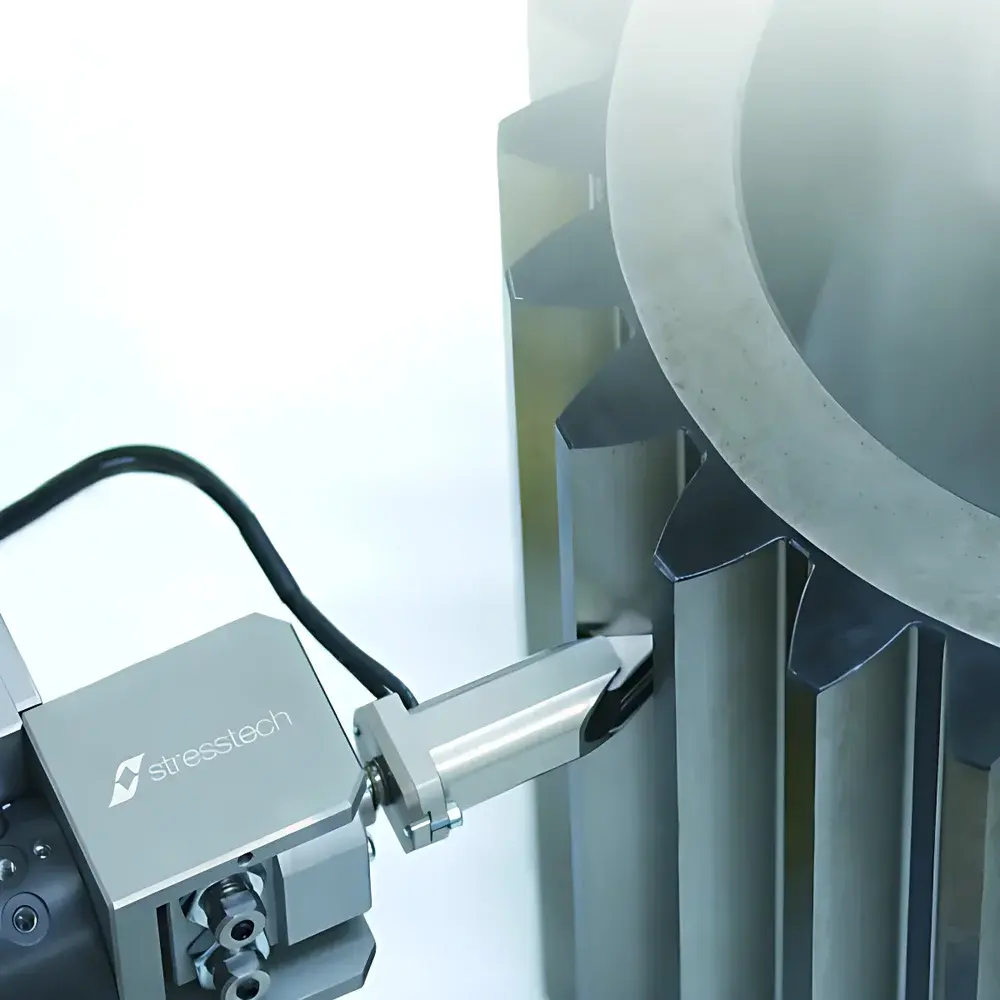
Stresstech Gearscan Barkhausen Noise-Based Gear Grinding Burn Detection System
| Brand | Stresstech Oy |
|---|---|
| Origin | Finland |
| Model | Gearscan |
| Measurement Principle | Barkhausen Noise Analysis (BNA) |
| Applicable Gear Types | Spur, Helical, Bevel, and Worm Gears |
| Diameter Range | 5–2000 mm |
| Module Range | 1–70 |
| Measurement Time per Tooth | 2–30 s (dependent on geometry and surface condition) |
| Motion Control | PC-controlled precision DC servo motor with linear-bearing-driven probe |
| Compliance | Designed for ISO 286-1, ASTM E1444/E1444M (magnetic particle testing reference), and compatible with GLP/GMP data integrity requirements |
| Software | GearScan™ v5.x with audit trail, measurement parameter programming, alarm threshold setting, spatial mapping of burn locations, statistical reporting, and CSV/PDF export |
Overview
The Stresstech Gearscan is a dedicated non-destructive testing (NDT) system engineered for the rapid, quantitative assessment of grinding-induced thermal damage in case-hardened gears. Unlike destructive acid etching—a legacy method requiring surface alteration, hazardous chemical handling, and subjective interpretation—the Gearscan employs the physics-based Barkhausen Noise Analysis (BNA) principle. BNA detects irreversible magnetic domain wall motion triggered by microstructural changes associated with overheating during grinding, such as tempering (reverted austenite or soft-phase formation) and secondary quenching (untempered martensite). These microstructural anomalies directly correlate with residual stress gradients, hardness deviations, and fatigue life reduction. The system delivers objective, repeatable, and traceable results without altering gear geometry, surface finish, or metallurgical integrity—making it suitable for 100% in-process inspection and final acceptance testing in high-reliability applications.
Key Features
- Non-contact, non-destructive evaluation of grinding burn across all critical gear regions: tooth flank, root fillet, end face, and bore transition zones
- Programmable measurement sequences via intuitive operator interface: selectable tooth indexing, variable dwell time per measurement point, and user-defined alarm thresholds based on calibrated BNA amplitude and noise spectral energy
- Modular probe architecture with interchangeable sensor heads optimized for spur, helical, bevel, and internal gears—each featuring precision linear bearing guidance for consistent lift-off control and signal stability
- Integrated motion control subsystem driven by a high-resolution DC servo motor and optical encoder feedback, enabling repeatable positioning accuracy better than ±5 µm
- Real-time spatial mapping of burn severity: color-coded heatmaps overlay BNA response values onto CAD-aligned gear geometry, highlighting localized damage zones with sub-millimeter resolution
- Compliance-ready software architecture supporting 21 CFR Part 11–aligned electronic signatures, full audit trail logging (user actions, parameter changes, calibration events), and secure data export in CSV, PDF, and XML formats
Sample Compatibility & Compliance
The Gearscan accommodates a broad spectrum of gear geometries and materials. It supports external and internal gears with diameters from 5 mm to 2000 mm and module ranges from 1 to 70, including fine-pitch aerospace gearing and heavy-duty power transmission components. Compatible with case-hardened steels (e.g., 18CrNiMo7-6, 20MnCr5, AISI 8620), carburized alloys, and nitrided surfaces. The system meets functional requirements referenced in ISO 6336 (calculation of load capacity of spur and helical gears), ASTM E1444/E1444M (standard practice for magnetic particle testing), and supports quality assurance documentation per AS9100 and EN 10204 Type 3.1 certification workflows. Its design facilitates integration into automated production lines and aligns with IATF 16949 process validation protocols for NDT equipment.
Software & Data Management
GearScan™ software provides a validated, role-based interface for operators, QA engineers, and metrology supervisors. It enables full configuration of measurement plans—including gear type selection, number of teeth, rotational increment, probe speed, and filtering parameters. All measurements are timestamped and linked to part ID, batch number, and operator credentials. Statistical process control (SPC) tools calculate Cp/Cpk, trend charts, and capability indices per tooth group or gear set. Raw BNA waveforms and frequency-domain spectra are archived for root cause analysis. Data export complies with laboratory information management system (LIMS) ingestion standards and supports direct import into MES platforms via OPC UA or REST API interfaces. Calibration history, probe verification logs, and system self-test reports are retained for regulatory audits.
Applications
The Gearscan is deployed across industries where gear reliability dictates system safety and service life: aerospace actuation systems and helicopter main gearboxes; marine propulsion shafts and reduction gears; nuclear reactor coolant pump assemblies; wind turbine planetary carriers and main bearings; high-pressure boiler feedwater pump gears; and electric vehicle e-axle differentials. It serves as a critical tool in failure analysis laboratories investigating premature pitting, spalling, or bending fatigue failures. Universities utilize the platform for fundamental research in tribology, grinding mechanics, and magnetic microstructure-property relationships. Its ability to detect subsurface damage—up to 100–200 µm below the surface—without sectioning makes it indispensable for validating new grinding coolants, wheel dress strategies, and adaptive CNC grinding cycles.
FAQ
Does the Gearscan require surface preparation prior to measurement?
No. The system operates on as-ground or as-polished surfaces without cleaning agents, coatings, or conductivity enhancement. Minimal oil film is tolerated; heavy contamination must be removed via vapor degreasing or ultrasonic cleaning—consistent with standard gear cleaning procedures.
Can it distinguish between temper burn and rehardening burn?
Yes. Through multi-parameter analysis—including peak Barkhausen voltage, noise envelope integral, and high-frequency spectral ratio—the Gearscan differentiates microstructural states with proven correlation to metallographic cross-section validation per ASTM E3-22.
Is operator training required for ISO/IEC 17025 accreditation?
Yes. Stresstech provides certified Level II NDT training aligned with EN ISO 9712, covering BNA theory, system calibration, measurement uncertainty estimation, and report generation per ISO/IEC 17025 clause 7.8.
What is the typical measurement repeatability under controlled conditions?
Repeatability (within-operator, same location) is typically ≤3% coefficient of variation (CV) for amplitude-based burn index when using calibrated reference gears and stable environmental conditions (20 ± 2 °C, <60% RH).





