
Stresstech RollScan 250 Non-Destructive Grinding Burn Detection System
| Brand | Stresstech Oy |
|---|---|
| Country of Origin | Finland |
| Model | RollScan 250 |
| Application | Surface Burn & Microstructural Damage Detection in Ferrous & Nickel-Based Alloys |
| Measurement Principle | Magnetic Barkhausen Noise (MBN) Analysis |
| Sensor Compatibility | Interchangeable MBN Probes (Surface, Encircling, Miniature) |
| Data Acquisition | Integrated DSP with Real-Time Signal Processing |
| Software Platform | ViewScan (Optional, Windows-based, ASTM E3147-21 Compliant) |
| Compliance | ISO 20986:2021, EN 10327, ASTM A938, NADCAP AC7114/3 |
Overview
The Stresstech RollScan 250 is a precision-engineered, non-destructive magnetic Barkhausen noise (MBN) analysis system designed for the reliable detection of grinding-induced surface burns, thermal damage, and microstructural anomalies in case-hardened and through-hardened ferromagnetic components. Unlike conventional acid etching—a destructive, labor-intensive, and environmentally regulated method—the RollScan 250 operates entirely on electromagnetic principles: it excites localized magnetic domain wall motion using controlled alternating magnetic fields and captures the resulting stochastic voltage pulses induced in high-permeability sensor coils. These MBN signals correlate directly with subsurface residual stress gradients, martensitic phase instability, and plastic deformation zones generated during aggressive grinding or improper heat treatment. The system delivers quantitative, repeatable, and operator-independent assessment of burn severity across complex geometries—including bearing rings, gear teeth, crankshafts, camshafts, fuel injector nozzles, and aircraft landing gear—without surface preparation, material removal, or chemical exposure.
Key Features
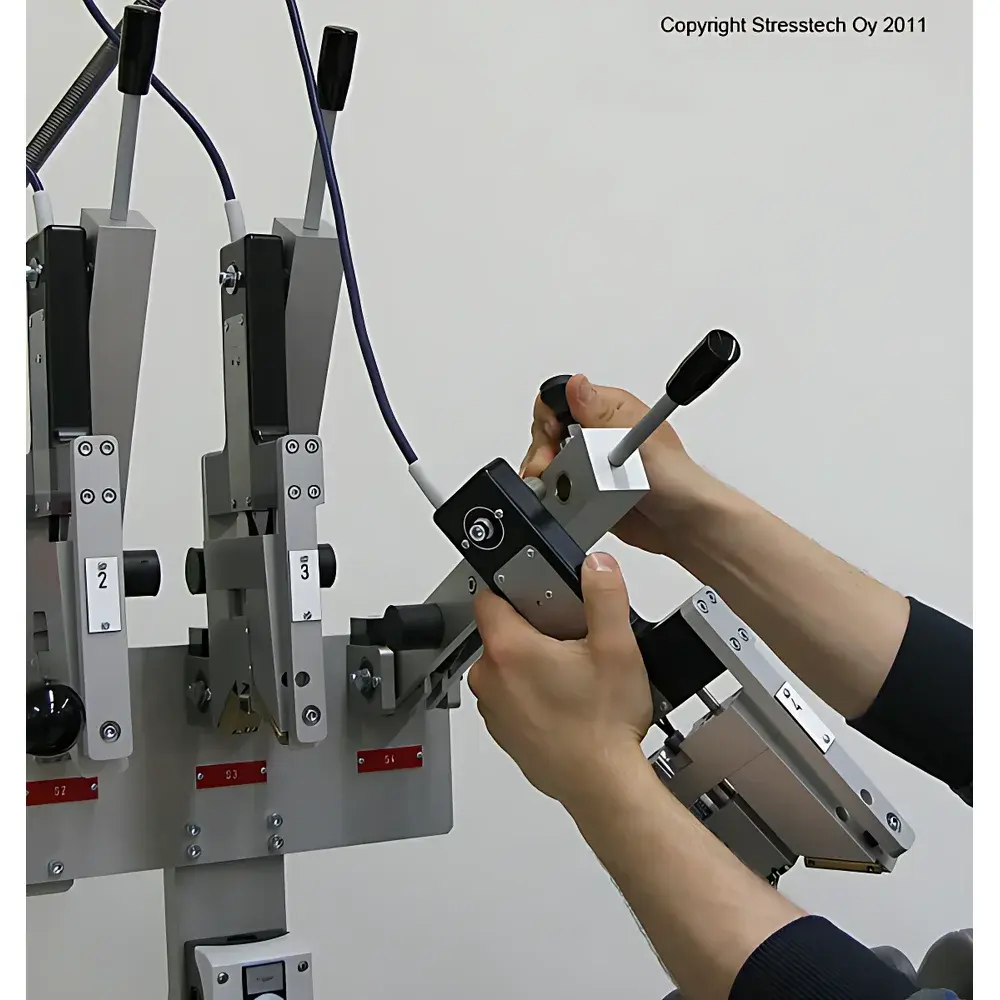
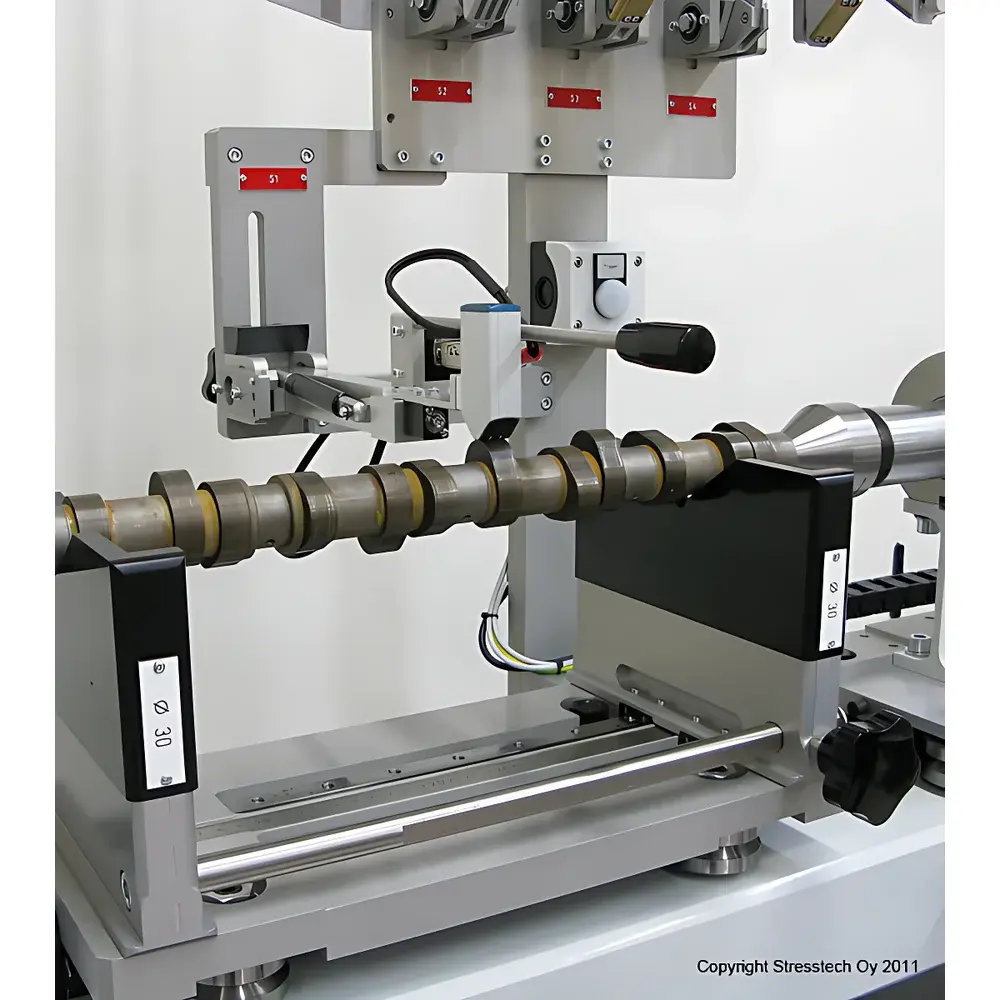
- Non-contact or light-contact MBN probe architecture with interchangeable sensor heads: surface scanning probes for flat/curved surfaces, encircling probes for shafts and pins, and miniature probes for confined geometries (e.g., gear root fillets, valve seats)
- Integrated digital signal processor (DSP) enabling real-time spectral analysis, noise suppression, and adaptive thresholding to distinguish burn signatures from background microstructure variations
- Full parametric control via front-panel rotary encoder: adjustable excitation frequency (20–200 Hz), magnetizing voltage (0.5–10 Vpp), and current amplitude (0.1–2.0 App)—all visible and modifiable during live measurement
- Hardware-level synchronization between magnetization cycle and signal acquisition ensures phase-locked detection of MBN burst amplitude, RMS energy, and peak frequency shift—key indicators of white-layer formation and tensile residual stress accumulation
- Modular design compatible with both RollScan 250 and RollScan 300 sensor ecosystems; supports future firmware upgrades for enhanced defect classification algorithms
- No calibration compensation required for part geometry or material batch variation—enabled by proprietary normalization routines embedded in the acquisition firmware
Sample Compatibility & Compliance
The RollScan 250 is validated for use on carbon steels, alloy steels (e.g., AISI 4340, 52100), stainless steels (e.g., 410, 420, 17-4PH), nickel-based superalloys (e.g., Inconel 718, Waspaloy), and cobalt-chromium alloys (e.g., Stellite 6). It meets the technical requirements of ISO 20986:2021 (“Non-destructive testing — Magnetic Barkhausen noise testing — General principles”) and supports compliance workflows aligned with ASTM E3147-21 (“Standard Practice for Magnetic Barkhausen Noise Testing of Ferromagnetic Materials”), EN 10327 (“Cold rolled narrow steel strip — Technical delivery conditions”), and NADCAP AC7114/3 (Nondestructive Testing – Magnetic Particle and Magnetic Barkhausen Noise). Its measurement traceability is maintained through factory-certified reference standards traceable to national metrology institutes (e.g., VTT MIKES, PTB). The system is routinely deployed in AS9100-certified aerospace manufacturing lines and ISO 17025-accredited laboratories.
Software & Data Management
ViewScan software (optional, Windows 10/11 compatible) provides comprehensive data acquisition, visualization, and reporting functionality. It enables synchronized multi-channel waveform capture, time-domain and frequency-domain MBN signature mapping, cross-sectional burn profiling, and automated pass/fail evaluation against user-defined acceptance criteria. All raw and processed data are stored in HDF5 format with embedded metadata (operator ID, timestamp, sensor ID, parameter set, environmental temperature). Audit trails comply with FDA 21 CFR Part 11 requirements when configured with electronic signatures and role-based access control. Export options include CSV, PDF reports (with configurable templates), and XML for integration into MES/QMS platforms such as Siemens Opcenter, ETQ Reliance, or MasterControl.
Applications
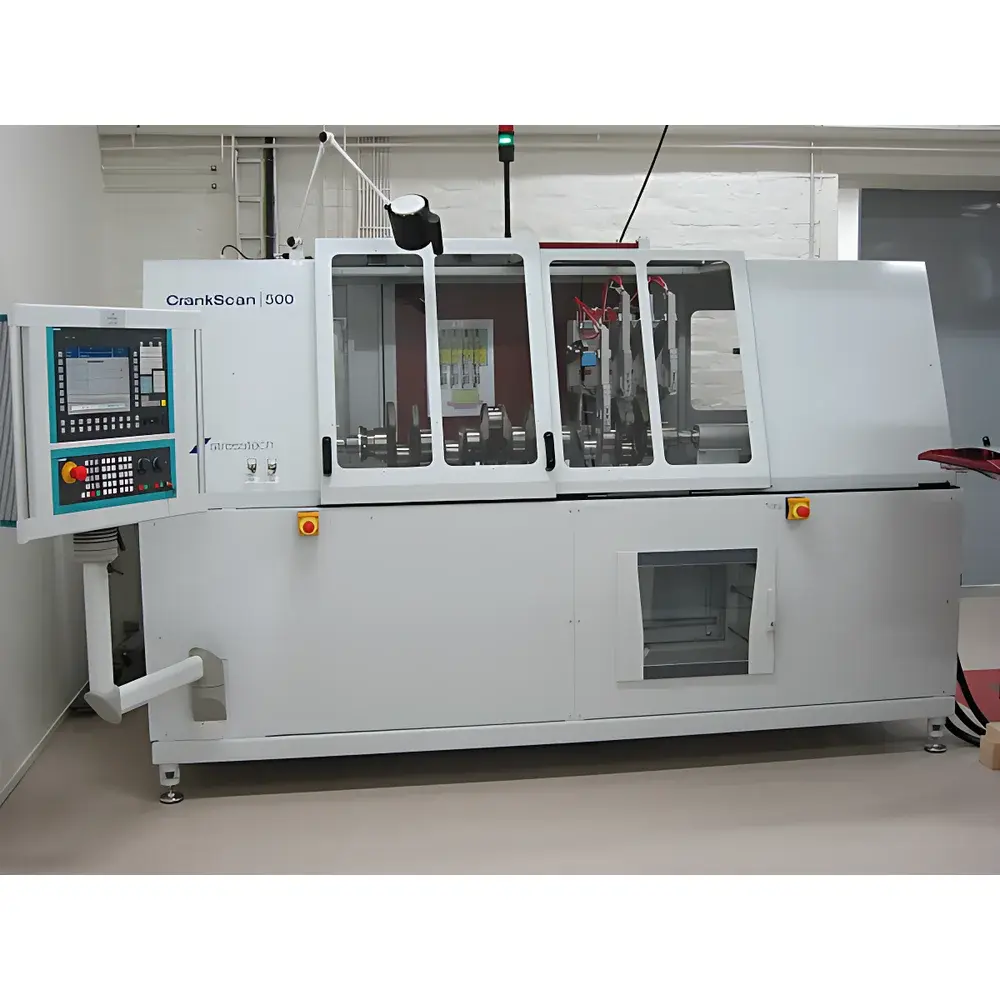
The RollScan 250 serves critical quality assurance functions across high-reliability sectors: in aerospace, it verifies surface integrity of turbine disks, compressor blades, and landing gear components post-grinding; in automotive, it screens transmission gears, CV joint housings, and engine camshafts for grinding burns that may initiate fatigue cracks under cyclic loading; in power generation, it assesses rotor shafts and boiler tube supports subjected to high-temperature service; in nuclear applications, it validates cladding integrity on pressure vessel internals; and in additive manufacturing, it detects near-surface microcracking and phase segregation in laser powder bed fusion (LPBF) parts made from maraging steel or Inconel. Research institutions utilize its high-resolution MBN mapping capability to correlate grinding parameters (wheel speed, feed rate, coolant flow) with subsurface damage evolution.
FAQ
How does the RollScan 250 differentiate between grinding burn and normal case-hardened microstructure?
It analyzes deviations in MBN signal amplitude distribution, spectral centroid shift (>15 kHz), and pulse density decay rate—parameters empirically linked to white-layer thickness and compressive-to-tensile stress transition at the surface.
Can it detect subsurface burns beyond the immediate surface layer?
Yes—penetration depth is controllable (typically 10–150 µm) via excitation frequency and magnetic field strength, enabling depth-resolved assessment of thermally affected zones.
Is operator training required to interpret results?
Basic operation requires minimal training; however, advanced diagnostics (e.g., burn severity grading, correlation with fatigue life models) benefit from certification per ISO 9712 Level 2 MBN testing standards.
Does the system require periodic recalibration?
No routine recalibration is needed; annual verification using certified reference blocks (e.g., Stresstech SRB-1 series) is recommended for audit readiness.
Can it be integrated into automated production lines?
Yes—via Ethernet/IP or Modbus TCP interfaces, supporting trigger synchronization with CNC grinders and robotic handling systems for 100% inline inspection.




