
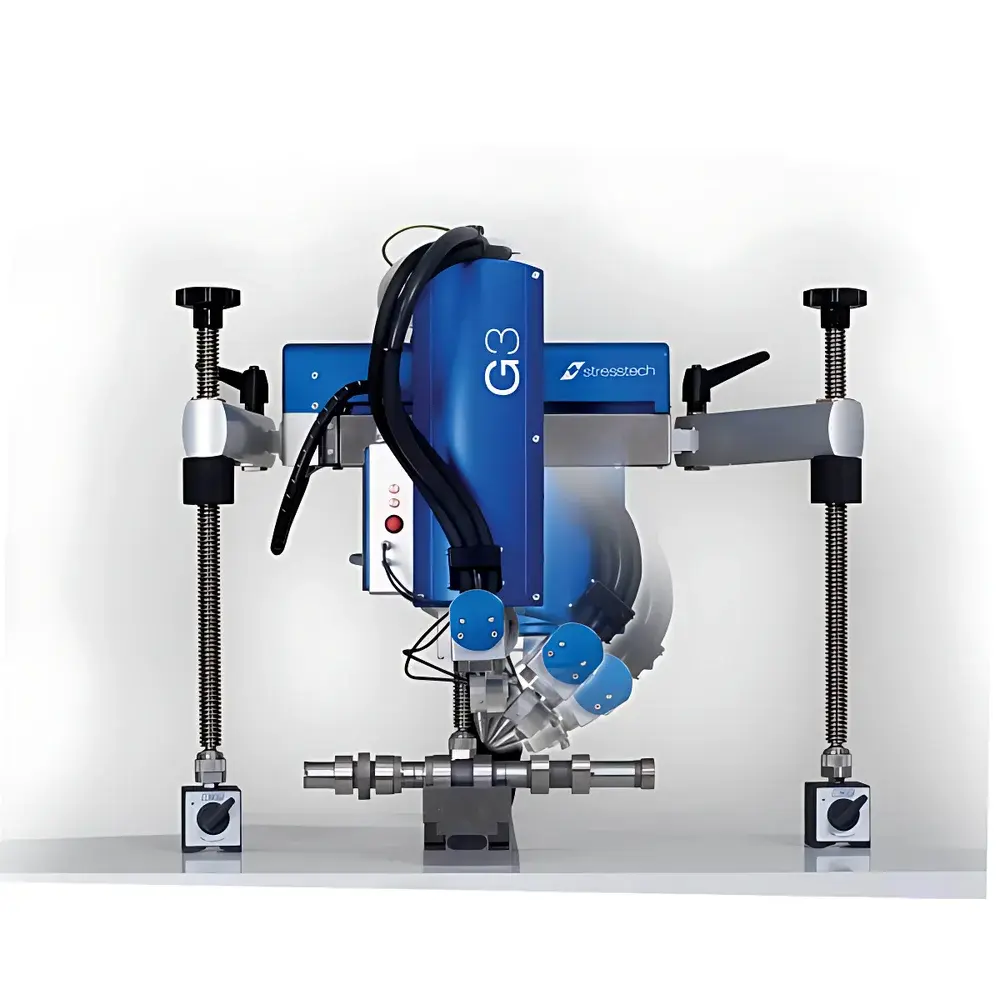
Stresstech xstress3000 Portable X-ray Residual Stress Analyzer
| Brand | Stresstech Oy |
|---|---|
| Origin | Finland |
| Model | xstress3000 |
| X-ray Tube | 5–30 kV / 0–10 mA / 300 W adjustable |
| Anode Materials | Cr, Cu, Co, Ti, Mn |
| 2θ Range | 117°–170° continuous adjustment |
| Detector Configuration | Dual symmetric detectors |
| Goniometer | Tilt & rotation axes with enhanced y-geometry (side-inclination method) |
| Cooling | Closed-loop recirculating system with forced-air assist |
| Power Supply | 100–240 VAC, 50/60 Hz |
| Compliance | Designed for ASTM E915, ISO 21432, and EN 15305-compliant residual stress measurement workflows |
Overview
The Stresstech xstress3000 Portable X-ray Residual Stress Analyzer is an engineered solution for non-destructive, in-situ determination of near-surface residual stresses in polycrystalline metallic components. It operates on the principle of X-ray diffraction (XRD) using the sin²ψ method—measuring lattice strain via angular shifts in Bragg diffraction peaks under controlled sample tilting. Unlike laboratory-based benchtop diffractometers, the xstress3000 integrates a compact microfocus X-ray tube, high-stability goniometry, and dual symmetric solid-state detectors into a field-deployable platform. Its mechanical architecture supports both side-inclination (y-geometry) and conventional ψ-tilt configurations, enabling robust stress evaluation on curved, large, or immobile parts—including gears, crankshafts, turbine blades, welded joints, and pressure vessel nozzles—without component removal or surface preparation beyond standard metallographic polishing.
Key Features
- Field-portable design weighing under 25 kg (excluding laptop), with integrated shock-absorbing chassis and IP54-rated enclosure for operation in industrial environments including workshops, power plants, and offshore platforms.
- Modular microfocus X-ray tube (5–30 kV, 0–10 mA, 300 W max) with rapid anode-swapping capability—Cr, Cu, Co, Ti, and Mn targets are user-replaceable in <3 minutes without tools, optimizing Kα wavelength selection per material system (e.g., Cr for ferritic steels, Co for austenitic alloys).
- High-precision goniometer with motorized tilt (±30°) and rotation (360°) axes, calibrated to ±0.02° angular accuracy; 2θ detector arm continuously adjustable from 117° to 170° to accommodate diverse diffraction geometries and minimize peak overlap.
- Dual symmetric Si-PIN or CdTe detectors enable simultaneous acquisition of diffracted intensity profiles, improving signal-to-noise ratio and reducing measurement time by up to 40% compared to single-detector systems.
- Integrated closed-loop water–air hybrid cooling system maintains thermal stability of the X-ray source and detector electronics across extended duty cycles, supporting >4-hour continuous operation at rated power.
- Comprehensive hardware interlocks—including beam shutter control, emergency stop circuitry, radiation door sensors, and real-time dose monitoring—ensure compliance with IEC 61010-1 and local regulatory requirements for portable radiation-emitting equipment.
Sample Compatibility & Compliance
The xstress3000 is validated for residual stress analysis in ferrous and non-ferrous alloys, including carbon steels, stainless steels, aluminum alloys, titanium grades (e.g., Ti-6Al-4V), nickel-based superalloys (e.g., Inconel 718), and cast irons. Surface accessibility requirements are minimal: a flat or gently curved area ≥8 mm × 8 mm with Ra ≤ 0.8 µm is sufficient for reliable data acquisition. The instrument adheres to internationally recognized standards for residual stress measurement, including ASTM E915 (Standard Test Method for Verifying the Alignment of X-Ray Diffraction Instrumentation for Residual Stress Measurement), ISO 21432 (Non-destructive testing — Standard test method for determining residual stresses by X-ray diffraction), and EN 15305 (Non-destructive testing — Qualification and certification of NDT personnel — General principles). All measurement protocols support audit-ready documentation required under GLP and ASME BPVC Section V frameworks.
Software & Data Management
Controlled via Windows-based xstress software (v6.x or later), the system provides full instrument orchestration—including real-time high-voltage regulation, automatic exposure optimization, live diffraction pattern preview, and on-the-fly lattice parameter refinement. Software modules support automated peak search (Pseudo-Voigt fitting), stress tensor calculation (including biaxial and triaxial models), error propagation analysis per ISO/IEC 17025 guidelines, and export of raw .xye, .csv, and .xlsx files. Audit trail functionality logs all operator actions, parameter changes, and calibration events with timestamps and user IDs—meeting FDA 21 CFR Part 11 requirements when deployed in regulated manufacturing environments. Data synchronization with enterprise LIMS or QMS platforms is supported via OPC UA and RESTful API interfaces.
Applications
The xstress3000 delivers quantitative residual stress data critical to process validation and structural integrity assurance across multiple sectors. In aerospace, it verifies stress states in machined landing gear components post-shot peening and assesses thermal distortion in additive-manufactured brackets. In power generation, it monitors stress evolution in steam turbine discs after welding repairs and validates stress-relief annealing efficacy in nuclear reactor piping welds. Automotive and heavy machinery users apply it to quantify grinding burn-induced tensile stresses in camshafts and bearing races, while R&D laboratories employ it for correlating heat treatment parameters (e.g., quench severity, tempering time) with subsurface stress gradients. Its portability also enables comparative studies across production batches directly on the shop floor—eliminating sampling bias introduced by lab transport and handling.
FAQ
What X-ray safety certifications does the xstress3000 meet?
The system complies with IEC 61010-1 for electrical safety and incorporates Type B radiation shielding certified per national regulations (e.g., FDA 21 CFR 1020.40 in the US, IR(ME)R in the UK). A site-specific radiation risk assessment and local licensing remain the responsibility of the end user.
Can the xstress3000 measure through coatings or platings?
Yes—provided the coating thickness is ≤20 µm and composed of low-Z elements (e.g., Zn, Ni, Cr), diffraction signals from the substrate remain resolvable. Thicker or high-Z coatings (e.g., WC-Co) require surface removal or alternative techniques such as neutron diffraction.
Is third-party calibration traceable to national standards available?
Stresstech offers annual calibration services traceable to NIST (USA), PTB (Germany), or VTT (Finland), including certificate of conformance, uncertainty budgeting, and goniometer angular verification per ISO 10012.
Does the system support automated mapping of stress fields?
Yes—the optional xstress Scan module enables programmable XY-stage integration (via external motorized positioners) for grid-based residual stress mapping, with positional repeatability of ±5 µm and full data fusion in post-processing.
What training and technical support options are provided?
Stresstech delivers on-site installation qualification (IQ), operational qualification (OQ), and user training covering measurement methodology, uncertainty estimation, and regulatory documentation. Remote diagnostics and firmware updates are supported via secure TLS-encrypted connection.





