
Struers DuraVigo-150 Entry-Level Rockwell Hardness Tester
| Brand | Struers |
|---|---|
| Origin | Denmark |
| Model | DuraVigo-150 |
| Hardness Test Method | Rockwell & Superficial Rockwell |
| Load Range | 3–250 kgf (29.4–2452.5 N) |
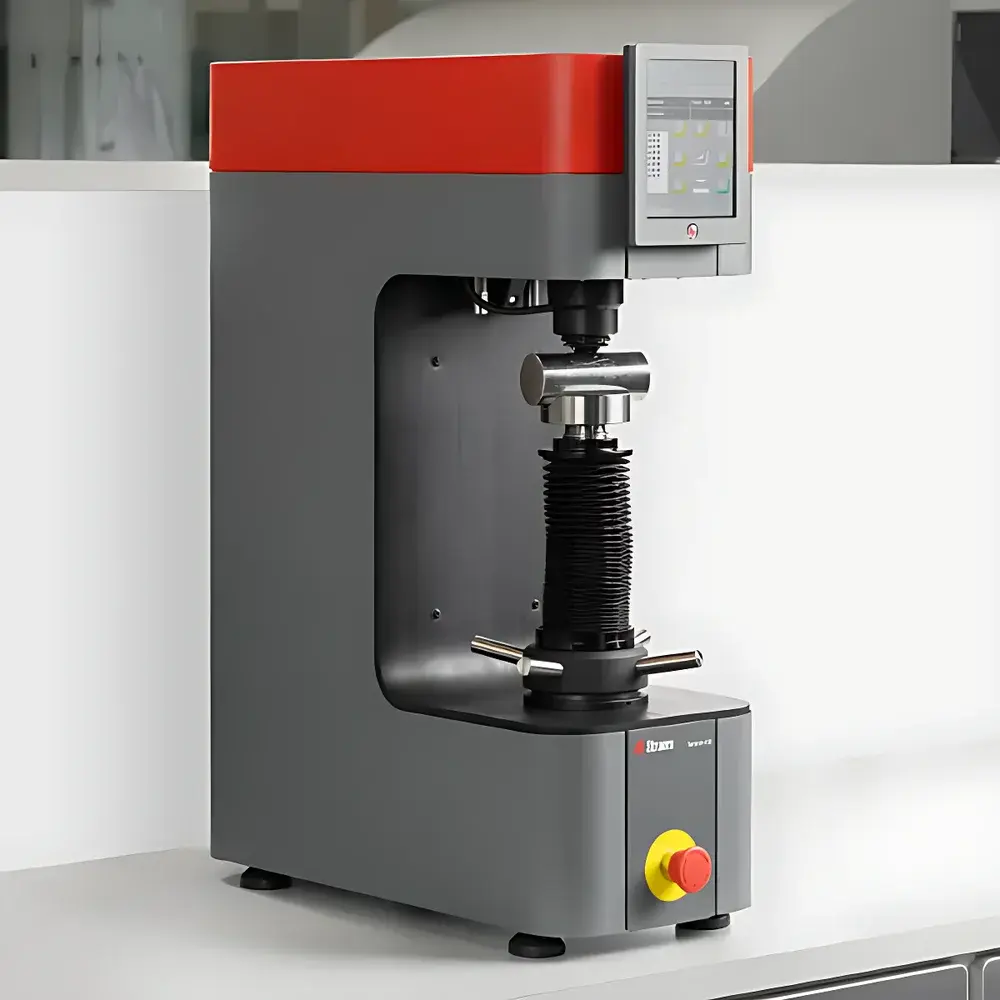
| Frame Type | C-frame with reinforced steel construction |
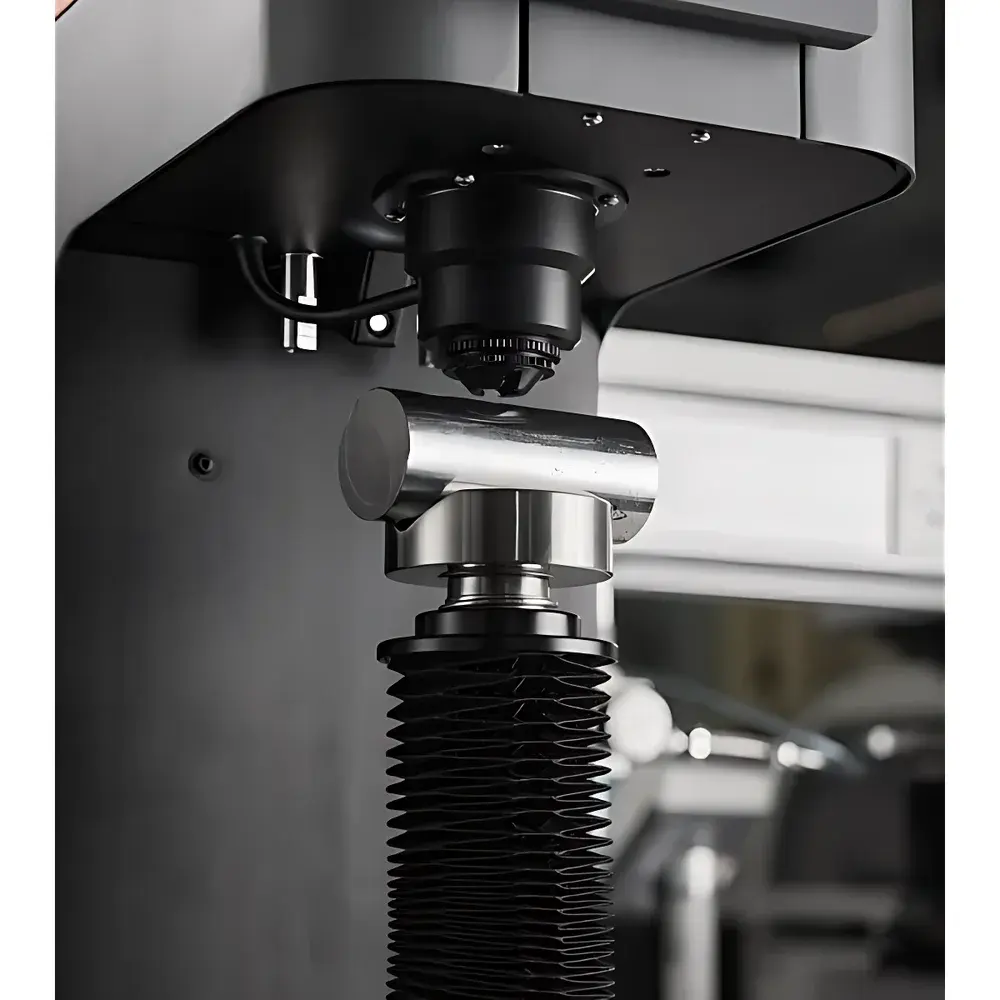
| Depth Measurement System | Direct sub-micron axial displacement sensor |
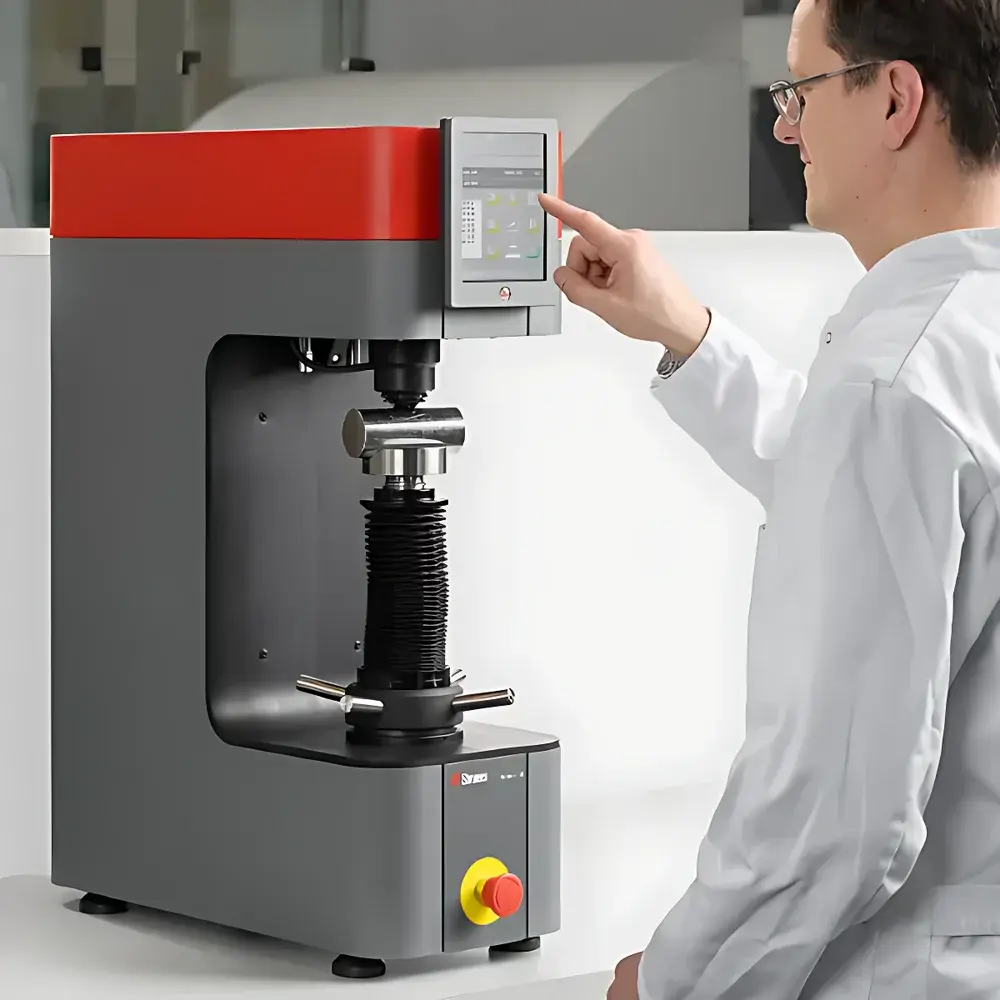
| Display | 6.5-inch capacitive color touchscreen |
| Interface | USB port for data export |
| Compliance | ISO 6508-1, ASTM E18, EN ISO 2039-2 |
| Software Features | Statistical analysis, hardness conversion tables, upper/lower limit visualization (green/red), surface correction, GLP-compliant audit trail |
Overview
The Struers DuraVigo-150 is a robust, entry-level Rockwell hardness tester engineered for precision, repeatability, and long-term operational stability in quality control laboratories and production environments. It implements the standardized Rockwell and superficial Rockwell indentation principle—measuring the permanent depth deformation of a material under controlled major and minor loads using diamond cone (HRA, HR15N, etc.) or hardened steel ball (HRB, HRF, etc.) indenters. Its closed-loop electronic force control system ensures traceable, real-time load application across the full 3–250 kgf range (29.4–2452.5 N), eliminating mechanical drift and minimizing operator influence. The instrument’s rigid C-frame architecture—constructed from high-strength steel and fitted with protective rubberized pads—mitigates structural deflection and safeguards test specimens from surface damage (e.g., paint chipping or coating abrasion). Sub-micron axial displacement sensing, aligned precisely with the indenter axis, eliminates parallax and frame compliance errors common in legacy lever-based systems, thereby delivering metrologically sound hardness values directly traceable to national standards.
Key Features
- Electronically regulated closed-loop loading system with continuous force monitoring and automatic cycle sequencing
- C-frame mechanical design optimized for rigidity, thermal stability, and resistance to environmental vibration
- 6.5-inch capacitive color touchscreen interface with intuitive icon-driven navigation and large tactile buttons
- Integrated USB port enabling direct export of test records (CSV, PDF, XML) to external storage or LIMS
- Real-time visual feedback via color-coded pass/fail indicators (green/red) against user-defined specification limits
- Onboard statistical engine supporting mean, standard deviation, Cp/Cpk, histogram generation, and trend analysis per test series
- Automatic hardness scale conversion (Rockwell ↔ Brinell ↔ Vickers) compliant with ISO 18265 and ASTM E140
- Surface correction algorithm compensating for curvature and thin-section effects per ASTM E18 Annex A4
Sample Compatibility & Compliance
The DuraVigo-150 accommodates a broad spectrum of metallic and non-metallic engineering materials—including annealed steels, aluminum alloys, case-hardened components, tool steels, plastics, and sintered metals—across all standard Rockwell scales (A, B, C, D, E, F, G, H, K) and superficial scales (15N, 30N, 45N, 15T, 30T, 45T). Specimen height clearance up to 250 mm and throat depth of 150 mm support medium-sized forgings, castings, and machined parts. All testing protocols adhere strictly to ISO 6508-1:2016 (Metallic materials — Rockwell hardness test — Part 1: Test method), ASTM E18-23 (Standard Test Methods for Rockwell Hardness of Metallic Materials), and EN ISO 2039-2 for polymer characterization. Instrument validation includes factory-certified force calibration (traceable to DKD/DAkkS-accredited standards) and depth measurement verification per ISO/IEC 17025 requirements. Full GLP/GMP audit trail capability—recording operator ID, timestamp, environmental conditions, calibration status, and raw depth/load data—is enabled via optional software licensing.
Software & Data Management
The embedded firmware supports seamless integration into industrial QA workflows through structured data handling. Test results include raw indentation depth, applied load, dwell time, hardness value, scale identifier, and uncertainty estimation. Export formats comply with ISO/IEC 17025 documentation requirements and are compatible with enterprise LIMS, MES, and SPC platforms. Optional Struers LabReport software extends functionality with multi-instrument fleet management, automated report generation (PDF/A-2 compliant), digital signature support, and 21 CFR Part 11–ready electronic record archiving—including immutable audit logs for all user actions, parameter changes, and calibration events. Data integrity is enforced via password-protected access levels (operator, supervisor, administrator) and session timeout policies.
Applications
The DuraVigo-150 serves as a foundational hardness verification tool across aerospace component inspection (e.g., turbine blade root hardness mapping), automotive powertrain QA (crankshaft surface hardness profiling), heat treatment process validation (case depth uniformity assessment), metal supplier certification (incoming material verification per ASTM A370), and R&D screening of new alloy formulations. Its rapid cycle time (<15 s per test) and minimal maintenance burden make it suitable for high-throughput environments where statistical process control (SPC) mandates ≥50 daily measurements. The instrument is routinely deployed in third-party testing labs accredited to ISO/IEC 17025 and manufacturing facilities operating under IATF 16949 or AS9100 quality management systems.
FAQ
What Rockwell scales does the DuraVigo-150 support?
It covers all standard Rockwell (A, B, C, D, E, F, G, H, K) and superficial Rockwell (15N, 30N, 45N, 15T, 30T, 45T) scales per ISO 6508-1.
Is force calibration traceable to national standards?
Yes—factory calibration is performed using DKD/DAkkS-traceable deadweight machines, with certificate included.
Can test data be exported to Excel or LIMS?
Yes—via USB port in CSV, PDF, or XML format; optional LabReport software enables direct LIMS API integration.
Does the instrument meet FDA 21 CFR Part 11 requirements?
With LabReport software license and proper system configuration (electronic signatures, audit trails, role-based access), full Part 11 compliance is achievable.
What maintenance is required?
No routine mechanical adjustment is needed; annual verification of force and depth accuracy is recommended per ISO/IEC 17025.
Related Products



