
YANRUN HR-150A Manual Rockwell Hardness Tester
| Brand | YANRUN |
|---|---|
| Origin | Shanghai, China |
| Manufacturer Type | Direct Manufacturer |
| Country of Origin | China |
| Model | HR-150A |
| Instrument Type | Rockwell Hardness Tester |
| Hardness Range | HRA: 20–88, HRB: 20–100, HRC: 20–70 |
| Preliminary Test Force | 98.07 N (10 kgf) |
| Total Test Forces | 588 N (60 kgf), 980 N (100 kgf), 1471 N (150 kgf) |
| Maximum Specimen Height | 170 mm |
| Distance from Indenter Center to Front of Machine | 135 mm |
| Hardness Resolution | 0.5 HR |
| Dimensions (W×D×H) | 466 × 238 × 630 mm |
| Weight | 65 kg |
| Compliance | GB/T 230.2, JJG 112 |
Overview
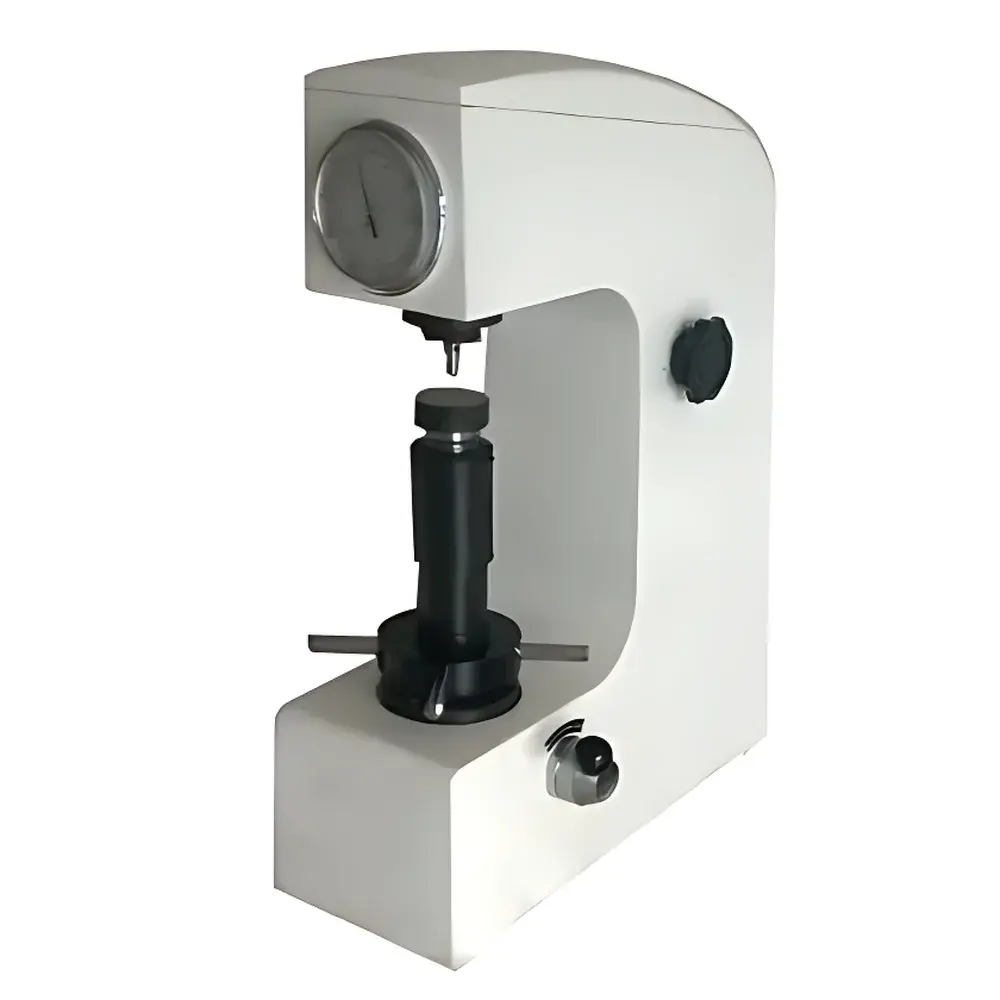
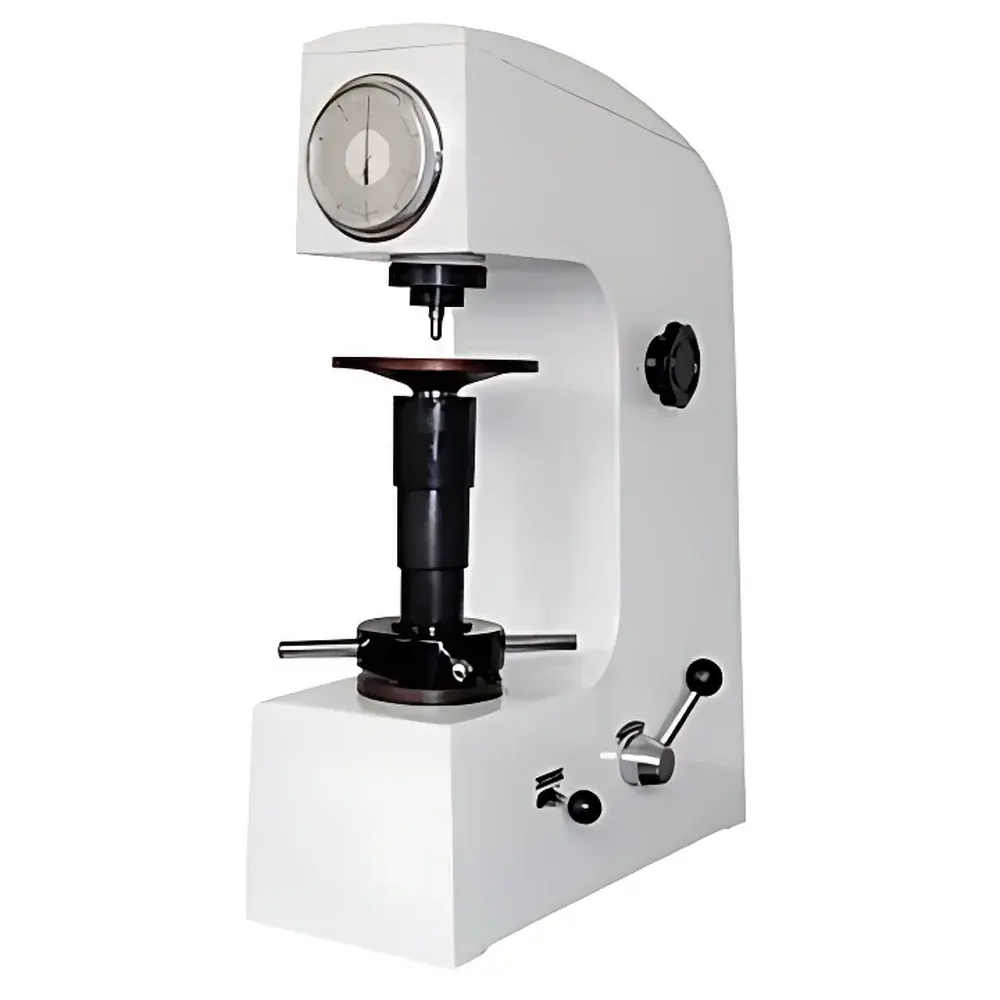
The YANRUN HR-150A Manual Rockwell Hardness Tester is a precision-engineered mechanical hardness testing instrument designed for routine Rockwell hardness evaluation of metallic materials in production, quality control, and metrology environments. Based on the standardized Rockwell principle—where hardness is determined by measuring the depth of permanent indentation under controlled preliminary and major loads—the HR-150A delivers repeatable, traceable results across nine standard Rockwell scales (HRA, HRB, HRC, HRD, HRE, HRF, HRG, HRH, HRK). Its robust cast-iron frame ensures long-term dimensional stability and resistance to operational vibration, while the manually actuated loading mechanism eliminates electronic complexity, enhancing reliability and serviceability in industrial settings where electromagnetic interference or power instability may be present.
Key Features
- Heavy-duty cast-iron housing with precision-machined mounting surfaces, providing high rigidity and minimal deflection during load application.
- High-contrast metal dial gauge with 0.5 HR resolution, manufactured to meet stringent mechanical accuracy requirements per GB/T 230.2 and calibrated against certified reference blocks.
- Dual-load capability: selectable total test forces of 588 N (60 kgf), 980 N (100 kgf), and 1471 N (150 kgf), paired with a fixed 98.07 N (10 kgf) preliminary force for consistent preload stabilization.
- Interchangeable indenter system supporting both diamond cone (120° apex angle, 0.2 mm tip radius) for HRA/HRC/HRD applications and tungsten carbide ball (1.5875 mm diameter) for HRB/HRE/HRF testing.
- Three standard anvil configurations included: large flat anvil, medium flat anvil, and V-anvil—enabling secure positioning of plates, bars, rods, and irregularly shaped specimens up to 170 mm in height.
- Fully mechanical operation with manual lever actuation—no electrical components, software, or firmware dependencies—ensuring compliance with environments requiring intrinsic safety or legacy process validation.
Sample Compatibility & Compliance
The HR-150A accommodates a broad range of metallic specimens—including carbon steels, alloy steels, stainless steels, aluminum alloys, copper, brass, and hardened tooling materials—provided surface finish meets ASTM E18 minimum requirements (Ra ≤ 0.8 µm for HRC testing). Specimen thickness must exceed ten times the anticipated indentation depth to prevent substrate influence. The instrument conforms to national metrological verification regulation JJG 112 and implements the methodology and tolerances defined in GB/T 230.2—China’s equivalent to ISO 6508-2 and ASTM E18 for Rockwell hardness testing machines. While not electronically compliant with FDA 21 CFR Part 11, its mechanical design supports GLP/GMP-aligned manual recordkeeping when used with standardized logbooks and certified reference standards.
Software & Data Management
The HR-150A operates without embedded electronics or digital interfaces; therefore, it does not include proprietary software or automated data export functionality. All hardness values are read directly from the analog metal dial and recorded manually. This architecture aligns with laboratories maintaining paper-based QA/QC workflows or those subject to regulatory constraints limiting digital instrumentation. Users may integrate the instrument into broader digital systems via external documentation protocols—e.g., transcription into LIMS or Excel-based SPC templates—with full audit-trail accountability maintained through operator signatures, calibration logs, and traceable reference block certificates.
Applications
- Final inspection of heat-treated components (gears, shafts, bearings) using HRC scale.
- Verification of case-hardened depth consistency in carburized or nitrided parts via sequential HRC/HRA measurements.
- Quality assurance of raw material batches (e.g., aluminum extrusions, copper wire rod) using HRB or HRE scales.
- Metrology lab verification of hardness reference blocks prior to use in automated testers.
- Educational demonstration of classical hardness measurement principles in materials science curricula.
- On-site verification in maintenance workshops where portability, durability, and independence from AC power are critical.
FAQ
Is the HR-150A suitable for non-metallic materials?
No. This instrument is validated exclusively for metallic specimens per GB/T 230.2 and ASTM E18. Plastics, ceramics, or composites require alternative methods such as Shore or Vickers microhardness testing.
What calibration standards are required for periodic verification?
Certified Rockwell hardness reference blocks traceable to NIM (National Institute of Metrology, China) or NIST are mandatory. At minimum, one high-, one medium-, and one low-range block per scale in use must be verified annually—or per internal QA schedule—and documented in a calibration log.
Can the machine be upgraded with digital readout or motorized loading?
No. The HR-150A is a fixed-design mechanical instrument. Digital enhancements would constitute a new model variant and are not supported via retrofit kits.
What maintenance is recommended for long-term accuracy?
Monthly visual inspection of indenter integrity, annual cleaning and lubrication of the lever mechanism, and biannual verification of dial zero position and force spring calibration by an accredited metrology service provider.
Does the HR-150A meet international export certification requirements?
Yes—its mechanical design and conformity to GB/T 230.2 facilitate CE marking eligibility when installed in CE-compliant test environments. Export documentation includes RoHS-compliant material declarations and factory calibration certificates.



