
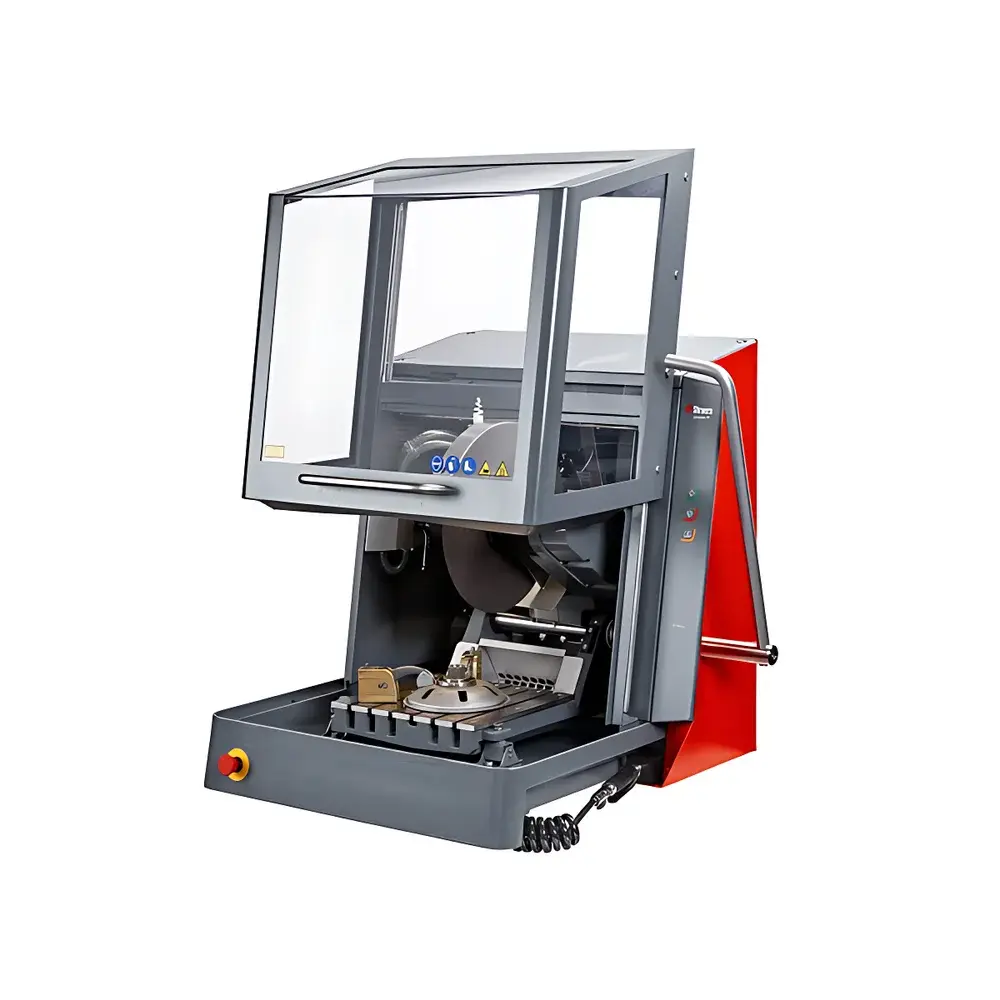
Struers Labotom-20 Manual Precision Cutting System
| Brand | Struers |
|---|---|
| Origin | Denmark |
| Model | Labotom-20 |
| Cutting Wheel Diameter | 250 mm or 350 mm |
| Maximum Sample Dimensions | 62 mm × 250 mm (2.5″ × 9.8″) |
| Compliance | CE, ISO 12100, EN 60204-1 |
Overview
The Struers Labotom-20 is a manually operated, benchtop precision cutting system engineered for reproducible, high-integrity sample sectioning in metallurgical, materials science, and failure analysis laboratories. It operates on the principle of abrasive wheel cutting under controlled coolant delivery—optimized for minimizing thermal distortion and mechanical damage to microstructures. Unlike semi-automated or CNC-based systems, the Labotom-20 prioritizes operator control, tactile feedback, and rapid setup without programming overhead. Its rigid cast-iron frame, precision-machined guideways, and balanced handwheel mechanism ensure consistent feed force and directional stability during manual advancement. Designed for routine use in QA/QC labs, R&D facilities, and academic core instrumentation centers, it delivers deterministic cut quality across heterogeneous material classes—including ferrous and non-ferrous alloys, ceramics, composites, and additively manufactured components—without requiring specialized operator certification.
Key Features
- Robust mechanical architecture with vibration-damped base and hardened steel guide rails for long-term dimensional stability and repeatable cut geometry.
- Fixed-position coolant nozzle aligned coaxially with the cutting plane—eliminates misalignment-induced thermal gradients and ensures uniform wheel lubrication and debris removal during operation.
- Three-button intuitive interface (START / STOP / FLUSH) enabling immediate machine response with no learning curve; compliant with ISO 13857 safety clearance requirements for manual control stations.
- Large cutting table featuring standardized 10 mm T-slots for modular fixture integration—supports custom clamping solutions, multi-sample holders, and extended-length workpiece adapters (optional).
- Integrated flush gun with adjustable flow rate and ergonomic trigger design, coupled with oversized drain tray and sloped basin geometry to accelerate post-cut cleanup and reduce downtime between samples.
- Tool-free wheel change mechanism compatible with standard 250 mm (10″) and 350 mm (14″) abrasive wheels—accommodates both resin-bonded and metal-bonded diamond or silicon carbide variants per ASTM E3–22 guidelines.
Sample Compatibility & Compliance
The Labotom-20 accepts specimens up to 62 mm in height and 250 mm in length, supporting cross-sectional, longitudinal, and angled cuts across irregular geometries including rods, tubes, castings, and welded joints. Its low-speed, high-torque cutting configuration minimizes chatter and edge chipping in brittle phases (e.g., intermetallics, oxides), preserving integrity for subsequent mounting, grinding, polishing, and microscopic evaluation. The system conforms to CE marking requirements under the Machinery Directive 2006/42/EC and meets electromagnetic compatibility standards per EN 61000-6-2/6-4. All safety interlocks—including emergency stop circuitry, guard position monitoring, and wheel cover presence detection—are validated per EN ISO 13857 and EN 954-1 Category 3 architecture. Documentation includes full EU Declaration of Conformity and risk assessment report traceable to ISO 12100:2012.
Software & Data Management
As a manually operated instrument, the Labotom-20 does not incorporate embedded firmware or digital control logic. However, its mechanical repeatability supports GLP-compliant documentation workflows when integrated into laboratory information management systems (LIMS). Operators may log cutting parameters—including wheel type, coolant composition, feed rate estimation, and specimen ID—via structured paper-based or electronic forms aligned with ISO/IEC 17025:2017 clause 7.5.2. Struers provides optional digital record templates compatible with common LIMS platforms and audit-ready maintenance logs that satisfy FDA 21 CFR Part 11 requirements for handwritten entries when paired with qualified electronic signature procedures.
Applications
- Preparation of metallographic specimens for optical microscopy (OM) and scanning electron microscopy (SEM) analysis per ASTM E3, ISO 16071, and EN 10365.
- Sectioning of coated components (e.g., thermal barrier coatings, PVD/CVD layers) for interface integrity assessment and thickness measurement.
- Cutting of additive manufacturing build plates and lattice structures where minimal heat input and mechanical stress are critical to preserve as-built microstructure.
- Routine quality assurance sampling in foundries, forging shops, and heat treatment facilities—supporting incoming inspection, in-process verification, and final release testing.
- Educational use in undergraduate and graduate metallurgy laboratories due to its transparency of operation, mechanical simplicity, and alignment with ISO/IEC 17025 pedagogical training objectives.
FAQ
Is the Labotom-20 suitable for cutting ceramic or tungsten carbide samples?
Yes—when equipped with appropriate diamond-impregnated wheels and optimized coolant flow, it achieves clean, low-damage sectioning of hard and brittle materials without microcracking.
Can the machine be upgraded to semi-automatic mode?
No—the Labotom-20 is purpose-built as a manual system; Struers offers the Accutom series for motorized feed and programmable cycles.
What coolant types are compatible with the integrated delivery system?
Water-soluble coolants, glycol-based emulsions, and synthetic formulations meeting ISO 6743-7 classification are supported; avoid chlorinated or highly alkaline fluids to prevent corrosion of aluminum components.
Does Struers provide validation documentation for GMP environments?
Yes—IQ/OQ protocols, calibration certificates for torque and positional repeatability, and material traceability reports for structural components are available upon request.
How often does the coolant nozzle require maintenance?
Inspection and cleaning are recommended after every 20 operating hours; nozzle alignment verification is part of the annual preventive maintenance service package.



