
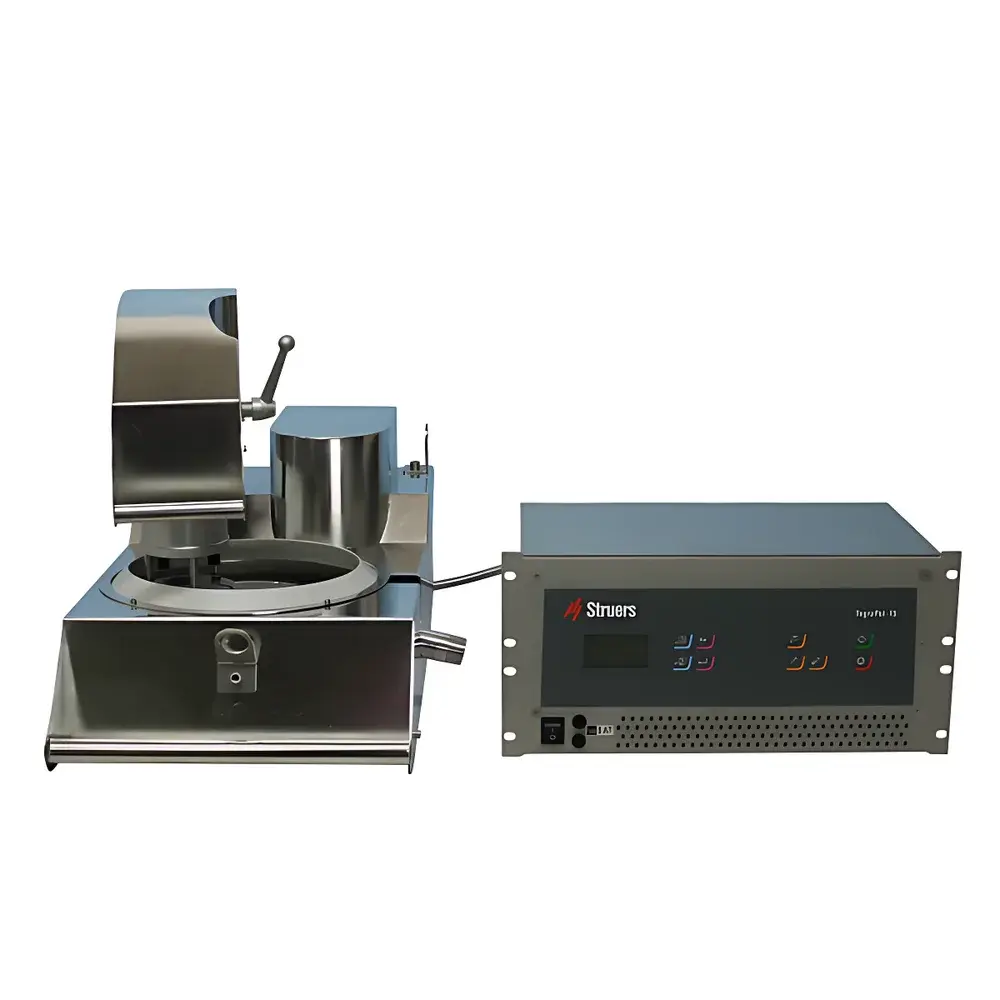
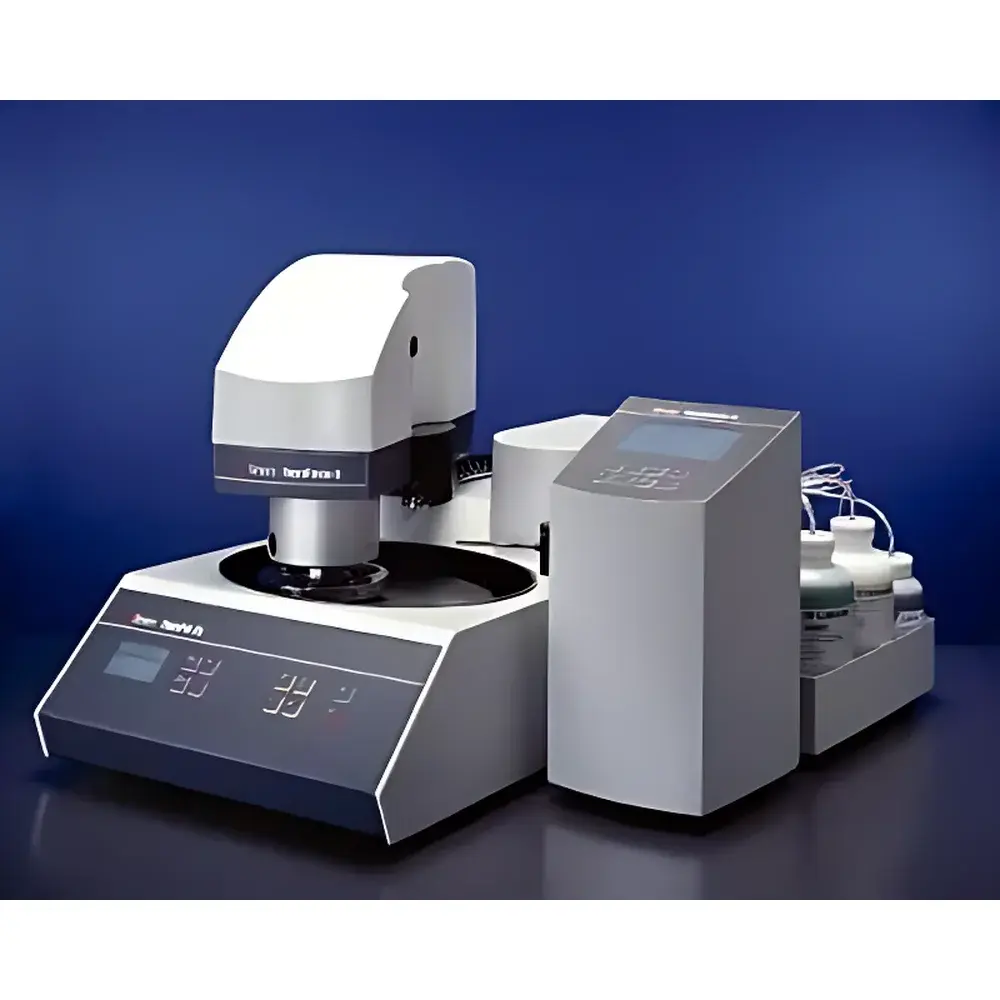
Struers TegraSystem Hot Cell Sample Preparation System
| Brand | Struers |
|---|---|
| Origin | Denmark |
| Model | TegraSystem |
| Grinding/Polishing Disc Count | 1 |
| Disc Diameter | 200 mm (8") |
| Rotational Speed Range | 40–600 rpm |
| Construction Material | Stainless Steel and Anodized Aluminum Cabinet |
| Remote Operation Interface | Touch Panel with Integrated Control Logic |
| Modular Consumable Tray | Removable and Decontaminable |
| Maintenance Access | Full Frontal & Top Serviceability for Motor, Drive Belt, and Fluid Lines |
Overview
The Struers TegraSystem is a purpose-engineered hot cell-compatible sample preparation system designed for safe, precise, and operator-independent metallographic processing of radioactive specimens. Built on Struers’ decades-long expertise in automated materials preparation, the TegraSystem operates under strict ALARA (As Low As Reasonably Achievable) principles by eliminating direct human contact during grinding, polishing, and cleaning stages. Its core architecture employs a single-motor, single-disc rotational platform governed by a closed-loop speed control system—ensuring consistent shear stress application across abrasive and polishing media. The system leverages Couette-flow hydrodynamics during slurry delivery and integrates real-time torque feedback to maintain process repeatability across variable specimen geometries and hardness profiles. Designed exclusively for integration into shielded nuclear laboratories, gloveboxes, or remote-handling hot cells, the TegraSystem complies with IAEA SSG-46 guidance for radiological containment and meets structural requirements outlined in ANSI N13.1-2022 for equipment installed in high-background radiation environments.
Key Features
- Single 200 mm (8″) magnetic-mount grinding/polishing disc enables rapid tooling changeover without mechanical fasteners—critical for minimizing cross-contamination between radioactive samples.
- Variable-speed drive (40–600 rpm) with digital encoder feedback ensures reproducible material removal rates across coarse grinding, fine grinding, and final polishing stages.
- Touch-panel HMI with password-protected user levels supports full remote operation via fiber-optic or hardened Ethernet link; interface includes programmable step sequences, time-based dwell control, and emergency stop confirmation protocols.
- Modular consumable tray—constructed from electropolished 316L stainless steel—is fully removable, autoclavable, and compatible with gamma irradiation sterilization (up to 25 kGy), facilitating compliant waste segregation and decontamination.
- Cabinet structure utilizes non-porous, passivated stainless steel and anodized aluminum surfaces with seamless welds and zero crevice design to prevent radionuclide entrapment and simplify wipe-testing per ISO 20553:2022.
- Front-access service architecture allows robotic arm intervention for motor replacement, belt tensioning, and fluid line servicing—eliminating need for manual entry into contaminated zones.
Sample Compatibility & Compliance
The TegraSystem accommodates specimens up to 100 mm in diameter and 50 mm in height—including fuel cladding segments, irradiated zirconium alloys, activated stainless steels, and ceramic nuclear fuels. It supports all standard Struers MD-Series consumables (e.g., MD-Allegro, MD-Largo, MD-Chem, and MD-Nap) as well as third-party ISO 9276-2–compliant abrasives and colloidal silica suspensions. System validation documentation includes traceable calibration certificates for rotational speed and applied load (where applicable), and it conforms to GLP audit requirements per OECD Series on Principles of Good Laboratory Practice. Radiation tolerance testing confirms functional integrity at cumulative doses exceeding 10⁶ Gy (SiO₂-equivalent), satisfying qualification criteria for Category B hot cell deployment per IEC 61000-4-20.
Software & Data Management
The embedded control firmware (v3.2+) logs all operational parameters—including disc speed, elapsed time per step, slurry flow duration, and HMI interaction timestamps—with immutable, encrypted storage on internal industrial-grade SSD. Audit trails comply with FDA 21 CFR Part 11 requirements through dual-role electronic signatures, session lockout after 5 minutes of inactivity, and cryptographic hash verification of log integrity. Optional Struers LabManager™ integration enables centralized fleet monitoring, predictive maintenance alerts based on motor current harmonics analysis, and export of raw process data in ASTM E1357-compliant CSV format for regulatory submission.
Applications
- Post-irradiation examination (PIE) of LWR and Gen-IV reactor fuel pins and structural components.
- Preparation of alpha-emitting actinide-bearing samples for SEM-EDS, EPMA, and TEM lamella extraction.
- Routine quality control of nuclear-grade welds and cladding materials under ASME Section III, Division 1, NB-2000 requirements.
- Radiochemical separation support—producing planar, scratch-free surfaces for alpha spectrometry source preparation.
- Decommissioning waste characterization, including concrete-embedded metallic fragments and spent ion-exchange resins.
FAQ
Can the TegraSystem be integrated with existing hot cell manipulators?
Yes—the system features standardized M6 and ¼”-20 threaded mounting points on base and cabinet, aligned with ISO 8396-2 robotic interface specifications. All critical actuators are accessible within ±15° of vertical approach angle.
Is validation support provided for GMP-regulated nuclear facilities?
Struers delivers IQ/OQ documentation packages aligned with ASTM E2500-13 and EU Annex 15, including radiation-hardened sensor calibration records and traceable uncertainty budgets for speed and timing parameters.
What is the maximum allowable ambient dose rate at the cabinet surface during operation?
The TegraSystem maintains structural integrity and functional performance at continuous dose rates up to 10 Sv/h at 10 cm distance, verified per IEC 62582-2 ed. 2.0 (2020).
Does the system support automated slurry dispensing with concentration feedback?
While the base configuration uses gravity-fed or peristaltic delivery, optional Struers AutoDispense™ module adds conductivity-based real-time slurry concentration monitoring and closed-loop replenishment control.
How often does the drive belt require replacement under typical PIE lab usage?
Under nominal 8-hour/day operation with 200–400 rpm average speed, the aramid-reinforced polyurethane belt achieves ≥12,000 operating hours before scheduled replacement—validated via accelerated aging per ASTM D412.



