
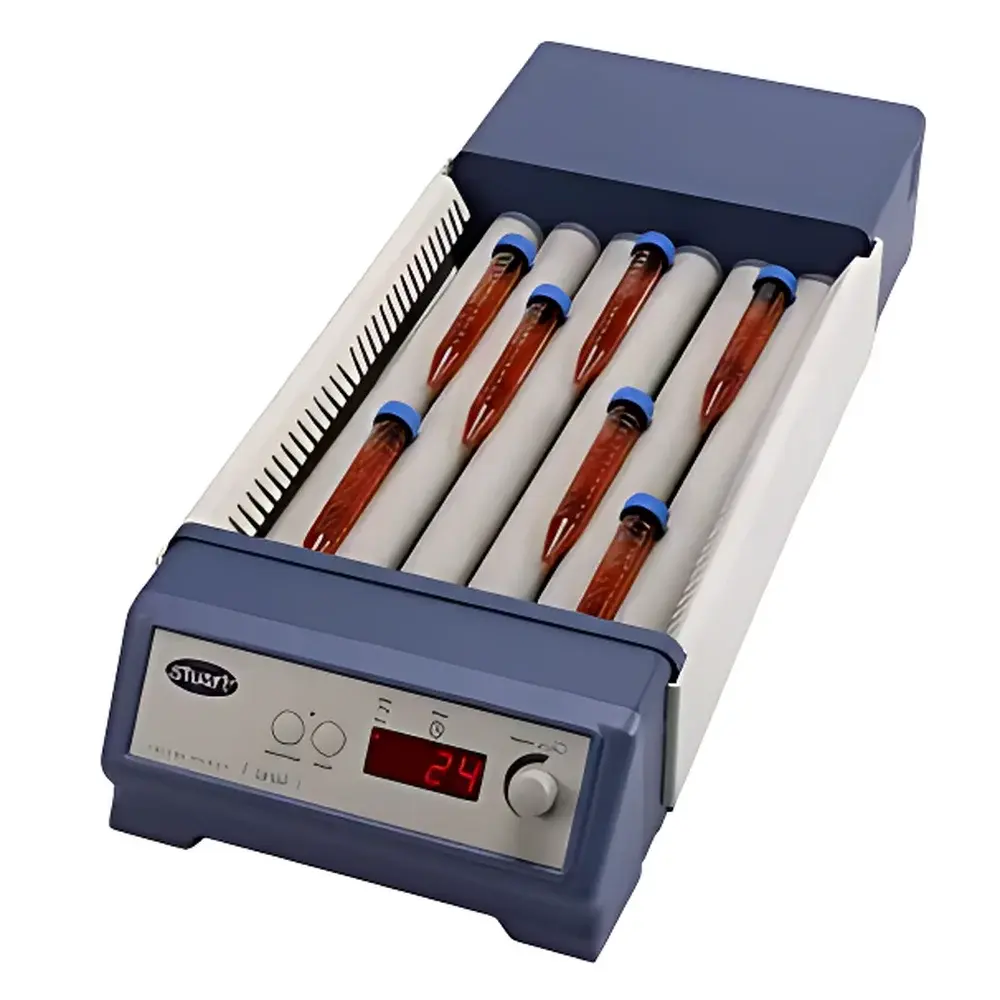
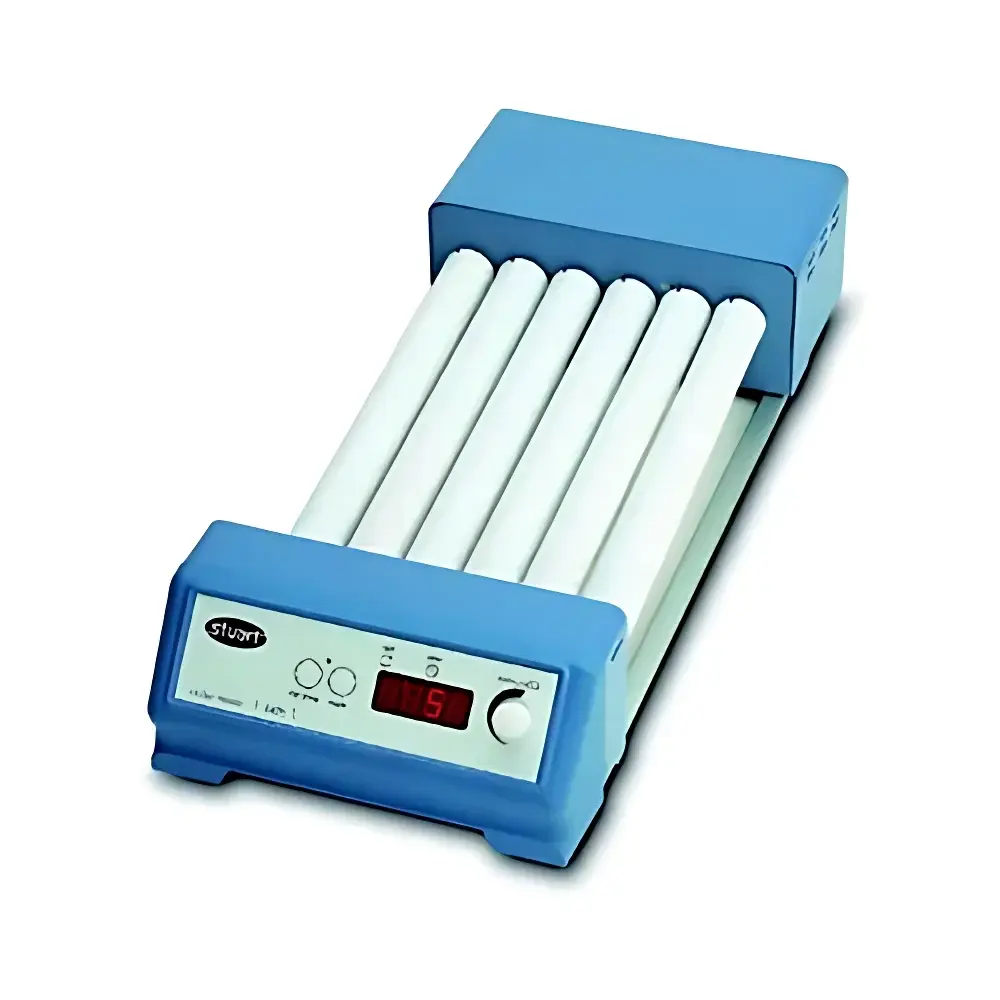
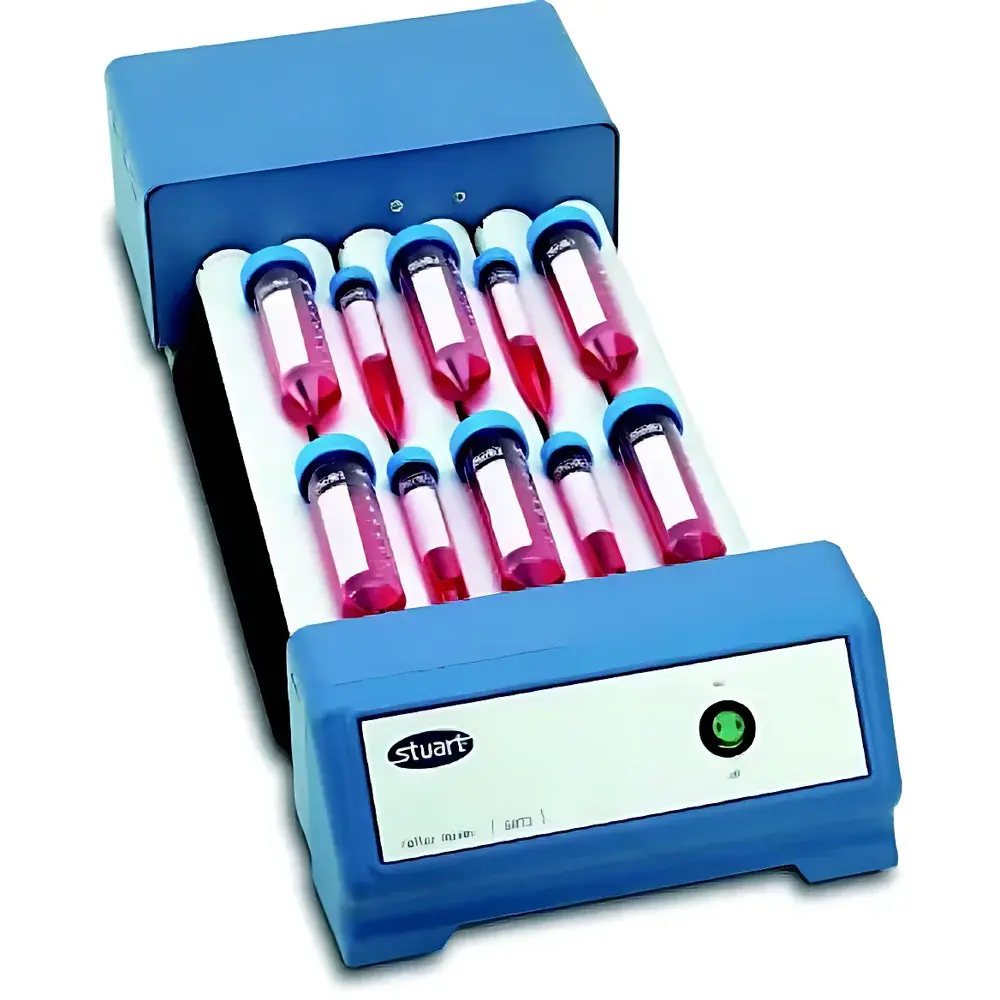
Stuart SRT6 and SRT6D Orbital Rocker Mixers
| Brand | Stuart |
|---|---|
| Origin | United Kingdom |
| Model | SRT6D |
| Speed Range | 5–60 rpm (SRT6D), 33 rpm fixed (SRT6) |
| Oscillation Amplitude | 16 mm |
| Number of Rollers | 6 |
| Max Load Capacity | 5 kg |
| Timer | Integrated digital timer (1 s – 9 h, SRT6D only) |
| Operating Temperature Range | 4–60 °C |
| Max Relative Humidity | 80 % |
| Roller Dimensions (L × Ø) | 340 × 30 mm |
| External Dimensions (W × D × H) | 565 × 240 × 110 mm |
| Net Weight | 5.1 kg |
| Power Supply | 230 V, 50 Hz, 50 W |
| IP Rating | IP20 |
| Control Type | Analog on/off (SRT6), Digital speed & timer interface (SRT6D) |
| Dual-mode Operation | Orbital rocking + gentle vertical vibration |
Overview
The Stuart SRT6 and SRT6D Orbital Rocker Mixers are precision-engineered laboratory instruments designed for low-shear, non-aerating sample homogenization. Unlike vortexers or orbital shakers that induce turbulent agitation, these mixers operate on a dual-mode principle—combining controlled orbital rocking with subtle vertical vibration—to ensure uniform suspension of sensitive biological and viscous samples without foaming, denaturation, or phase separation. This makes them especially suitable for applications where oxygen exposure must be minimized, such as blood bank processing, antibody-antigen incubation, cell culture maintenance, and preparation of high-viscosity reagents or particulate suspensions. Both models feature six parallel rollers arranged in a compact footprint, enabling efficient use of benchtop, cold room, or incubator space. Their robust polymer housing, chemical-resistant roller surfaces, and integrated drip tray support routine cleaning and long-term reliability under GLP-compliant workflows.
Key Features
- Dual-action mixing mechanism: Synchronized orbital rocking (±8° tilt) plus 16 mm peak-to-peak vertical oscillation ensures thorough yet gentle sample dispersion.
- Compact six-roller architecture: Optimized for space-constrained environments; compatible with standard test tubes (10–50 mL), centrifuge tubes, culture flasks (up to 250 mL), and glass vials.
- SRT6D model includes fully programmable digital control: Adjustable speed from 5 to 60 rpm in 1-rpm increments and a built-in timer spanning 1 second to 9 hours with auto-shutdown.
- SRT6 model offers simplified analog operation: Single-pole toggle switch for immediate start/stop at fixed 33 rpm—ideal for standardized protocols requiring reproducible agitation intensity.
- Environmental resilience: Certified for continuous operation within temperature-controlled enclosures (4–60 °C) and ambient humidity up to 80 % RH; no condensation-related failure observed during extended cold-room use.
- Modular stacking capability: Optional accessory kit enables vertical stacking of multiple units to maximize vertical lab space without compromising airflow or stability.
- IP20-rated enclosure: Dust-protected design with smooth, non-porous surfaces facilitates wipe-down decontamination between runs—critical for cross-contamination-sensitive workflows.
Sample Compatibility & Compliance
These mixers accommodate a broad range of container geometries and viscosities—from whole blood units and serum/plasma aliquots to hydrogel precursors and ceramic slurries. The absence of aggressive shear forces preserves erythrocyte integrity and prevents bubble formation in protein-rich media. Units comply with IEC 61010-1:2010 for electrical safety in laboratory equipment and meet essential requirements of the UKCA marking framework. While not intrinsically rated for sterile environments, their cleanable construction supports ISO 13485-aligned quality systems when deployed in QC/QA labs handling medical diagnostics or biopharmaceutical intermediates. No firmware or hardware modifications post-manufacture are permitted—particularly regarding mode switching between dual-action (rocking + vibration) and rolling-only configurations (e.g., SRT6ROLL/SRT6DROLL variants).
Software & Data Management
The SRT6D incorporates embedded microcontroller logic with non-volatile memory for retaining last-used settings across power cycles. Though it lacks network connectivity or PC interface ports, its timer functionality satisfies traceability needs under FDA 21 CFR Part 11 Annex 11 guidelines when paired with manual logbook entries or LIMS-integrated run documentation. All operational parameters—including elapsed time, set speed, and activation timestamp—are visible via LED display. No proprietary software installation is required; calibration verification is performed via external tachometer measurement per ASTM E2917-22 (Standard Practice for Verification of Speed Accuracy in Laboratory Agitators).
Applications
- Blood banking: Gentle resuspension of sedimented RBCs prior to crossmatching or transfusion preparation.
- Clinical microbiology: Homogenization of sputum or stool specimens prior to nucleic acid extraction.
- Pharmaceutical development: Blending of ointment bases, suspensions, and emulsions without air entrapment.
- Academic research: Long-duration hybridization steps in Southern/Northern blotting protocols.
- Quality control: Uniform dispersion of reference standards in viscosity calibration workflows.
- Industrial R&D: Pre-mixing of catalyst slurries or pigment dispersions prior to rheological testing.
FAQ
Can the SRT6 or SRT6D be used inside a CO₂ incubator?
Yes—provided internal humidity remains below 80 % RH and temperature does not exceed 60 °C. Ventilation gaps around the unit must remain unobstructed to prevent localized overheating.
Is speed calibration traceable to national standards?
Speed accuracy is verified against NIST-traceable tachometers during factory acceptance testing; users may perform periodic checks using calibrated handheld optical tachometers per ASTM E2917-22.
What is the maximum tube diameter supported by the rollers?
Rollers accommodate cylindrical containers up to 30 mm outer diameter; conical tubes require centering aids to prevent lateral slippage during extended runs.
Does the drip tray accommodate all common spill volumes?
The integrated polypropylene tray captures up to 50 mL of incidental overflow; for high-volume protocols, secondary containment trays are recommended.
Are replacement rollers available as spare parts?
Yes—Stuart supplies OEM roller assemblies (P/N SRT-ROLLER-KIT) with identical 340 × 30 mm dimensions and chemical resistance profile.



