
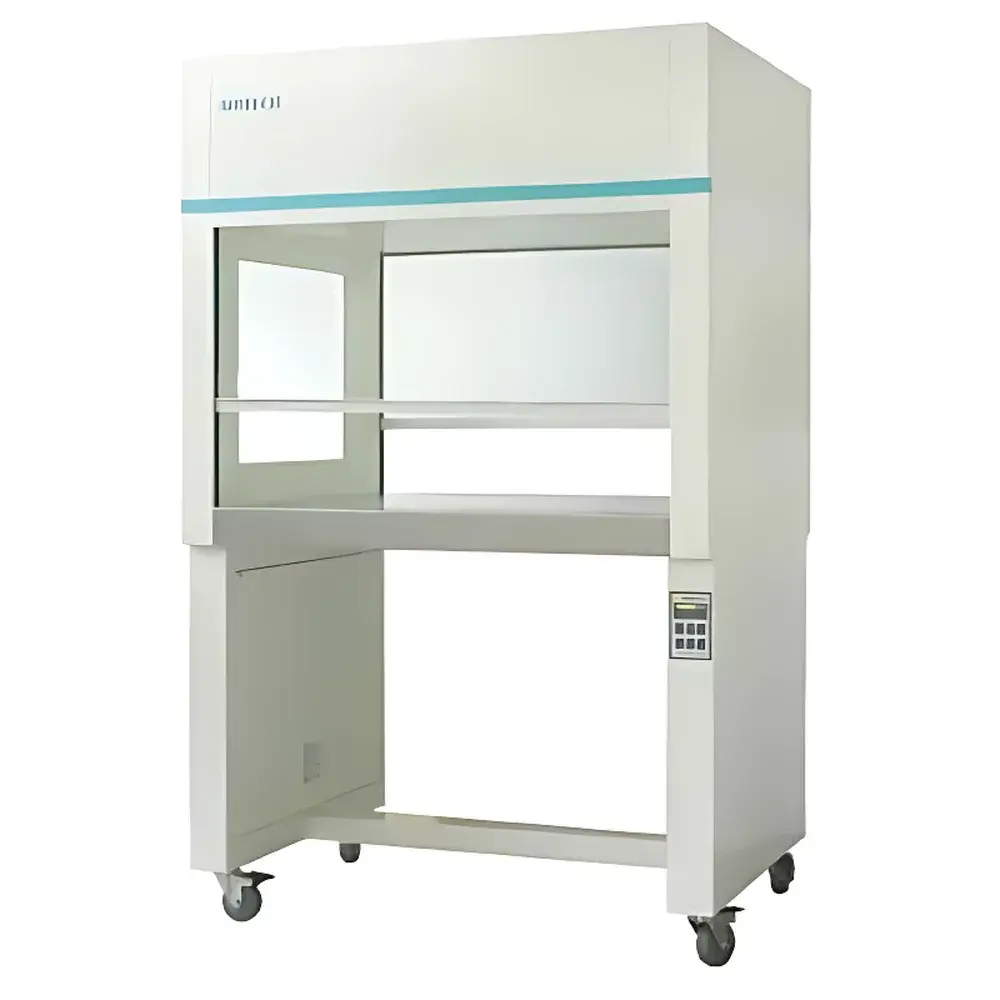
SuJing Antai SW-CJ-2FD Vertical Laminar Flow Clean Bench
| Brand | SuJing Antai |
|---|---|
| Origin | Jiangsu, China |
| Manufacturer Type | Authorized Distributor |
| Country of Origin | China |
| Model | SW-CJ-2FD |
| Instrument Category | Vertical Laminar Flow Clean Bench |
| Cleanliness Class | ISO Class 5 (equivalent to Fed. Std. 209E Class 100) |
| Noise Level | ≤62 dB(A) |
| User Capacity | Dual-operator, single-face configuration |
| Airflow Pattern | Vertical downward laminar flow |
| Average Air Velocity | 0.3–0.6 m/s (adjustable) |
| Vibration (Half-Peak) | ≤5 µm |
| Illuminance | ≥300 lx |
| Power Supply | AC 220 V, 50 Hz, Single-phase |
| Max. Power Consumption | 0.8 kW |
| Net Weight | 350 kg |
| Work Area Dimensions (W×D×H) | 1360 × 700 × 520 mm |
| Overall Dimensions (W×D×H) | 1480 × 720 × 1600 mm |
| Microbial Count | ≤0.5 CFU/plate·hour (90 mm Petri dish) |
| Work Surface Material | Imported stainless steel (AISI 304) |
Overview
The SuJing Antai SW-CJ-2FD is a vertically oriented laminar flow clean bench engineered for reliable particulate and microbial control in non-sterile but critical environmental applications. It operates on the principle of unidirectional, HEPA-filtered vertical airflow—air is drawn through a pre-filter, conditioned, then passed through a high-efficiency particulate air (HEPA) filter (≥99.99% @ 0.3 µm) before descending uniformly across the work surface at a controlled velocity (0.3–0.6 m/s). This laminar flow displaces airborne contaminants away from the operator and sample zone, maintaining an ISO Class 5 (Fed. Std. 209E Class 100) environment within the work area. Designed for routine aseptic handling—not terminal sterilization—the SW-CJ-2FD serves as a primary containment solution for applications where personnel protection is not required, but product or process integrity must be preserved against ambient particulates and viable microorganisms.
Key Features
- Vertical laminar airflow architecture with adjustable fan speed via soft-touch voltage control, enabling precise maintenance of optimal working velocity under varying filter loading conditions.
- Dual-operator, single-face configuration (SW-CJ-2FD) with a fully enclosed front sash and side panels—minimizing cross-contamination risk and reducing external draft interference.
- Work surface fabricated from imported AISI 304 stainless steel: corrosion-resistant, non-porous, and compatible with standard laboratory disinfectants including 70% ethanol and sodium hypochlorite solutions.
- Integrated LED illumination system delivering ≥300 lx uniformity across the entire work area—compliant with ISO 14644-1 and EU GMP Annex 1 lighting recommendations for visual inspection tasks.
- Low-noise operation (≤62 dB[A] at 1 m) achieved via vibration-damped fan assembly and acoustic insulation—suitable for shared laboratory environments requiring sustained user comfort.
- Structural stability ensured by a rigid steel frame and reinforced base; total mass of 350 kg contributes to minimal operational vibration (≤5 µm half-peak amplitude), supporting sensitive manual manipulations.
Sample Compatibility & Compliance
The SW-CJ-2FD supports open-vessel handling of biological samples, pharmaceutical intermediates, cell culture reagents, and chemical standards where environmental cleanliness is essential but full biosafety cabinet-level containment is unnecessary. It complies with ISO 14644-1:2015 for cleanroom classification and meets the performance criteria defined in Fed. Std. 209E (Class 100) for airborne particle concentration. While not certified to NSF/ANSI 49 or EN 12469, its design aligns with general laboratory good practice (GLP) and supports workflows referenced in USP , ISO 13408-1, and EU GMP Annex 1 for aseptic processing zones. Routine validation—including airflow velocity mapping, particle counting (via ISO 14644-3 protocols), and microbial settle plate assays (≤0.5 CFU/plate·hour)—is recommended per institutional SOPs.
Software & Data Management
The SW-CJ-2FD is a standalone mechanical system without embedded digital controllers or data logging capabilities. All operational parameters—including fan voltage, illumination status, and power input—are manually monitored and recorded by users in paper-based or electronic lab notebooks (ELN). For laboratories operating under FDA 21 CFR Part 11 or EU Annex 11 requirements, integration into broader facility monitoring systems (e.g., BMS or EMS) may be implemented externally using third-party sensors (e.g., calibrated anemometers, particle counters, or temperature/humidity transmitters) with audit-trail-enabled data acquisition software.
Applications
- Preparation of microbiological media and sterile diluents in QC laboratories.
- Aseptic transfer of bacterial cultures, fungal spores, or yeast suspensions in academic and industrial microbiology.
- Weighing and dispensing of active pharmaceutical ingredients (APIs) during non-sterile formulation development.
- Handling of sensitive optical components or precision electronics where electrostatic discharge (ESD)-safe variants are not required.
- Chemical synthesis steps involving air-sensitive reagents under inert gas purging (when used in conjunction with local nitrogen/vacuum manifolds).
- Cell passaging and medium exchange in non-sterile tissue culture workflows where biosafety level 1 (BSL-1) agents are handled.
FAQ
Is the SW-CJ-2FD suitable for handling hazardous or pathogenic biological materials?
No. This unit provides product protection only and lacks inward airflow, negative pressure containment, or exhaust filtration. It must not be used for BSL-2 or higher agents.
What HEPA filter specifications does it support?
It accommodates standard 610 × 610 × 50 mm (24 × 24 × 2 in) HEPA filters with minimum efficiency of 99.99% at 0.3 µm (EN 1822 H14 or equivalent). Filter replacement intervals depend on usage frequency and ambient air quality.
Can it be validated for ISO Class 5 compliance?
Yes—validation requires periodic testing per ISO 14644-3:2019, including airflow uniformity, particle count (0.5 µm and larger), and microbial settle plate assessment under operational conditions.
Does it meet electrical safety standards for international use?
The unit is rated for AC 220 V / 50 Hz operation. For use outside China, a certified step-down transformer and local regulatory certification (e.g., CE, UL, or PSE) must be obtained separately.
What maintenance is required beyond HEPA filter replacement?
Routine cleaning of stainless steel surfaces with approved disinfectants, pre-filter replacement every 3–6 months, and annual verification of airflow velocity and illumination intensity are recommended per manufacturer guidelines.



