
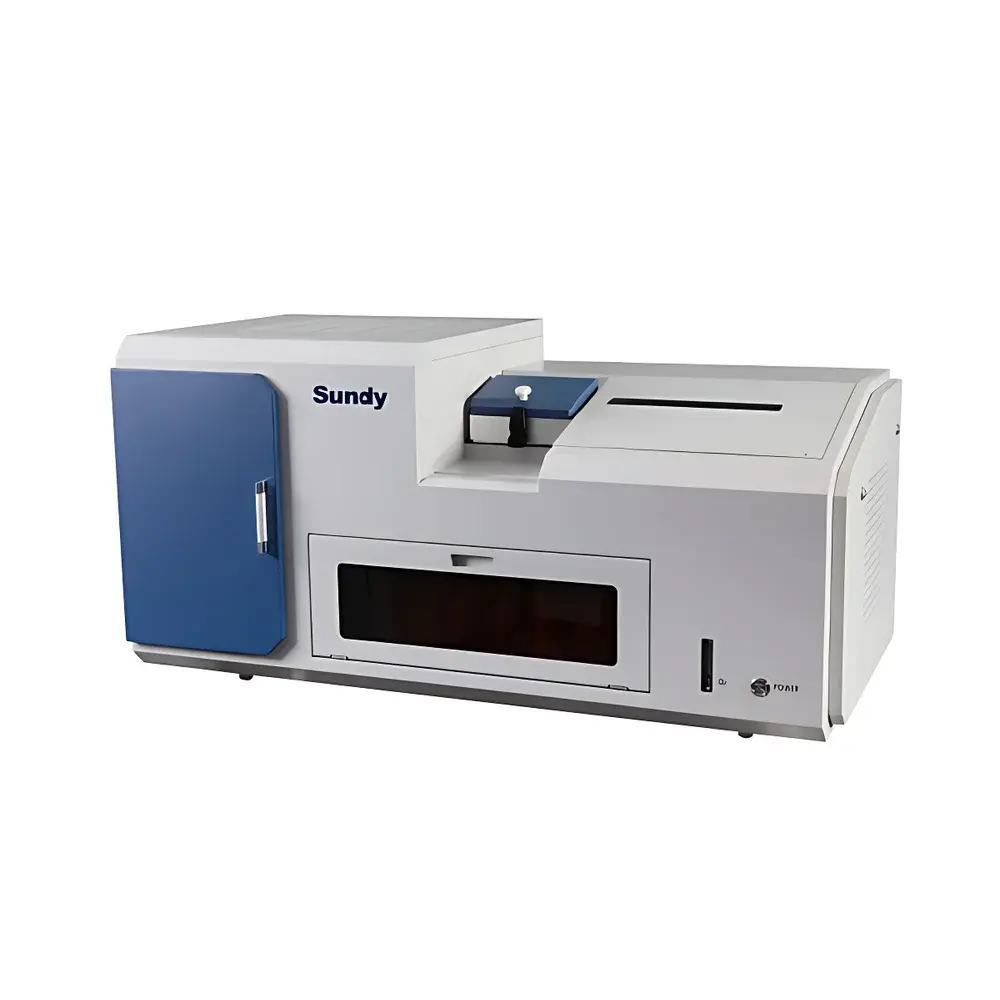
Sundys SDFCl3000 Automated Fluorine and Chlorine Analyzer
| Brand | Sundy |
|---|---|
| Origin | Hunan, China |
| Model | SDFCl3000 (dual-channel F/Cl) / SDF3000 (F-only) / SDCl3000 (Cl-only) |
| Measurement Range | F: 50–5000 ppm, Cl: 50–5000 ppm |
| Sample Mass | 0.5 g (typical) |
| Combustion Temperature | 1100 °C ±5 °C |
| Digestion & Collection Time | ~30 min (incl. rinse cycle) |
| Analysis Time per Solution | ~5 min (F), ~5 min (Cl) |
| Power Consumption | ≤4 kW |
| Voltage | AC 220 V ±10 %, 50 Hz ±1 Hz |
| Dimensions (L×W×H) | 1160 × 550 × 570 mm |
| Weight | ~75 kg |
| Compliance | GB/T 3558-2014, GB/T 4633-2014 |
Overview
The Sundys SDFCl3000 is a fully automated high-temperature combustion–ion-selective electrode (ISE) analyzer engineered for precise, simultaneous quantification of fluorine and chlorine in solid heterogeneous matrices—primarily coal, coke, fly ash, geological samples, and industrial feedstocks. It operates on the principle of high-efficiency pyrohydrolysis: samples are combusted at 1100 °C in a controlled oxygen-rich atmosphere, converting bound fluorine and chlorine into volatile hydrogen halides (HF and HCl). These gases are swept through a quartz reaction tube, absorbed quantitatively into deionized water within a temperature-stabilized condensation chamber, and subsequently analyzed via dual-channel ion-selective electrodes calibrated in real time. This method eliminates manual titration, wet chemistry handling, and inter-laboratory variability associated with classical Schöniger or Parr bomb techniques—delivering trace-level accuracy (50–5000 ppm) with metrological traceability aligned to national standards GB/T 3558-2014 (chlorine) and GB/T 4633-2014 (fluorine).
Key Features
- True Dual-Channel Automation: Single-sample introduction yields independent, concurrent fluorine and chlorine results without re-injection or method switching—reducing turnaround time and cross-contamination risk.
- Integrated Cold-Condensation System: A Peltier-cooled absorption unit maintains collection solution temperature within ±1 °C across all runs, minimizing thermal drift in ISE response and ensuring consistent ion hydration state during measurement.
- Dead-Volume-Free Fluidic Architecture: Precision micro-pipetting and zero-dead-volume Teflon™-lined tubing eliminate carryover and memory effects; rinse cycles are algorithmically optimized per sample matrix using conductivity feedback.
- Self-Calibrating Electrode Management: On-board standard addition and slope verification routines execute prior to each batch, logging electrode sensitivity (mV/decade), asymmetry potential, and detection limit—fully auditable under GLP/GMP workflows.
- Robust High-Temperature Combustion Furnace: Silicon carbide heating elements and PID-controlled thermal zoning ensure stable 1100 °C operation with ±5 °C uniformity over 100+ hour service intervals.
Sample Compatibility & Compliance
The SDFCl3000 accepts solid samples up to 1.0 g (standardized at 0.5 g for coal per GB protocols), including air-dried, ground (<200 mesh), and homogenized materials. It accommodates high-ash coals, low-volatile bituminous samples, and chloride-rich fly ashes without modification. All hardware and software modules comply with ISO/IEC 17025:2017 requirements for testing laboratories, and analytical outputs meet data integrity criteria defined in FDA 21 CFR Part 11 when deployed with optional audit-trail-enabled software licensing. Method validation documentation—including precision (RSD <3.5% at 200 ppm), recovery (95–102%), and LOD/LOQ determination—is provided with instrument commissioning.
Software & Data Management
Control and reporting are managed via Sundys Analytical Suite v4.2—a Windows-based application supporting multi-user role permissions, electronic signatures, and configurable report templates (PDF/CSV/XLSX). Raw electrode potentials, temperature logs, gas flow rates, and calibration histories are stored in encrypted SQLite databases with automatic daily backup. The system supports LIMS integration via ASTM E1384-compliant HL7 messaging and includes built-in tools for uncertainty budgeting per GUM (JCGM 100:2008). Audit trails record every parameter change, result override, and user login with timestamp and IP address—enabling full forensic reconstruction during regulatory inspections.
Applications
- Coal quality control in power generation and coking plants (Cl-induced high-temperature corrosion mitigation)
- Environmental monitoring of fluorine emissions from aluminum smelters and phosphate fertilizer production
- Geochemical exploration for fluorite and halite deposits via bulk rock analysis
- QA/QC of activated carbon and catalyst supports where residual Cl compromises performance
- Research-grade halogen speciation studies in biomass ash and waste-derived fuels
FAQ
Does the SDFCl3000 require external cooling water?
No—its integrated thermoelectric condenser eliminates dependence on municipal water supply, reducing operational overhead and enabling deployment in remote or mobile labs.
Can the instrument analyze fluorine and chlorine separately if only one element is required?
Yes. Software allows selective activation of F-only (SDF3000 mode) or Cl-only (SDCl3000 mode) workflows while retaining identical hardware configuration and calibration logic.
How is method validation supported for ISO 17025 accreditation?
The system ships with a complete validation kit: CRM reference materials (NIST SRM 1632e coal), SOP templates, uncertainty calculation worksheets, and raw data export formats compatible with third-party statistical packages (e.g., Minitab, R).
What maintenance intervals are recommended for routine operation?
Quartz combustion tubes: replace every 500 analyses; ISE membranes: inspect weekly, replace quarterly; furnace insulation: verify annually via thermographic imaging. Full PM checklist is embedded in the software’s maintenance scheduler.




