
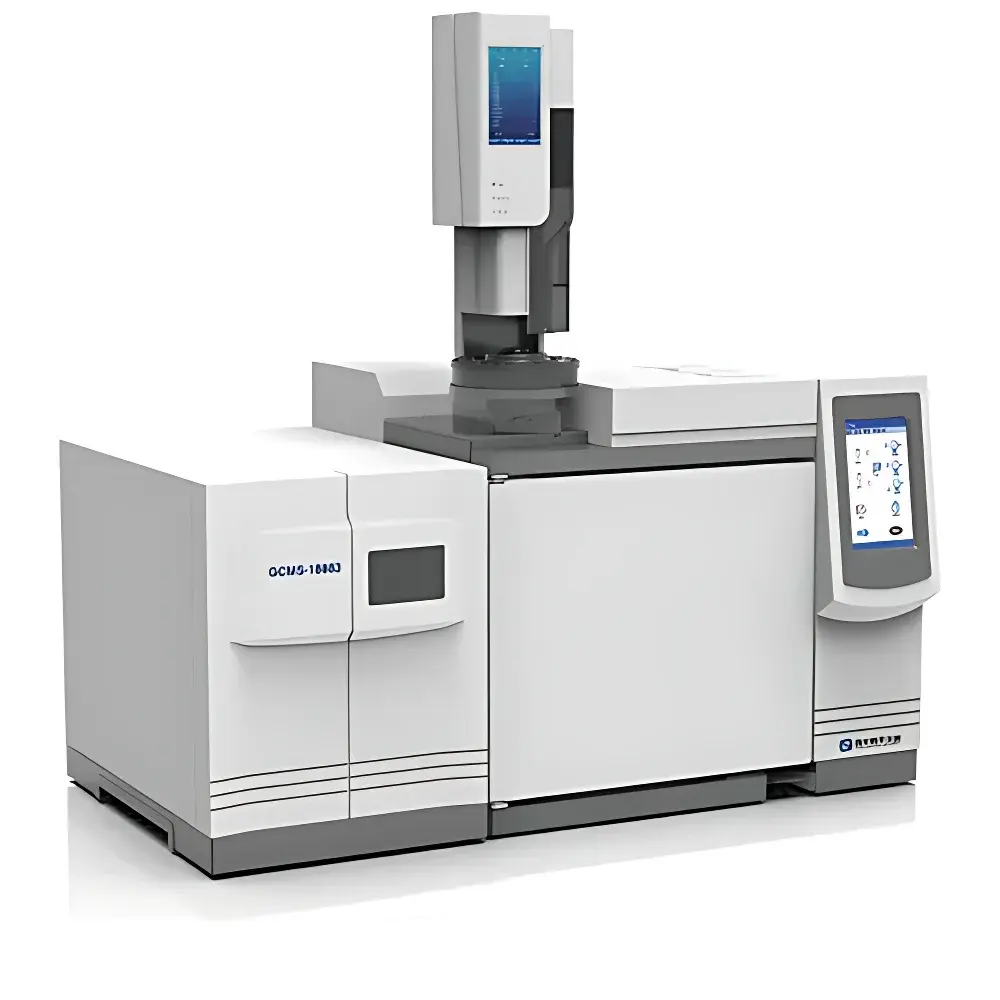
SUNNY HENGPING GCMS-18883 Gas Chromatography Mass Spectrometry System
| Brand | SUNNY HENGPING INSTRUMENT |
|---|---|
| Origin | Shanghai, China |
| Manufacturer Type | Original Equipment Manufacturer (OEM) |
| Instrument Type | Single Quadrupole Mass Spectrometer |
| GC Configuration | Conventional Capillary GC-MS |
| Mass Range | 1–1000 amu |
| Mass Resolution (FWHM) | ≥1200 (at m/z 502) |
| Sensitivity | ≥200:1 (Signal-to-Noise Ratio, S/N, for 1 pg OFN in Full Scan Mode) |
| Scan Speed | ≥10,000 u/s |
| Oven Ramp Rate | ≥80 °C/min |
| Pressure Control Accuracy | ±0.01 psi (EPC-controlled) |
Overview
The SUNNY HENGPING GCMS-18883 is a benchtop gas chromatography mass spectrometry (GC-MS) system engineered for routine environmental and regulatory compliance analysis. It integrates a high-stability capillary gas chromatograph with a single quadrupole mass spectrometer operating on the principle of mass-filtering ion transmission under radiofrequency (RF) and direct current (DC) fields. The instrument employs electron ionization (EI) as the standard ionization mode and supports full-scan, selected ion monitoring (SIM), and autotune acquisition modes—enabling qualitative identification, quantitative determination, and method validation across volatile and semi-volatile organic compounds (VOCs and SVOCs). Designed specifically for laboratories conducting indoor air quality (IAQ), drinking water, soil extract, and industrial emission testing, the GCMS-18883 delivers robust performance under extended operational cycles while maintaining analytical reproducibility across multi-day batch runs.
Key Features
- Optimized Quadrupole Design: Features a custom-fabricated, elongated rod geometry quadrupole manufactured to ISO 9001-certified precision machining standards. This configuration enhances mass axis stability (35% compared to conventional short-rod geometries.
- Curved Repeller Electrode: A proprietary curved repeller electrode replaces traditional planar designs to generate a more uniform electric field distribution in the ion source region, increasing ion extraction efficiency and reducing space-charge effects—contributing directly to improved signal-to-noise ratio and long-term sensitivity retention.
- Digital Electronic Pressure Control (EPC): Fully integrated EPC module regulates carrier gas flow (He or H2) and inlet pressure with ±0.01 psi accuracy across temperature gradients from 35–350 °C. All pneumatic parameters are digitally logged and traceable per GLP/GMP requirements.
- High-Speed Scanning Architecture: Supports scan rates up to 10,000 u/s without sacrificing resolution or dynamic range, enabling narrow peak capture (e.g., fast-eluting VOCs in EPA Method TO-17 or ISO 16000-6 workflows) and reliable deconvolution of co-eluting analytes.
- Thermal Management System: GC oven achieves ramp rates ≥80 °C/min with <±0.1 °C isothermal stability, ensuring precise retention time locking (RTL) and inter-laboratory method transfer compatibility.
Sample Compatibility & Compliance
The GCMS-18883 is validated for use with solid-phase microextraction (SPME), thermal desorption (TD), purge-and-trap (P&T), and direct liquid injection protocols. It complies with key international test standards including GB/T 18883–2022 (Indoor Air Quality), GB/T 5750.8–2023 (Drinking Water – Organic Contaminants), EPA Methods 524.4, 8260D, and 8270E, and ISO 16000-6:2011 (Indoor Air – Determination of Volatile Organic Compounds). Its hardware architecture and firmware support audit trail functionality, electronic signatures, and user-access-level permissions aligned with FDA 21 CFR Part 11 and EU Annex 11 requirements when operated with compliant LIMS integration.
Software & Data Management
Controlled via SUNNY HENGPING’s MS Navigator™ software suite (v3.2+), the system provides method development wizards, automated calibration routines (tune, mass calibration, sensitivity check), spectral library search (NIST 2022, Wiley 11th Ed.), and customizable report templates exportable in PDF, CSV, and XML formats. All raw data files (.RAW) are stored with embedded metadata—including instrument configuration, operator ID, timestamp, and environmental sensor logs—ensuring full traceability. Software supports remote diagnostics, scheduled maintenance alerts, and secure network deployment in multi-user laboratory environments.
Applications
- Quantitative analysis of 22 target VOCs in indoor air per GB/T 18883–2022, including benzene, toluene, xylene isomers, chlorobenzene, styrene, and 1,4-dichlorobenzene.
- Multi-residue screening of halogenated hydrocarbons (e.g., chloroform, carbon tetrachloride, trichloroethylene) and oxygenates (e.g., ethyl acetate, butyl acetate) in surface water and groundwater samples.
- Verification of cleaning agent residuals and solvent impurities in pharmaceutical excipients per ICH Q3C guidelines.
- Identification and quantification of plasticizer migrants (e.g., phthalates) in food contact materials using SIM mode with isotopically labeled internal standards.
- Support for method validation studies including linearity (r² ≥0.999), LOD/LOQ determination, precision (RSD ≤5% intra-day, ≤8% inter-day), and recovery (85–115%) per ISO/IEC 17025:2017 requirements.
FAQ
What regulatory standards does the GCMS-18883 support out-of-the-box?
The system includes pre-configured methods and calibration protocols for GB/T 18883–2022, GB/T 5750.8–2023, and EPA TO-17, with optional add-ons for USP , ASTM D5845, and ISO 16000 series.
Is the quadrupole mass analyzer certified to any international metrological standards?
Yes—the quadrupole assembly is manufactured under ISO/IEC 17025-accredited dimensional control processes and verified against NIST-traceable mass standards during final system qualification.
Can the GCMS-18883 be integrated into an existing LIMS environment?
It supports ASTM E1482-compliant data exchange via ODBC and HL7 interfaces; full 21 CFR Part 11 compliance requires optional Audit Trail Module activation and role-based access configuration.
What is the recommended maintenance interval for the ion source and detector?
Under typical environmental lab usage (≤8 h/day, 5 days/week), source cleaning is recommended every 200–300 sample injections; detector replacement is typically required after ≥2 years or 5,000 hours of operation.
Does the system include a built-in tune compound vial and auto-tune sequence?
Yes—each unit ships with a sealed perfluorotributylamine (PFTBA) tune vial and executes fully automated tuning, mass calibration, and sensitivity verification upon startup or scheduled intervals.





