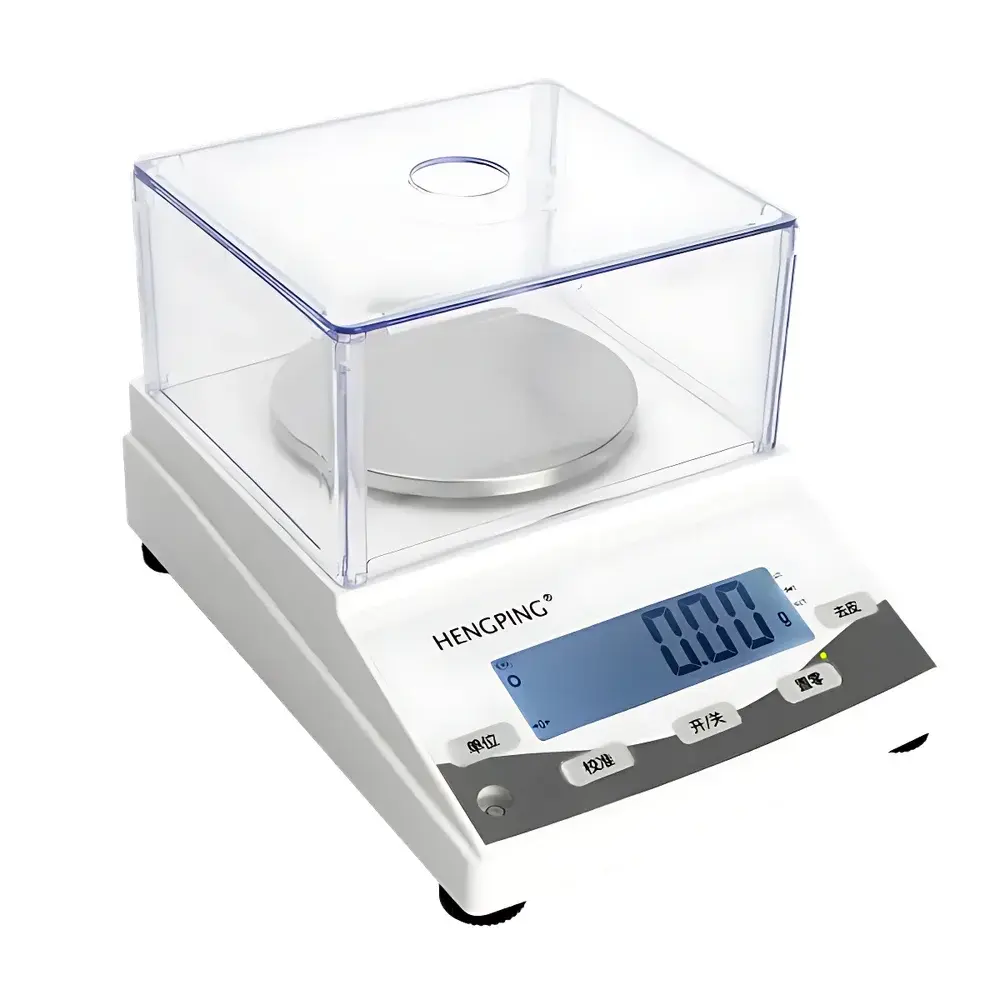
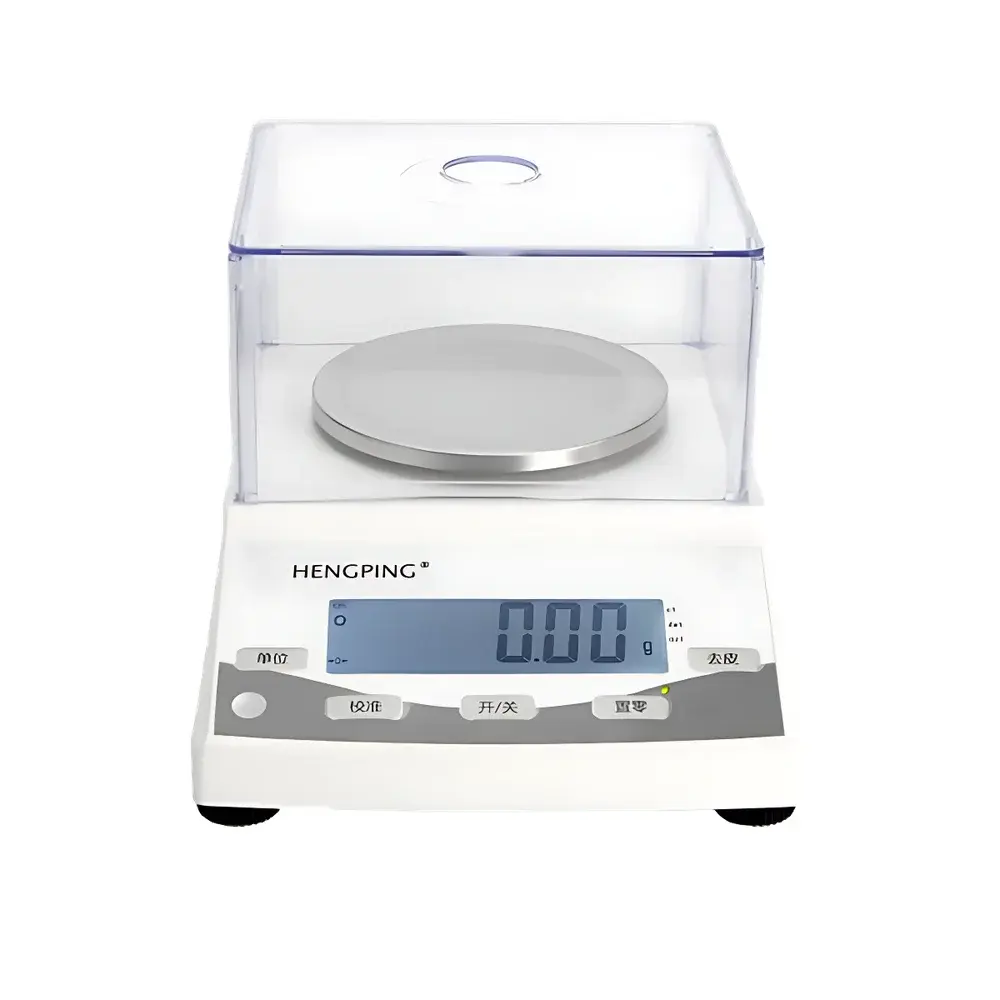
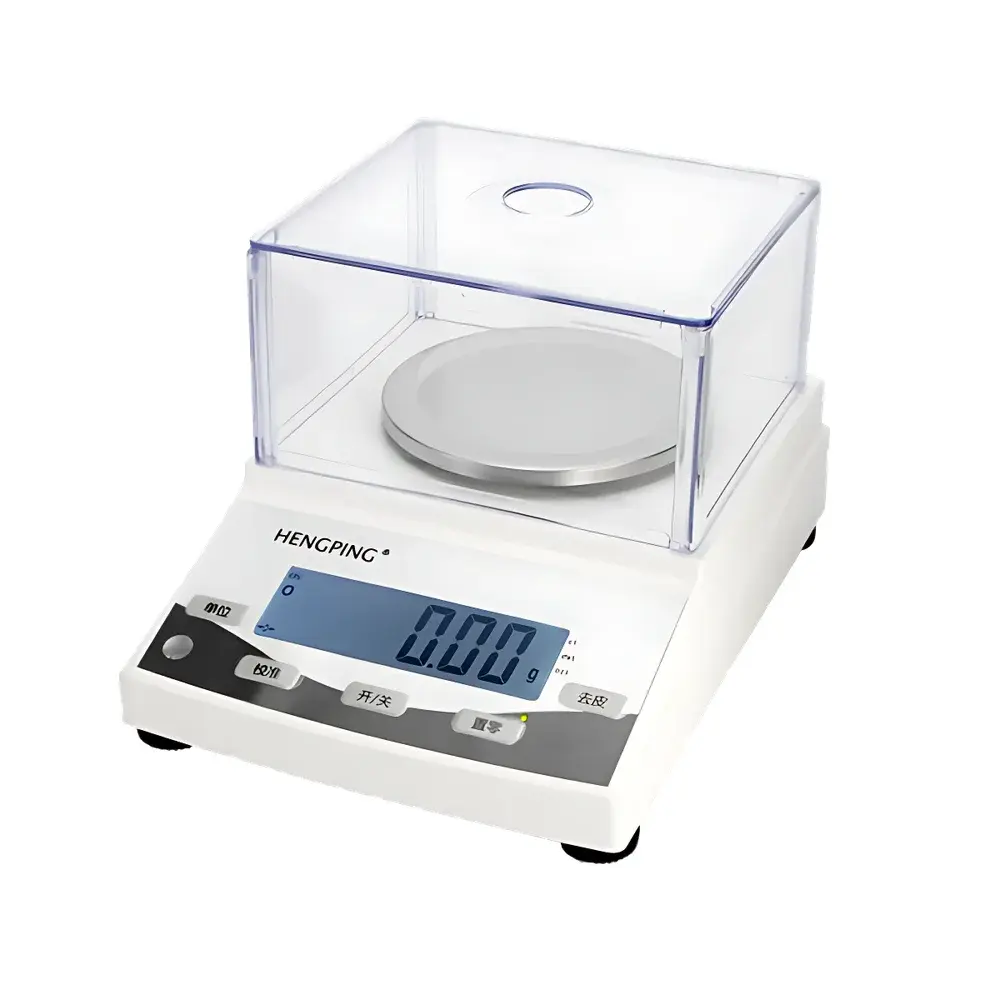
SUNNY HENGPING YP Series Precision Electronic Balance
| Brand | SUNNY HENGPING INSTRUMENT |
|---|---|
| Origin | Shanghai, China |
| Manufacturer Type | Direct Manufacturer |
| Product Category | Domestic (China-made) |
| Model Series | YP102N / YP202N / YP502N / YP602N / YP1002N |
| Instrument Type | Precision Balance |
| Capacity Range | 100–1000 g |
| Readability | 0.01 g |
| Repeatability | ±0.01 g |
| Linearity Error | ±0.02 g |
| Calibration Method | External Calibration |
| Stabilization Time | ≤2 s |
| Operating Temperature | 5–40 °C |
| Relative Humidity | ≤85% RH |
| Pan Diameter | Φ130 mm |
| Draft Shield Dimensions (W×D×H) | 175×145×88 mm |
| Unit Conversions | g, oz, ct, lb, etc. |
| Interface | RS232 standard |
| Power Supply | AC/DC dual-mode |
| Leveling | Integrated bubble level |
| Features | Full-range tare, counting mode, backlit LCD display, draft shield included |
Overview
The SUNNY HENGPING YP Series Precision Electronic Balance is an entry-level yet rigorously engineered analytical weighing instrument designed for routine laboratory, quality control, and educational applications requiring reliable mass measurement at 0.01 g readability. Based on electromagnetic force compensation (EMFC) transduction technology, the YP series delivers stable, drift-resistant output by dynamically balancing the gravitational load on the weighing pan with a precisely controlled electromagnetic field. This principle ensures high reproducibility and long-term stability under typical ambient lab conditions (5–40 °C, ≤85% RH). The balances are factory-calibrated using traceable NIST-equivalent standards and support external calibration via certified weights—enabling compliance with internal SOPs and externally audited workflows. While not classified as analytical or microbalances, the YP series meets the performance requirements of ISO 9001-supported QC labs, GLP-aligned sample preparation, and USP general weighing guidelines for non-critical pharmaceutical unit operations.
Key Features
- Backlit LCD display with intuitive icon-based interface for rapid parameter recognition under variable lighting conditions
- Full-range tare function enabling net weight determination across the entire capacity spectrum without range switching
- Integrated leveling bubble and adjustable feet ensure mechanical stability prior to operation—a prerequisite for metrological integrity
- Removable acrylic draft shield (175 × 145 × 88 mm interior dimensions) minimizes air-current-induced fluctuations during low-mass measurements
- Counting mode with automatic average-piece-weight calculation supports inventory management and component verification in manufacturing environments
- RS232 serial interface enables direct data export to LIMS, Excel, or custom QA databases; compatible with standard terminal emulation protocols
- AC/DC dual-power architecture allows uninterrupted operation during power transitions or mobile deployment in field labs
- Multi-unit conversion (g, oz, ct, lb, pcs) reduces manual calculation errors in cross-functional workflows involving formulation, packaging, or teaching labs
Sample Compatibility & Compliance
The YP series accommodates solid, granular, and powdered samples up to 1000 g (YP1002N model), with optimal accuracy maintained for loads between 10% and 90% of maximum capacity. The Φ130 mm stainless-steel weighing pan resists corrosion from common reagents and facilitates easy cleaning. All models comply with OIML R76-1 Class II accuracy requirements for non-automatic weighing instruments used in commercial and industrial settings. Though not certified for regulated GMP production weighing, the balances support documentation-ready workflows when paired with external calibration records, operator logbooks, and environmental monitoring logs—satisfying basic audit readiness per FDA 21 CFR Part 11 (when used with compliant data capture software) and ISO/IEC 17025 Clause 6.4.1 on equipment suitability.
Software & Data Management
No proprietary software is bundled; however, the RS232 interface outputs ASCII-formatted weight data (e.g., “+000.1234 g”) at user-selectable baud rates (default: 9600), compatible with third-party tools including LabArchives ELN, MATLAB Serial Toolbox, and open-source Python scripts (pySerial library). Timestamping requires external synchronization; built-in real-time clock is not present. Data transmission supports auto-print mode (for receipt printers) and continuous streaming for dynamic process monitoring. Audit trail generation depends on host-system configuration—not embedded within the balance firmware.
Applications
- Routine QC checks in food, chemical, and cosmetics manufacturing (e.g., batch ingredient verification, fill-weight sampling)
- University teaching labs for stoichiometry experiments, solution preparation, and density determination exercises
- Pharmaceutical R&D support tasks such as excipient blending, capsule filling validation, and stability study sample logging
- Small-scale electronics assembly for component counting and solder paste dispensing verification
- Veterinary and agricultural extension services performing feed ration formulation and seed viability testing
FAQ
What calibration weights are required for external calibration?
Each model requires a single certified weight equal to its nominal capacity (e.g., 200 g for YP202N); SUNNY HENGPING recommends Class M2 or better per ISO 9001 Annex B.
Is internal calibration available?
No—the YP series supports external calibration only; no motorized internal weight mechanism is integrated.
Can the balance be mounted on a vibration-isolated surface?
Yes; the compact footprint (257 × 295 × 75 mm) and low center of gravity make it suitable for installation on granite tables or active damping platforms where micro-vibration mitigation is critical.
Does the RS232 interface support bi-directional communication?
No—it is transmit-only; commands such as tare or unit change must be executed locally via front-panel keys.
What is the recommended recalibration frequency?
Per ISO/IEC 17025:2017, recalibration should occur before each shift if used continuously, or daily if operated intermittently—subject to risk-based assessment of process criticality and historical stability data.