
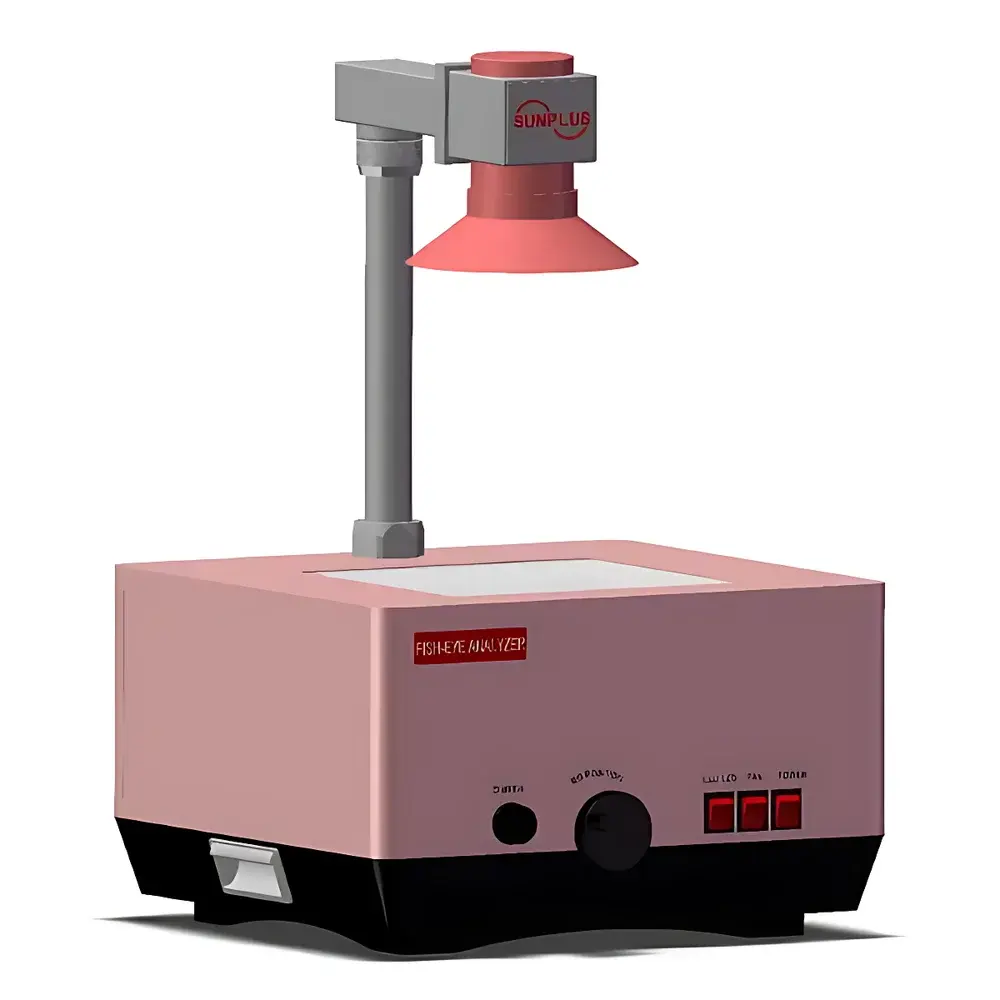
SUNPLUS Fish Eye Analyzer by HunterLab
| Brand | HunterLab |
|---|---|
| Origin | Canada |
| Model | SUNPLUS |
| Type | Film Gel Defect Analyzer (Fish Eye Measurement System) |
| Application | Polypropylene (PP) Cast & Biaxially Oriented Films |
| Measurement Principle | Optical Projection + Standard Aperture Masking |
Overview
The SUNPLUS Fish Eye Analyzer, engineered by HunterLab and manufactured in Canada, is a dedicated optical measurement system designed for the quantitative assessment of gel-like defects—commonly referred to as “fish eyes”—in polypropylene (PP) thin films. Unlike general-purpose imaging systems, the SUNPLUS employs a calibrated high-luminance overhead projection principle combined with traceable, NIST-traceable aperture masks (0.2 mm, 0.4 mm, and 0.8 mm nominal diameters) to isolate and enumerate discrete unmelted polymer agglomerates embedded within transparent or translucent film substrates. This method conforms to industry-accepted visual defect classification protocols used in QC laboratories for cast PP, BOPP, and related thermoplastic films where melt homogeneity directly impacts optical clarity, mechanical integrity, and downstream processing performance.
Key Features
- Optically stabilized overhead projection platform with uniform collimated illumination, minimizing edge distortion and shadow artifacts during magnified defect visualization.
- Three certified aperture masks (0.2 mm, 0.4 mm, and 0.8 mm diameter), each supplied with individual calibration certificates confirming dimensional accuracy per ISO/IEC 17025 requirements.
- Dedicated mounting fixture for flat, tension-controlled film sample presentation—ensuring consistent focus plane alignment and eliminating parallax-induced counting errors.
- Modular design compatible with standard laboratory benchtop environments; no PC or software installation required for basic pass/fail enumeration.
- Engineered for long-term stability: all optical components are housed in rigid aluminum chassis with thermal mass damping to reduce drift under ambient lab temperature fluctuations.
Sample Compatibility & Compliance
The SUNPLUS system is validated for use with polypropylene films ranging from 12 µm to 100 µm thickness, including mono-layer cast films, coextruded structures, and metallized BOPP laminates. It supports ASTM D3905–22 (“Standard Test Method for Determining Gel Content of Polyolefin Films”) as a qualitative/semi-quantitative screening tool when used in conjunction with defined counting procedures and operator training. While not an automated image analyzer, its aperture-based methodology satisfies internal quality control specifications aligned with ISO 9001:2015 clause 7.1.5 (Monitoring and measuring resources) and supports GLP-compliant documentation workflows through manual logbook entry or integration into LIMS via standardized reporting templates.
Software & Data Management
The base SUNPLUS configuration operates without proprietary software—enabling immediate deployment and minimizing IT validation burden in regulated environments. For laboratories requiring electronic recordkeeping, optional digital annotation modules (sold separately) provide timestamped image capture, mask selection logging, and CSV export of count data per ASTM E2500–21 Annex A2 guidelines. All exported records retain metadata including operator ID, sample lot number, mask size used, and environmental conditions (recorded manually or via optional USB-connected hygrothermograph). Audit trail functionality meets FDA 21 CFR Part 11 requirements when deployed with compliant electronic signature and access control infrastructure.
Applications
- Quality assurance of PP film production lines—detecting early-stage extrusion instability or insufficient barrel temperature profiles.
- Raw material evaluation: screening incoming PP resin batches for crosslinked contamination or thermal degradation products.
- R&D formulation studies: correlating additive package composition (e.g., nucleating agents, antioxidants) with melt dispersion behavior.
- Process troubleshooting: distinguishing between die lip buildup (surface fish eyes) versus bulk unmelted particles (subsurface gels).
- Customer complaint investigation: generating objective, repeatable defect counts for root cause analysis and corrective action reporting.
FAQ
What standards does the SUNPLUS Fish Eye Analyzer comply with?
It supports implementation of ASTM D3905–22 and aligns with ISO 9001:2015 requirements for calibrated measurement equipment. Aperture masks are certified to ISO/IEC 17025 by an accredited third-party metrology lab.
Can the SUNPLUS be used for materials other than polypropylene film?
While optimized for PP, it may be applied to other transparent thermoplastic films (e.g., PE, PET) if defect morphology and refractive index contrast permit clear optical differentiation—validation per ASTM D5267–21 is recommended prior to adoption.
Is operator training required?
Yes. Inter-operator variability in fish eye identification remains a recognized source of measurement uncertainty; HunterLab recommends documented competency assessment using reference film sets before routine use.
How often must the aperture masks be recalibrated?
Annual recalibration is advised per ISO/IEC 17025 best practices; calibration certificates include uncertainty budgets and traceability statements to national standards.
Does the system require external power conditioning or vibration isolation?
No. The unit operates on standard 100–240 VAC input and features passive damping; however, placement away from HVAC vents or heavy machinery is recommended to maintain optical stability over extended counting sessions.



