
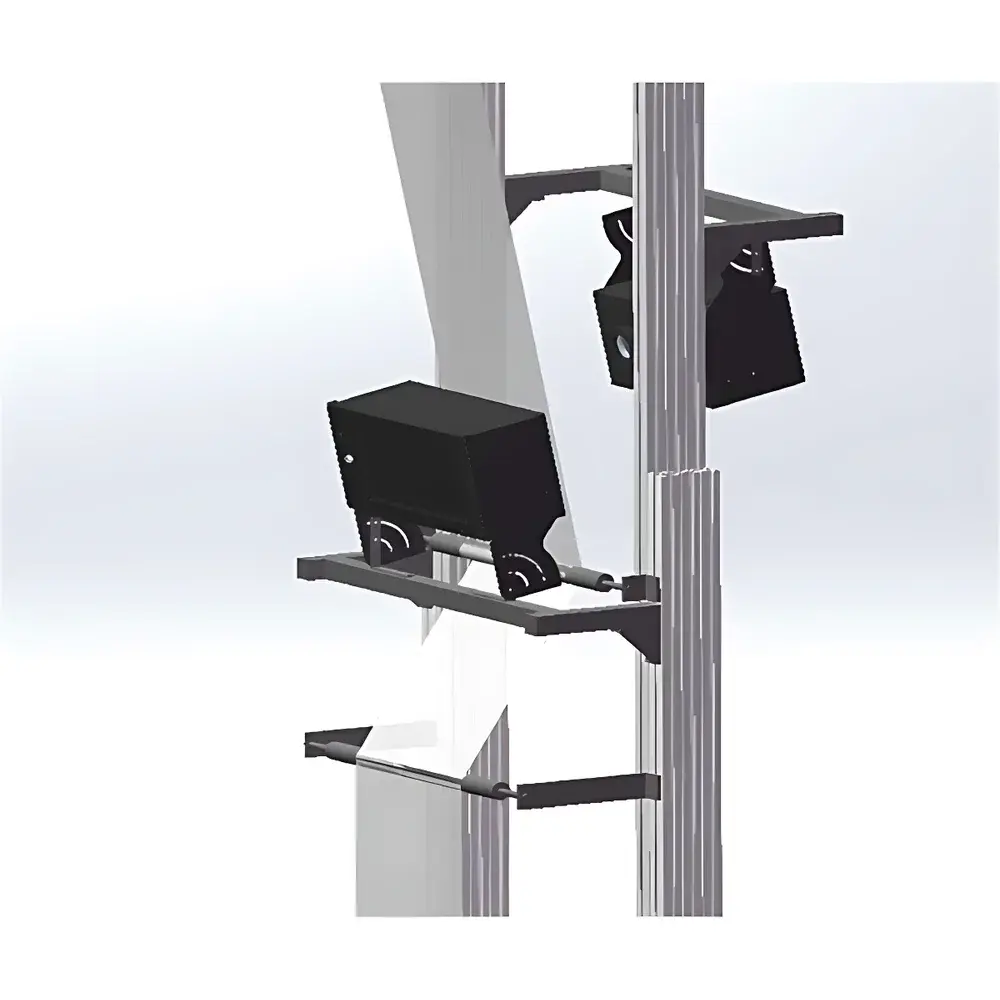
SUNPLUS FSD-300 Online Blow Film Surface Inspection System
| Brand | HunterLab |
|---|---|
| Origin | Canada |
| Manufacturer Type | Authorized Distributor |
| Origin Category | Imported |
| Model | FSD-300 |
| Quotation | Upon Request |
| Applicable Film Width | ≤340 mm |
| Minimum Detectable Feature Radius | 0.05 mm |
| Maximum Spatial Resolution | 30 µm |
| Sensor Type | Area-Scan CCD |
| Maximum Web Speed | 18 m/min |
| Light Source | 30 W LED Cold Illumination |
| Power Supply | 220 VAC, 50 Hz |
| Communication Interfaces | RS232 / RS485 / Ethernet / USB |
| Dimensions (Upper Unit) | 230 × 131 × 108 mm |
| Dimensions (Lower Unit) | 272 × 160 × 252 mm |
Overview
The SUNPLUS FSD-300 Online Blow Film Surface Inspection System is an industrial-grade optical inspection platform engineered for continuous, non-contact surface quality monitoring of extruded polymer films during production. Leveraging high-sensitivity area-scan CCD imaging and precisely calibrated LED cold illumination, the system detects and classifies surface anomalies—including fisheyes, gels, contaminants, pinholes, streaks, haze zones, and localized thickness variations—in real time. Its core architecture is optimized for transparent and semi-transparent thermoplastic films such as polypropylene (PP), polyethylene (PE), polyvinyl chloride (PVC), and other resin-based blown films. Unlike offline laboratory methods, the FSD-300 integrates directly into the film line—enabling immediate feedback to extrusion and winding operators without interrupting throughput. The system operates on the principle of high-contrast transmissive and reflective optical interrogation, where deviations in light transmission or scattering correlate to physical defects with sub-30 µm spatial resolution under standard configuration.
Key Features
- Real-time defect detection and classification with configurable alarm thresholds for size, shape, and density
- Simultaneous measurement of film edge position and lateral width variation for process alignment verification
- Zoomable live image display with adjustable contrast, brightness, and false-color mapping for enhanced visual assessment
- Modular sensor design supporting optional high-resolution CCD upgrades for sub-0.05 mm feature detection
- Ruggedized dual-unit mechanical layout: compact upper optical head (230 × 131 × 108 mm) and lower processing/control module (272 × 160 × 252 mm)
- Multi-protocol industrial connectivity via RS232, RS485, Ethernet, and USB for seamless integration with PLCs, SCADA, and MES systems
- Embedded data logging with timestamped image capture, defect coordinates, and metadata tagging (e.g., line speed, date/time, operator ID)
Sample Compatibility & Compliance
The FSD-300 supports a broad range of blown film substrates, including mono-layer and co-extruded structures, with particular sensitivity to optically homogeneous materials. It complies with internationally recognized standards for plastic film quality evaluation, including ASTM D3351–93 (Standard Test Method for Gel Content of Polyolefins), GB/T 4611–2008 (Plastic Films – Determination of Gel Particles), GB/T 11115–2009 (Polyethylene Resins), and GB 6595–86 (Determination of Fish-Eye Count in Polyethylene Film). While not certified to ISO/IEC 17025, the system’s measurement traceability aligns with GLP-aligned production environments and supports audit-ready documentation required under GMP-compliant packaging operations. Calibration routines follow manufacturer-defined procedures using NIST-traceable reference targets.
Software & Data Management
The embedded inspection software provides a Windows-based interface with intuitive navigation and role-based access control. All detection results—including defect count per unit area, size distribution histograms, positional heatmaps, and cumulative trend charts—are stored in a structured SQLite database. Reports are exportable in PDF, CSV, and XML formats, fully customizable to include production batch IDs, shift information, machine parameters, and user-defined pass/fail criteria. Audit trails record all configuration changes, report generation events, and user logins—supporting compliance with FDA 21 CFR Part 11 requirements when deployed with validated IT infrastructure. Historical data can be queried by date range, defect type, or film lot number, enabling root-cause analysis and SPC charting.
Applications
- Quality assurance in blown film extrusion lines for food packaging, medical pouches, and agricultural mulch films
- In-process monitoring of gel formation in PP and HDPE resins to optimize melt filtration and screw temperature profiles
- Validation of die lip cleanliness and static mixer performance through longitudinal defect pattern analysis
- Supporting IATF 16949 and ISO 9001 quality management system requirements for real-time statistical process control
- Pre-shipment inspection documentation for export-grade film rolls requiring third-party certification
- Research and development of new polymer blends where surface heterogeneity correlates with rheological instability
FAQ
What film thickness ranges can the FSD-300 inspect?
The system is optimized for films between 12 µm and 250 µm thick. Thinner films require higher illumination uniformity; thicker opaque films may necessitate reflectance-mode configuration.
Can the system distinguish between dust particles on the film surface versus embedded contaminants?
Yes—through synchronized focus stacking and multi-angle illumination analysis, the software differentiates surface-adherent particles from subsurface inclusions based on depth-of-field blur characteristics.
Is remote diagnostics supported?
Yes—via secure Ethernet connection, authorized service engineers can initiate remote session-based troubleshooting and firmware updates following ISO/IEC 27001-aligned authentication protocols.
Does the system support integration with ERP or LIMS platforms?
Yes—standard RESTful API endpoints and OPC UA server capability enable bidirectional data exchange with enterprise systems for automated defect reporting and material disposition workflows.
What maintenance intervals are recommended?
Optical path cleaning every 72 operational hours; annual CCD sensor calibration and LED intensity verification using factory-certified reference standards.




