
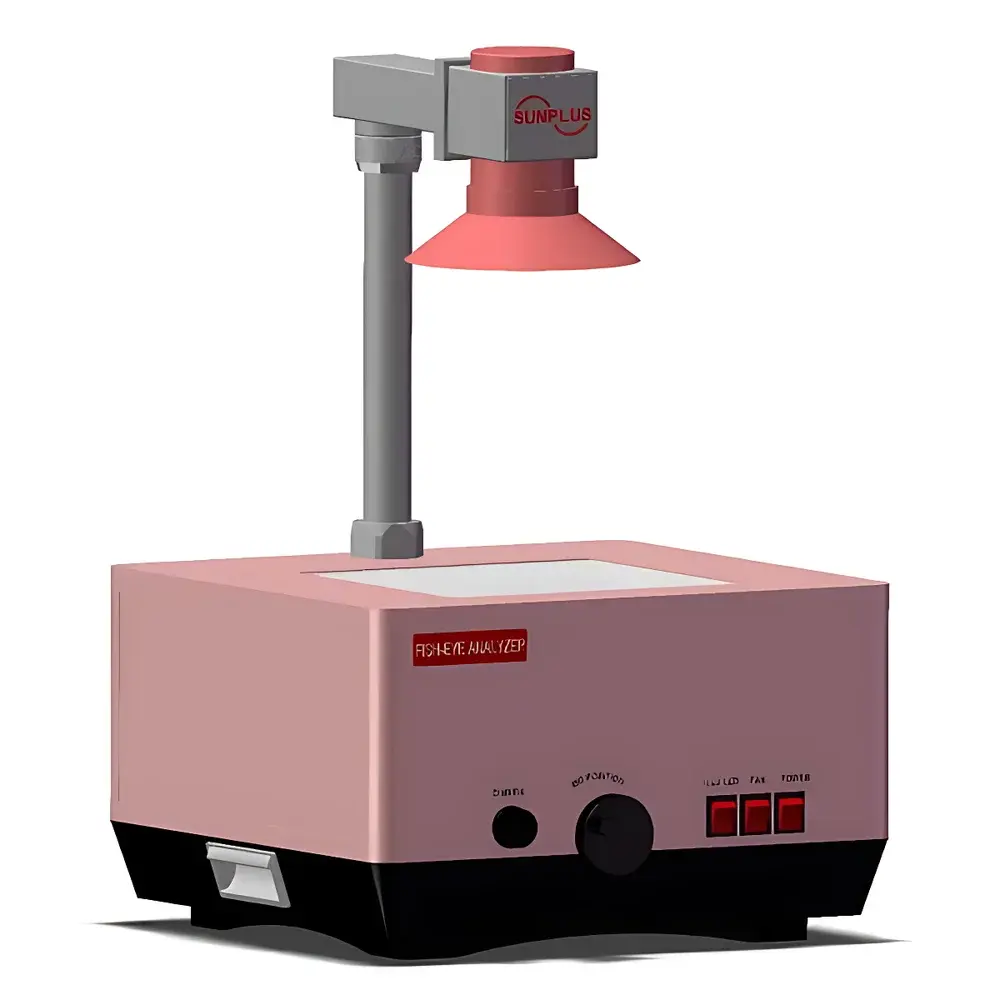
SUNPLUS SP-Y-1908 Automated Fish-Eye Analyzer
| Brand | HunterLab |
|---|---|
| Origin | Canada |
| Manufacturer Type | Authorized Distributor |
| Origin Category | Imported |
| Model | SP-Y-1908 |
| Measurement Range | 0.2 mm, 0.3 mm, 0.4 mm, 0.8 mm (software-selectable per standard) |
| Sensor | 20 MP CCD with high-resolution lens |
| Minimum Detectable Target Radius | 0.1 mm |
| Resolution | < 0.035 mm |
| Detection Area | ≥ 200 × 200 mm |
| Optical Magnification | > 30× |
| Illumination Intensity | ≥ 6000 lumens |
| Light Source | 24 V / 60 W halogen assembly |
| Power Supply | 220 V, 50 Hz |
| Dimensions | 459 × 426 × (276 + 380) mm |
Overview
The SUNPLUS SP-Y-1908 Automated Fish-Eye Analyzer is an industrial-grade optical inspection system engineered for quantitative defect analysis in polymeric films and rigid transparent substrates. It operates on the principle of high-contrast transmitted-light imaging combined with pixel-level grayscale threshold segmentation and morphological feature extraction. Designed to comply with standardized visual defect classification protocols, the instrument captures and classifies discrete scattering anomalies—commonly termed “fish-eyes”—arising from gel particles, crosslinked agglomerates, or unmelted resin domains in thermoplastic extrudates. Unlike subjective manual counting under magnifiers, the SP-Y-1908 delivers objective, repeatable, and auditable measurements traceable to national and international standards including GB/T 4611–2008, GB/T 11115–2009, GB 6595–1986, and ASTM D3351–93. Its optical architecture supports both transmission-mode inspection of flexible films and static imaging of rigid sheets such as PMMA, float glass, and polycarbonate panels.
Key Features
- 20-megapixel monochrome CCD sensor paired with a telecentric optical path and diffused uniform backlighting ensures sub-pixel edge fidelity and minimal parallax error across the full 200 × 200 mm field of view.
- Software-configurable detection thresholds enable compliance-driven sizing: users select nominal fish-eye diameters (0.2 mm, 0.3 mm, 0.4 mm, 0.8 mm) directly from the interface—each mapped to corresponding ISO/ASTM acceptance criteria.
- Automated morphometric analysis computes not only count and equivalent circular diameter (ECD), but also striation length, width, aspect ratio, and spatial distribution density (per cm²), supporting root-cause diagnostics in extrusion or calendering processes.
- Real-time zoom (≥30× digital magnification) and dynamic contrast enhancement allow operators to visually verify algorithmic classifications without switching hardware configurations.
- Integrated calibration routine uses NIST-traceable standard plates to validate measurement linearity and repeatability across the entire detection range, satisfying internal QA and external audit requirements (e.g., ISO/IEC 17025).
- One-click report generation produces PDF or Excel outputs containing raw image thumbnails, annotated defect maps, statistical summaries, pass/fail status per selected standard, and operator metadata—including timestamp, user ID, and instrument serial number.
Sample Compatibility & Compliance
The SP-Y-1908 accommodates a broad spectrum of industrial materials: biaxially oriented polypropylene (BOPP), low- and high-density polyethylene (LDPE/HDPE), polyvinyl chloride (PVC), ethylene-vinyl acetate (EVA), and acrylic (PMMA) sheets up to 5 mm thick. Its high-lumen (≥6000 lm), temperature-stabilized 24 V / 60 W halogen illumination module provides consistent spectral output (color temperature ~3200 K) suitable for both translucent and opaque specimens when used with reflective mode accessories (optional). All measurement logic adheres to the geometric definitions and counting rules specified in GB/T 4611–2008 (“Determination of fish-eyes in polyethylene film”) and ASTM D3351–93 (“Standard Test Method for Fish Eyes in Polyethylene Film”), ensuring regulatory alignment for QC labs operating under GMP or ISO 9001 frameworks. Audit trails—including parameter changes, image saves, and report exports—are time-stamped and user-logged, supporting FDA 21 CFR Part 11 readiness when deployed with validated software configuration.
Software & Data Management
The proprietary FishEyePro™ application (v4.2+) runs on Windows 10/11 x64 platforms and features a GLP-compliant data architecture. Raw images are stored in lossless TIFF format with embedded EXIF metadata (exposure, gain, lens focus position). Each analysis session generates a structured XML log file containing all measurement parameters, threshold values, and classification masks—enabling retrospective reprocessing without rescanning. The software supports multi-user role-based access control (administrator, technician, reviewer), configurable electronic signatures, and encrypted database backups. Export options include CSV for SPC integration, PNG overlays for presentation decks, and DICOM-compatible metadata tagging for enterprise LIMS interoperability. All reports include footer watermarks indicating revision level, software build ID, and instrument calibration due date.
Applications
- Quality assurance in blown film and cast film production lines—monitoring melt homogeneity and die lip contamination.
- Raw material release testing for polymer pellets and masterbatches prior to extrusion.
- Failure analysis of optical-grade films used in display laminates, photovoltaic encapsulants, and medical packaging.
- Process validation studies for resin drying, compounding, and screw profile optimization.
- Supplier qualification audits requiring third-party verifiable defect metrics.
- R&D evaluation of new stabilizer packages or nucleating agents affecting gel formation kinetics.
FAQ
What standards does the SP-Y-1908 natively support?
The system includes preloaded templates for GB/T 4611–2008, GB/T 11115–2009, GB 6595–1986, and ASTM D3351–93. Custom threshold sets can be defined for internal specifications or customer-specific requirements.
Can the instrument analyze non-planar or curved samples?
No—it requires flat, tension-free placement on the glass platen. For rolled film, a motorized unwind station (optional accessory) maintains consistent tension and registration.
Is calibration traceable to national metrology institutes?
Yes; the included standard plate is certified by a CNAS-accredited lab with uncertainty ≤ ±0.005 mm (k=2), and calibration certificates are issued annually upon service.
Does the software meet FDA 21 CFR Part 11 requirements?
Out-of-the-box functionality supports electronic signatures, audit trails, and data integrity controls. Full Part 11 compliance requires site-specific validation documentation and IT infrastructure alignment.
What is the typical throughput for a 200 × 200 mm scan?
Full-field acquisition and analysis takes ≤ 90 seconds per sample at maximum resolution, excluding manual loading/unloading time.




