
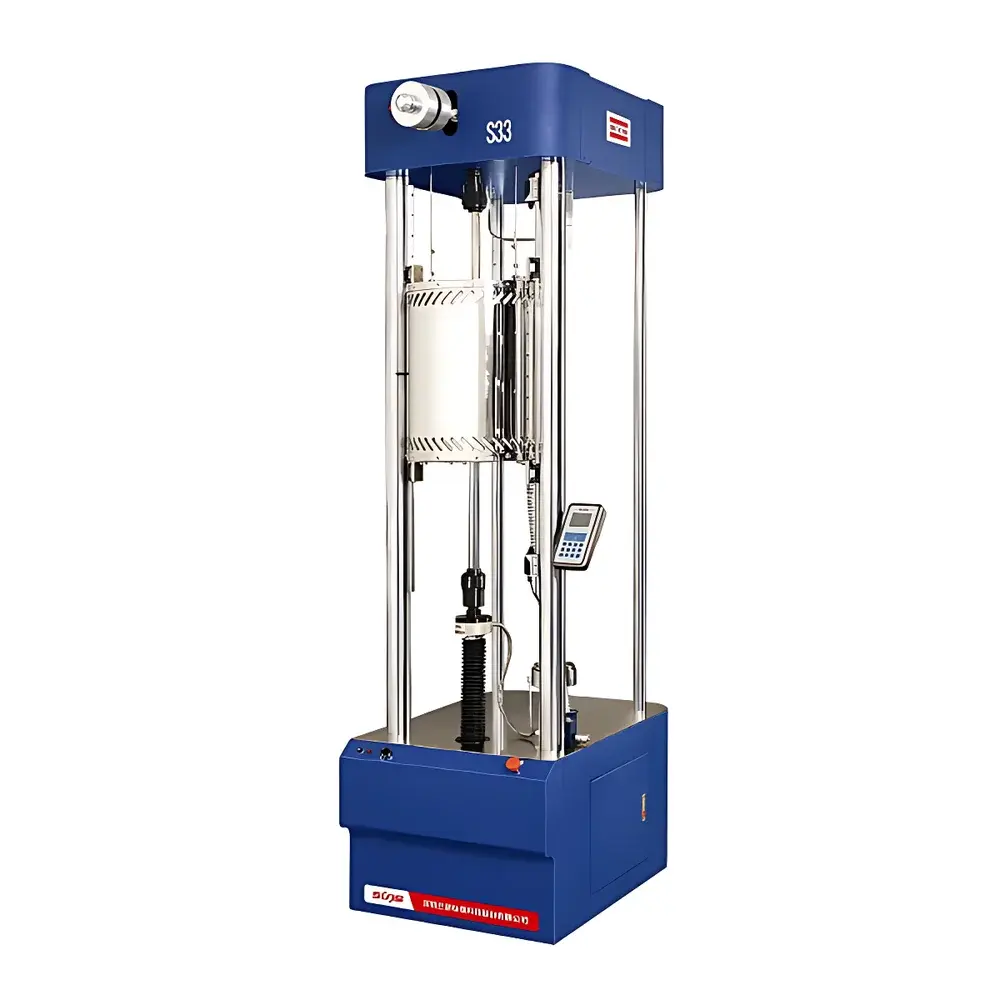
SUNS CTM Series High-Temperature Creep and Stress Rupture Testing Machine
| Brand | SUNS |
|---|---|
| Origin | Guangdong, China |
| Manufacturer Type | Direct Manufacturer |
| Regional Classification | Domestic (China) |
| Model | CTM Series-2 |
| Quotation | Upon Request |
| Instrument Type | Mechanical Loading System |
| Maximum Test Load | 30–100 kN |
| Maximum Crosshead Travel | 0–250 mm |
| Overall Dimensions (W×D×H) | 920 × 670 × 250 mm |
| Machine Weight | 280 kg |
Overview
The SUNS CTM Series High-Temperature Creep and Stress Rupture Testing Machine is a precision-engineered mechanical loading system designed for long-term static load testing of metallic alloys, composites, ceramics, and structural components under controlled elevated temperatures. It operates on the fundamental principle of uniaxial tensile creep deformation measurement—applying constant mechanical stress to a specimen while maintaining precise thermal conditions over extended durations (hours to thousands of hours), thereby quantifying time-dependent strain behavior including primary, secondary (steady-state), and tertiary creep stages. The system complies with internationally recognized standards including ASTM E139, ISO 204, GB/T 2039–2012 (revised edition of GB/T 2039–1997), and HB 5067–1985 for aerospace-grade metallic materials. Its architecture integrates a rigid mechanical loading frame, thermally isolated high-stability furnace subsystems, and closed-loop temperature regulation—enabling reliable determination of key material performance metrics such as creep limit, rupture life, minimum creep rate, and stress rupture strength.
Key Features
- Modular mechanical loading frame with load capacities spanning 30 kN, 50 kN, 80 kN, and 100 kN—engineered for high rigidity and minimal deflection under sustained loading.
- Electrically actuated cylindrical high-temperature furnace with linear guide rail positioning—ensures precise coaxial alignment between specimen axis and furnace centerline, critical for uniform thermal exposure and mechanical integrity.
- Low-voltage (25 V), high-current resistive heating design using HRE φ5 mm heating elements—eliminates electrical leakage risk and meets IEC 61000-4 electromagnetic compatibility requirements.
- Extended isothermal zone (≥200 mm at 1200 °C) achieved via multi-zone segmented heating control and advanced ceramic fiber insulation—ensuring temperature uniformity within ±4 °C across the active gauge length per ISO 204 Annex A.
- Surface temperature maintained ≤90 °C at furnace exterior when operating at 1200 °C—validated per GB/T 5977–2017 surface safety criteria and compliant with OSHA 1910.303(b)(2) thermal hazard mitigation guidelines.
- Integrated manual load release mechanism—provides fail-safe mechanical unloading during power interruption, protecting both load cell calibration integrity and specimen fixture geometry.
- Compact footprint (65% smaller than conventional dual-column creep frames)—optimized for laboratory space efficiency without compromising structural stability or thermal isolation performance.
Sample Compatibility & Compliance
The CTM Series accommodates standard tensile specimens per ASTM E8/E21, ISO 6892-2, and GB/T 228.2—including round, flat, and notched geometries up to 250 mm gauge length. It supports test environments from ambient to 1200 °C (cylindrical furnace) or 1100 °C (split-type furnace option), with interchangeable furnace configurations (K-, N-, S-, or R-type thermocouple compatibility). All operational parameters—including load application sequence, dwell time, temperature ramping profiles, and hold stabilization criteria—are programmable to satisfy GLP-compliant test protocols required by aerospace (e.g., NADCAP AC7101/3), nuclear (ASME BPVC Section III), and energy sector certification bodies. Data acquisition meets FDA 21 CFR Part 11 audit trail requirements when paired with validated third-party software modules.
Software & Data Management
While the base CTM Series employs analog-digital hybrid instrumentation with front-panel setpoint controls, optional integration with SUNS’ proprietary CreepTest Pro™ software enables automated test sequencing, real-time strain/time curve visualization, and compliance reporting per ISO 17025 clause 7.7. The software logs timestamped metadata—including furnace thermocouple readings, load cell output, crosshead displacement, and environmental chamber status—with checksum-verified binary storage. Export formats include CSV, XML, and PDF reports containing raw data tables, derivative calculations (e.g., log-log creep rate vs. stress), and statistical summaries (mean rupture life, standard deviation, confidence intervals per ASTM E139 Annex B). All digital records retain full traceability for regulatory audits.
Applications
This system serves as a core instrument in metallurgical R&D labs evaluating nickel-based superalloys (e.g., Inconel 718, Waspaloy) for turbine disk applications; in nuclear materials programs assessing zirconium cladding behavior under reactor operating conditions; and in automotive engineering validating aluminum-silicon carbide composites for exhaust manifold components. It is routinely deployed by national metrology institutes for inter-laboratory creep reference material certification, and by third-party testing houses accredited to ISO/IEC 17025 for contract-based qualification testing supporting AS9100 Rev D and API RP 1104 Annex A compliance documentation.
FAQ
What temperature ranges are supported, and which furnace configuration is recommended for 1200 °C testing?
The cylindrical furnace supports continuous operation from 200 °C to 1200 °C and is mandatory for tests above 1100 °C due to superior thermal stability and longer service life.
Does the system support automatic data logging and report generation?
Yes—when equipped with CreepTest Pro™ software, it provides fully automated acquisition, post-processing, and export-ready reporting aligned with ASTM E139 and ISO 204 reporting conventions.
How is thermal drift compensated during multi-day tests?
Multi-point furnace calibration using certified reference thermocouples (NIST-traceable) is performed prior to each test series, and real-time gradient monitoring ensures compliance with ISO 204 temperature uniformity tolerances throughout duration.
Can the machine be integrated into an existing LIMS or MES environment?
Via OPC UA or Modbus TCP interfaces, the system supports bidirectional communication with enterprise laboratory information management systems for sample ID synchronization, test initiation commands, and result ingestion.
What maintenance intervals are recommended for the heating elements and insulation?
Under continuous operation at ≤1200 °C, HRE heating elements require inspection every 5,000 hours; ceramic fiber insulation retains nominal performance for ≥30,000 hours if protected from mechanical abrasion and moisture ingress.



