
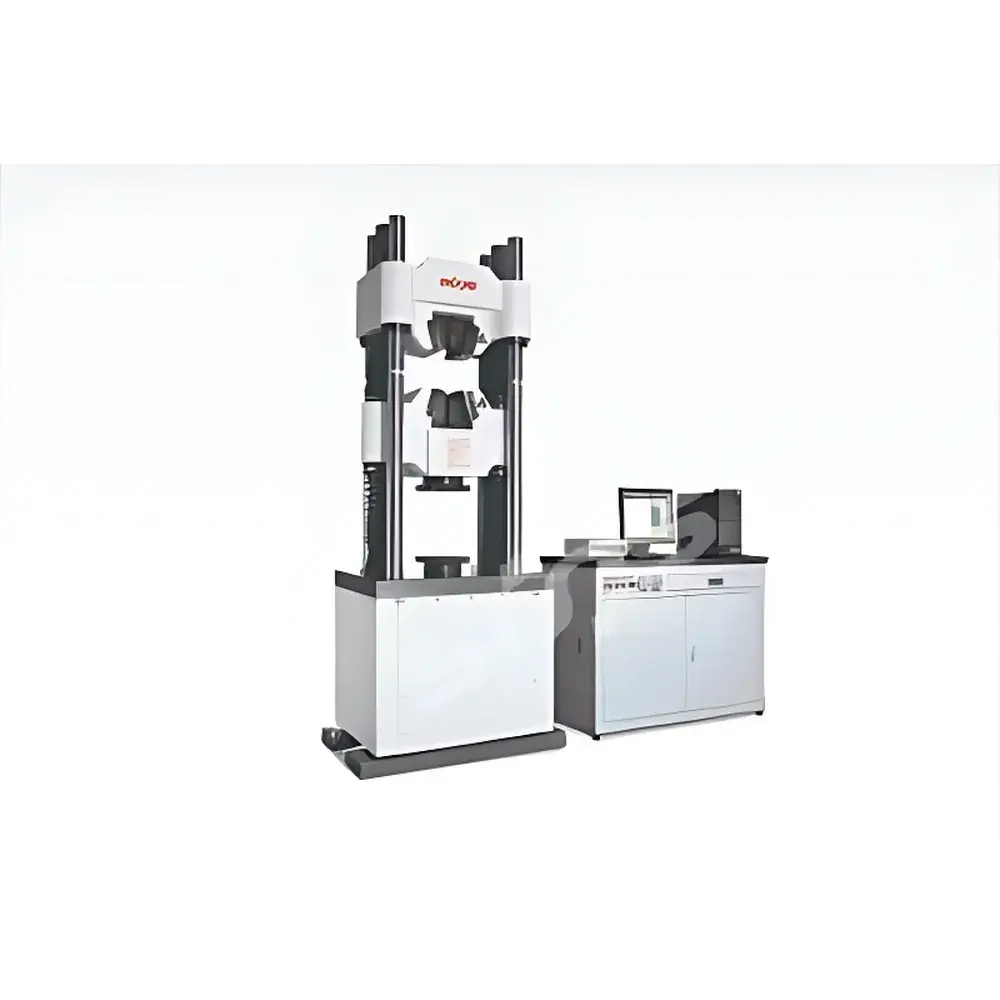
SUNS WE-Series Microprocessor-Controlled Hydraulic Universal Testing Machine
| Brand | SUNS |
|---|---|
| Origin | Guangdong, China |
| Manufacturer Type | Direct Manufacturer |
| Country of Origin | China |
| Model | WE |
| Quotation | Available Upon Request |
| Max Test Force | 100–2000 kN |
| Accuracy Class | Grade 1 / Grade 0.5 |
| Force Measurement Range | 1–100% FS (Full Scale, No Sub-Ranging) |
| Deformation Measurement Range | 1–100% FS (via Extensometer) |
| Deformation Relative Error | ±1% / ±0.5% |
| Deformation Resolution | 1/300,000 of Full-Scale Deformation |
| Crosshead Speed Range | 0–200 mm/min (model-dependent) |
| Column Spacing | 430–700 mm |
| Max Tensile Gap | 600–1160 mm |
| Max Compression Gap | 550–1000 mm |
| Round Specimen Grip Range | φ10–φ70 mm |
| Flat Specimen Thickness Range | 2–70 mm |
| Bend Support Span | 30–500 mm |
| Roller Diameter Options | 3–300 mm (optional) |
| Power Supply | 3–8 kW, AC 380 V, 50 Hz, 5-Wire System |
| Host Dimensions (L×W×H) | 820×580×1960 mm to 1370×820×3300 mm |
| Weight | 1200–8000 kg |
Overview
The SUNS WE-Series Microprocessor-Controlled Hydraulic Universal Testing Machine is a high-capacity, force-controlled mechanical testing system engineered for static and quasi-static tensile, compression, bending, and shear testing of metallic, composite, and structural materials under rigorous industrial and research conditions. Utilizing direct-load measurement via precision load cells—eliminating reliance on hydraulic pressure transduction—the WE-Series ensures metrological integrity by removing systematic errors associated with piston weight, seal friction, and oil compressibility. Its robust four- or six-column frame architecture provides exceptional rigidity (deflection < 0.1 mm per 1000 kN), enabling high-fidelity stress–strain characterization at loads up to 2000 kN. The system complies with ISO 7500-1:2018 (static calibration of force-proving instruments), ASTM E4 (verification of force-measuring systems), and EN 10002-2 (tensile testing of metallic materials), supporting traceable, audit-ready test execution in GLP- and GMP-regulated environments.
Key Features
- Direct-force measurement architecture using high-stability, temperature-compensated load cells—no correction required for piston mass or fluid dynamics.
- Full-scale force resolution up to 1/300,000 counts, meeting ISO 7500-1 Grade 0.5 requirements for high-precision applications.
- Microprocessor-based closed-loop control with real-time PID adjustment, enabling consistent strain rate control per ISO 6892-1 and ASTM E8/E21 protocols.
- USB 2.0 interface (12 Mb/s) for deterministic data acquisition, synchronized with extensometer and crosshead position signals at ≥1 kHz sampling rate.
- Modular frame design accommodating multiple configurations: standard tensile/compression, three- and four-point bending, shear, and proof-load testing.
- Integrated safety interlocks—including emergency stop, over-travel limit switches, and hydraulic pressure relief valves—certified to ISO 13850 and EN 60204-1.
Sample Compatibility & Compliance
The WE-Series accommodates a broad spectrum of specimen geometries and material classes: round bars (φ10–φ70 mm), flat plates (2–70 mm thick), threaded rebars (φ6–φ50 mm), prestressed steel strands (φ9.5–φ18 mm), and custom-profile specimens via adaptable grip inserts. Bending fixtures support span-to-depth ratios from 10:1 to 30:1, with optional rollers (3–300 mm diameter) for standardized flexural testing per ASTM C78, ISO 178, and GB/T 232. All mechanical components are manufactured to ISO 2768-mK general tolerances, and load cell calibrations are NIST-traceable via accredited third-party laboratories. The system supports 21 CFR Part 11-compliant electronic records when paired with SUNS TestMaster™ software (audit trail, user access control, digital signatures).
Software & Data Management
Control and analysis are performed using SUNS TestMaster™ v5.x—a Windows-based platform compliant with IEC 62591 (WirelessHART) and compatible with OPC UA server integration. The software provides preconfigured test methods aligned with ASTM E8, ISO 6892-1, EN 10002-1, and GB/T 228.1. Real-time plotting includes dual-axis stress–strain, load–displacement, and time-based parameter monitoring. Raw data exports in CSV, XML, and .tdms formats include metadata (operator ID, environmental conditions, calibration certificate IDs). Built-in report generators produce PDF outputs with embedded calibration certificates, statistical summaries (Rm, Rel, Agt, E), and pass/fail flags against user-defined specification limits.
Applications
- Mechanical property validation of structural steels, aluminum alloys, and high-strength rebar per ASTM A615/A706 and EN 10080.
- Proof-load certification of anchor systems, lifting lugs, and welded joints in offshore and civil infrastructure projects.
- Compression testing of concrete cylinders (ASTM C39), grout specimens (ASTM C109), and geopolymer composites.
- Three-point bending evaluation of rail profiles, I-beams, and extruded aluminum sections per EN 10034.
- Quality assurance of prestressed concrete strands (ASTM A416) and wire rope terminations.
- Research-grade cyclic loading studies (low-cycle fatigue pre-conditioning) with displacement-controlled hold segments.
FAQ
What accuracy class does the WE-Series meet—and how is it verified?
The WE-Series conforms to ISO 7500-1 Grade 0.5 (high-accuracy) or Grade 1 (standard-accuracy), verified annually using deadweight standards traceable to national metrology institutes. Calibration reports include hysteresis, repeatability, and creep error assessments across the full force range.
Can the system perform closed-loop strain control using an extensometer?
Yes—extensometer feedback is fully integrated into the servo-hydraulic control loop, enabling constant strain rate (e.g., 0.00025/s) per ISO 6892-1 Annex A. Both clip-on and non-contact video extensometers are supported.
Is the WE-Series suitable for ISO/IEC 17025-accredited laboratories?
Yes—when operated with documented procedures, calibrated accessories, and SUNS TestMaster™ configured for audit trails, the system meets ISO/IEC 17025:2017 Clause 6.4 (Equipment) and Clause 7.7 (Ensuring Validity of Results).
What electrical infrastructure is required for the 2000 kN model?
The WE-2000P requires a dedicated 3-phase, 5-wire 380 VAC, 50 Hz supply with ≥80 A circuit breaker, isolated grounding (5%.
Are bending fixtures supplied as standard or optional?
Standard configurations include two support rollers and one loading roller for three-point bending. Four-point bending kits, adjustable-span fixtures, and specialized rollers (e.g., hardened steel, V-grooved) are available as factory-installed options with full metrological documentation.



