
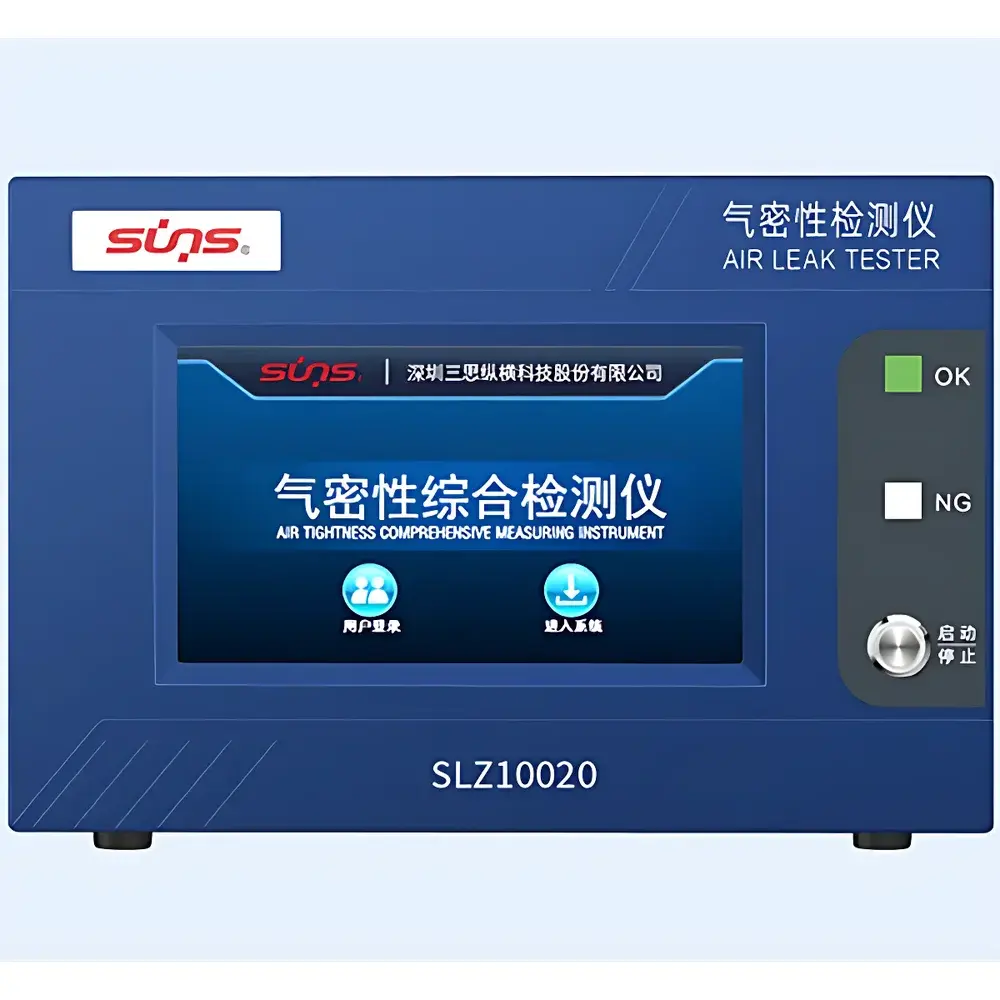
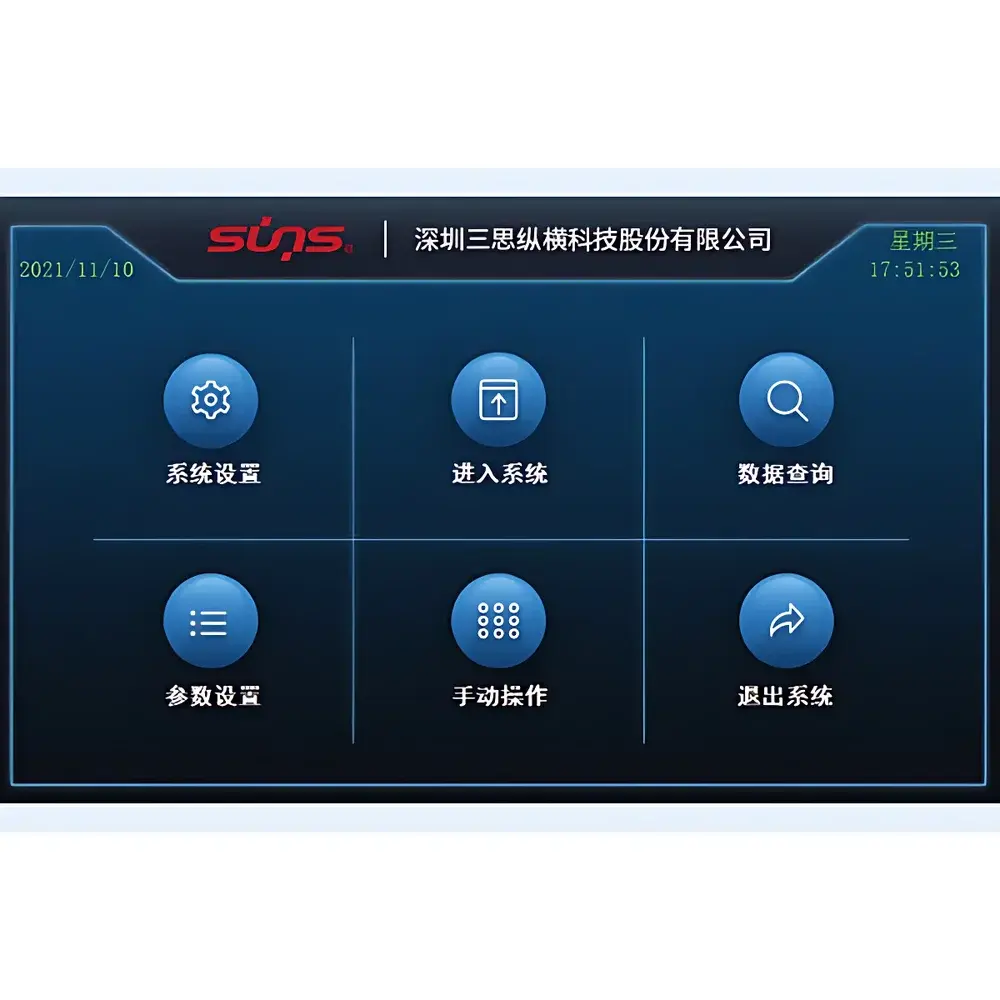
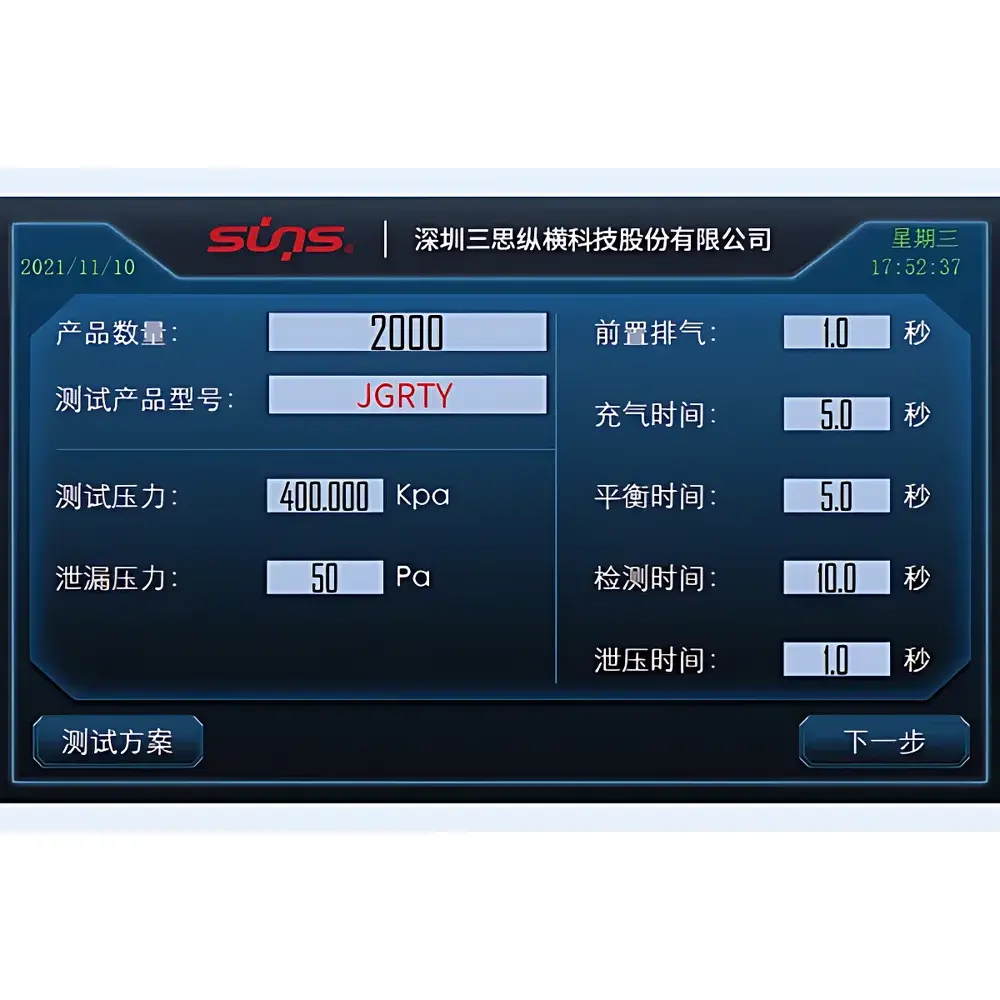
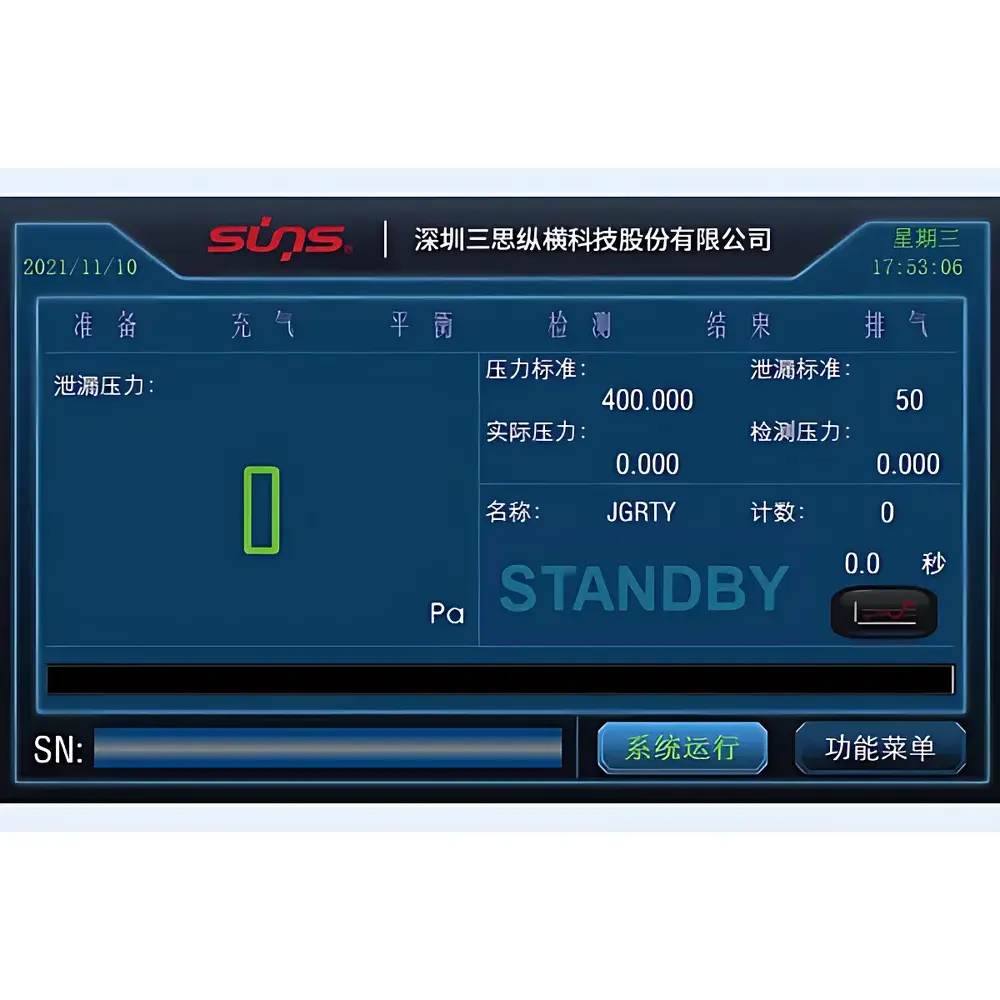
SUNS SLZ10020 Quantitative Leak Tester
| Brand | SUNS |
|---|---|
| Origin | Shenzhen, China |
| Manufacturer Type | Direct Manufacturer |
| Model | SLZ10020 |
| Pressure Range | 3–20 kPa / 5–50 kPa / 5–100 kPa / 5–200 kPa / 10–500 kPa / 10–800 kPa |
| Timing Range | 0–999.9 s (user-configurable) |
| Resolution | 1 Pa / 0.01 kPa / 0.1 kPa / 0.1 mL/min |
| Accuracy | ±0.2 % FS |
| Test Units | kPa, Pa, mL/min |
| Channels | 1 (multi-channel configurable) |
| Interface | RS232/RS485 (selectable), RJ45 Ethernet, 6-in/6-out I/O |
| Display | 7-inch LCD touchscreen |
| Power Supply | AC 110–240 V, 50/60 Hz |
| Pneumatic Supply | Clean, dry air at 0.4–0.8 MPa |
| Operating Environment | 5–45 °C, ≤80 % RH (non-condensing) |
| Weight | 9.8–11 kg |
| Dimensions | 450 × 270 × 190 mm |
Overview
The SUNS SLZ10020 Quantitative Leak Tester is an industrial-grade differential pressure decay leak detection system engineered for high-reproducibility, non-destructive integrity verification of sealed components. It operates on the principle of pressure decay measurement—monitoring minute changes in internal chamber pressure over a defined test interval to quantify leakage rate in real time. Unlike qualitative pass/fail testers, the SLZ10020 delivers traceable, quantitative output in absolute units (kPa, Pa, or volumetric flow mL/min), enabling statistical process control (SPC), tolerance band analysis, and compliance with ISO 50001 energy efficiency benchmarks. Its architecture integrates a 32-bit embedded processor, 24-bit high-resolution A/D conversion, and proprietary AI-accelerated signal processing to suppress thermal drift and environmental noise—critical for stable measurements across fluctuating ambient conditions in production-floor environments.
Key Features
- High-precision pressure sensing using imported OEM piezoresistive sensor chips with automatic zero-point drift compensation and temperature linearization algorithms.
- Imported SMC precision pressure regulator and ultra-sensitive differential transducers ensure consistent test repeatability (RSD < 0.3 % under controlled conditions).
- Real-time adaptive pressure stabilization algorithm minimizes settling time—typical stabilization achieved within 0.8–1.2 s across all calibrated ranges.
- Embedded real-time OS optimized for deterministic response; no third-party OS dependencies or background task interference.
- Integrated IoT-ready firmware supporting MQTT/HTTP(S) protocols for secure cloud synchronization and remote configuration via TLS 1.2 encrypted channels.
- Hardware-level I/O expansion support (6 digital inputs / 6 digital outputs) enables direct integration with PLCs, pneumatic actuators, and automated test fixtures without external relay modules.
Sample Compatibility & Compliance
The SLZ10020 is validated for testing rigid and semi-rigid sealed assemblies including medical device packaging (ISO 11607-2), automotive EV battery housings (UN 38.3 Annex 11), consumer electronics enclosures (IP67/IP68 validation), and pharmaceutical blister cards (USP ). It supports both internal and external reference volume configurations and accommodates custom tooling interfaces (e.g., quick-connect fittings, vacuum-sealed test chambers). All pressure calibration traces to NIST-traceable standards via factory-certified deadweight testers. The system meets electromagnetic compatibility requirements per IEC 61326-1 (industrial environment), safety compliance per IEC 61010-1, and supports audit-ready data integrity features aligned with FDA 21 CFR Part 11 (electronic signatures, audit trail, role-based access control) when deployed with optional GxP software module.
Software & Data Management
The SLZ10020 ships with SUNS LinkSuite™ v3.2—a Windows-based desktop application for advanced test method development, historical data mining, and SPC charting (X-bar/R, Cpk/Ppk). Raw measurement logs are stored in SQLite databases with SHA-256 hash integrity verification. Barcode scanning (via USB HID or serial RS232 scanner) auto-links test records to MES identifiers (e.g., SAP QM, Siemens Opcenter), enabling full batch traceability. Export formats include CSV (with metadata headers), PDF test reports (printable with company logo and QA sign-off fields), and XML for ERP integration. Network-enabled units support scheduled data push to FTP/SFTP servers or RESTful APIs for real-time dashboard ingestion.
Applications
- Automotive: EV battery module housing leak verification prior to electrolyte filling; brake master cylinder assembly testing per SAE J2716.
- Medical Devices: Sterile barrier integrity of Class II/III packaging per ASTM F2338-22; implantable device enclosure validation (ISO 11607-2 Annex D).
- Consumer Electronics: IP-rated waterproofing validation of smartphones, wearables, and smart home sensors.
- Industrial Valves & Fittings: Production-line acceptance testing of solenoid valves, pneumatic connectors, and compressed air system components.
- Pharmaceutical: Blister pack seal strength correlation studies and stability chamber leak monitoring per USP .
FAQ
What pressure decay methodology does the SLZ10020 use?
It employs differential pressure decay with dual-sensor architecture (test part vs. reference volume), minimizing influence from ambient temperature fluctuations and supply pressure variance.
Can the SLZ10020 be integrated into an existing MES or SCADA system?
Yes—via Modbus TCP over Ethernet, ASCII protocol over RS232/485, or HTTP POST API endpoints with JSON payload support.
Is multi-channel expansion supported out-of-the-box?
The base unit is single-channel; multi-channel operation (up to 8 channels) requires optional SLZ-MUX8 expansion module and synchronized firmware update.
Does the instrument support GLP/GMP-compliant audit trails?
When configured with the GxP Add-on License, it provides electronic signature workflows, immutable audit logs, and user permission tiers compliant with Annex 11 and ALCOA+ principles.
What maintenance intervals are recommended for long-term accuracy?
Annual recalibration against NIST-traceable standards is advised; pressure sensor zero calibration should be performed weekly in high-usage environments.
Related Products





