
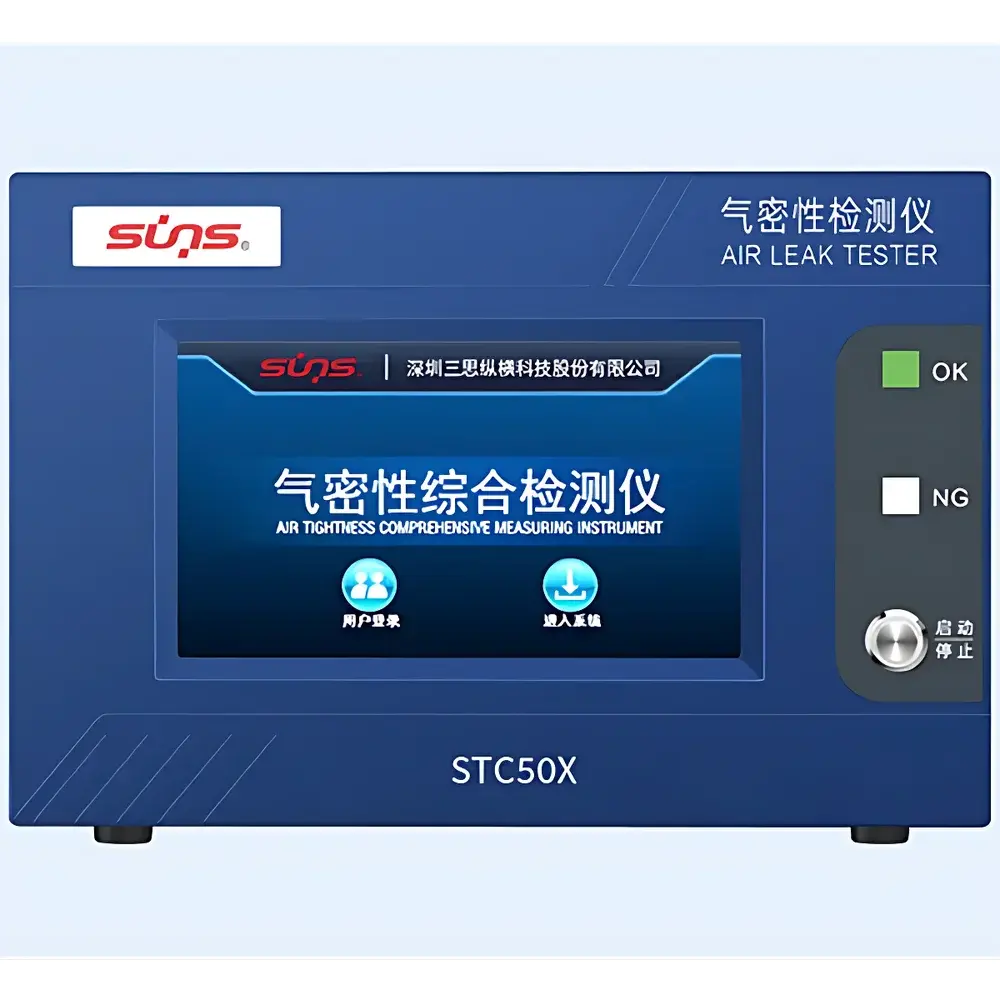
SUNS STC Series Direct-Pressure Leak Tester
| Brand | SUNS |
|---|---|
| Model | STC Series |
| Measurement Principle | Direct-Pressure Decay Method |
| Pressure Range Options | 3–50 kPa, 3–100 kPa, 5–200 kPa, 10–500 kPa, 10–800 kPa, 10–1000 kPa, 35–1000 kPa, 25–2000 kPa |
| Timing Range | 0–999.9 s |
| Pressure Source | Clean, Dry Compressed Air (0.4–0.8 MPa) |
| Resolution | 1 Pa |
| Accuracy | ±0.2 % FS |
| Units | kPa, Pa |
| Pressure Regulation | Mechanical or Electrically Controlled (Selectable) |
| Channels | Single Standard, Multi-Channel Configurable |
| Communication Interfaces | RS-232 / RS-485 / RJ45 Ethernet |
| I/O Ports | 6 Inputs, 6 Outputs |
| Display | 7-inch LCD Touchscreen |
| Power Supply | AC 110–240 V, 50/60 Hz |
| Operating Environment | 5–45 °C, ≤80 % RH (non-condensing) |
| Dimensions | 450 × 270 × 190 mm |
| Weight | 9.8–11 kg |
| Data Export | USB Mass Storage Mode |
| Compliance | Designed for ISO 50001 energy-aware operation |
Overview
The SUNS STC Series Direct-Pressure Leak Tester is an industrial-grade, microprocessor-controlled pressure decay leak detection system engineered for high-repeatability quantitative assessment of sealed component integrity. It operates on the direct-pressure decay principle: a test part is pressurized to a user-defined setpoint within a calibrated range, isolated from the pressure source, and monitored for pressure loss over a precisely controlled dwell time. The system calculates leakage rate by analyzing the slope of pressure decline—normalized against test volume and temperature—enabling traceable, physics-based quantification rather than binary pass/fail output. Built around a 32-bit embedded processor and 24-bit analog-to-digital converter, the STC Series delivers sub-millisecond sampling resolution and deterministic real-time response. Its architecture integrates native environmental drift compensation algorithms that continuously correct for thermal and barometric fluctuations using dual-sensor correlation—ensuring stability across shifts and ambient variations typical in production-floor environments.
Key Features
- Proprietary real-time OS optimized for deterministic control loop execution—minimizing latency between pressure event detection and valve actuation.
- High-fidelity pressure sensing chain: OEM-grade piezoresistive pressure transducer chips (imported), paired with SMC precision pressure regulators and ultra-low-hysteresis differential sensors.
- Auto-compensation for ambient temperature and atmospheric pressure drift—eliminates manual recalibration during extended operation or facility-wide HVAC cycling.
- Configurable multi-channel expansion support (up to 8 parallel test stations) with synchronized timing and independent parameter mapping per channel.
- Native IoT readiness: Embedded TCP/IP stack enables secure remote monitoring, firmware OTA updates, and centralized fleet management via HTTPS-based REST API.
- Factory-integrated barcode scanner interface and bidirectional MES integration (via OPC UA or custom JSON over HTTP) for full lot-level traceability and SPC data streaming.
- Comprehensive local data retention: All test records—including raw pressure-time curves, pass/fail flags, operator ID, timestamp, and environmental metadata—are stored with SHA-256 hash integrity verification.
Sample Compatibility & Compliance
The STC Series accommodates rigid and semi-rigid sealed components across automotive, medical device, consumer electronics, and aerospace supply chains—including fuel caps, IV bags, surgical instrument housings, EV battery modules, and MEMS sensor packages. Test fixtures are user-configurable via standardized pneumatic quick-connect ports and modular sealing interfaces. The system conforms to foundational metrological requirements outlined in ISO 9001:2015 Clause 7.1.5 and supports validation protocols aligned with ASTM F2096 (Bubble Emission), ISO 15528 (Calibration of Pressure Sensors), and USP for package integrity testing. Audit trails—including all parameter changes, calibration events, and user logins—are timestamped, immutable, and exportable in CSV/PDF formats to satisfy FDA 21 CFR Part 11 electronic record requirements.
Software & Data Management
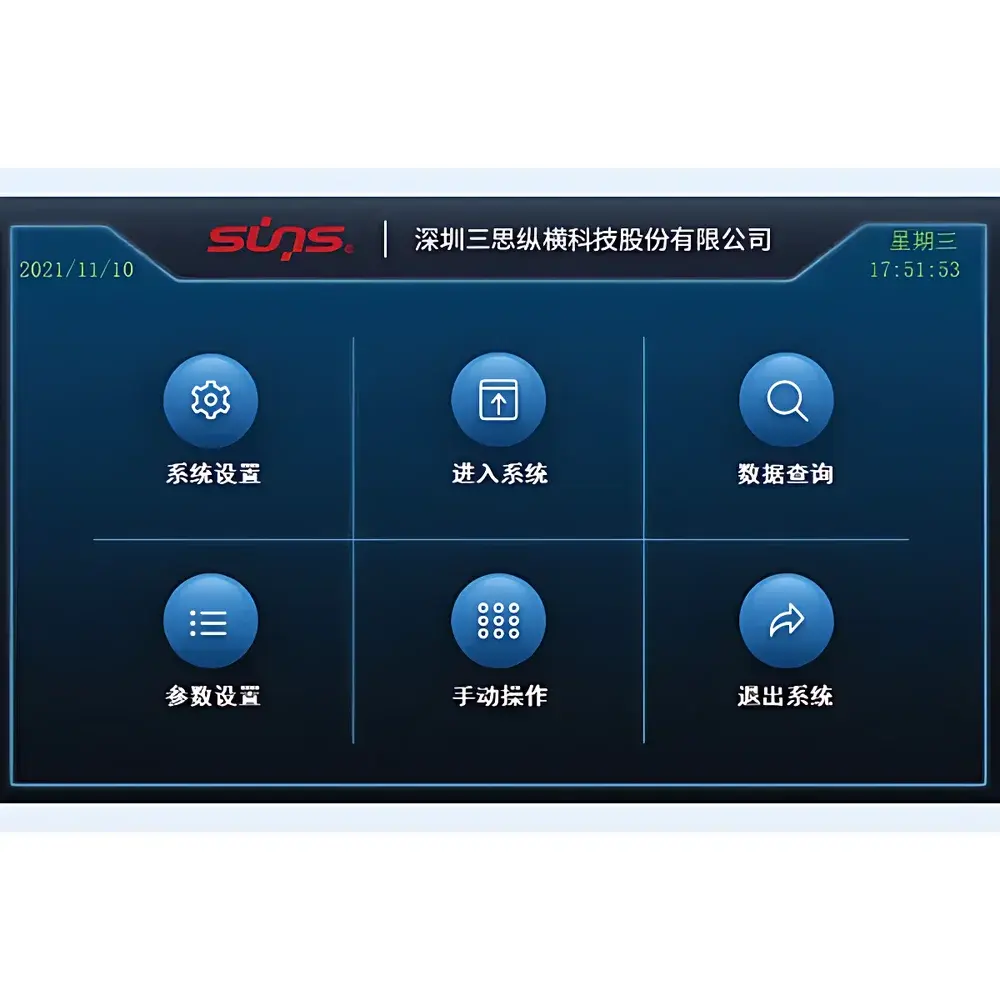
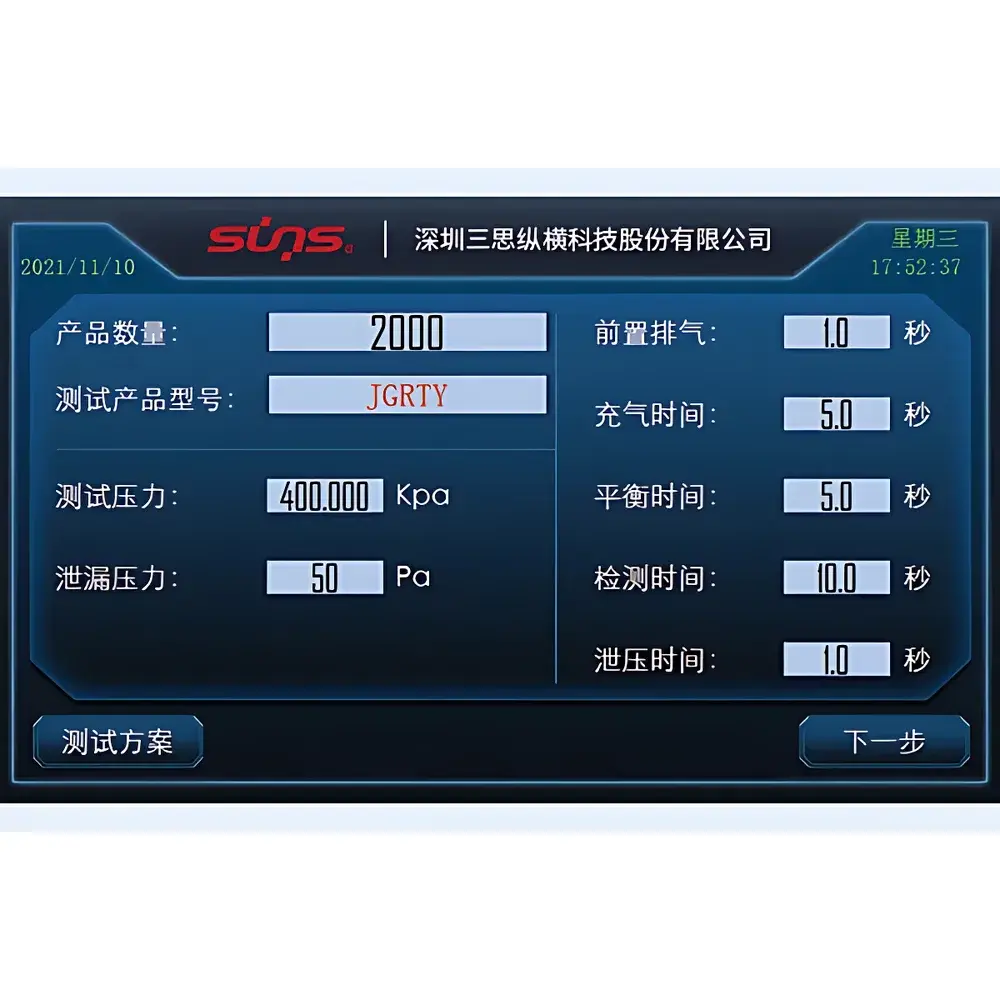
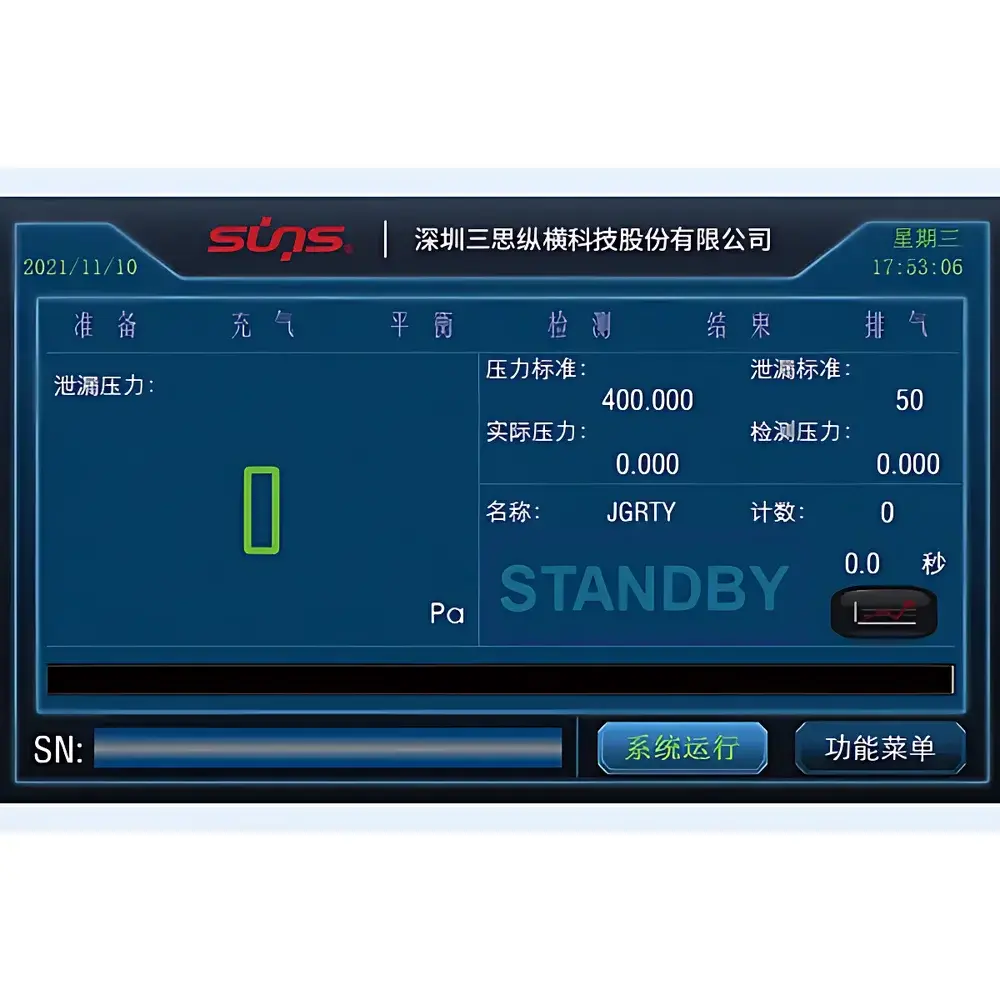
Embedded firmware provides full local control without dependency on external PCs. All configuration, test sequencing, and result review occur via the 7-inch capacitive touchscreen UI—designed for gloved operation and glare-resistant viewing under factory lighting. Historical data is indexed by serial number, batch ID, operator, and UTC timestamp. USB export supports both human-readable reports (PDF) and machine-parseable datasets (CSV with header metadata). Optional cloud synchronization enables centralized dashboarding in platforms such as Tableau or Power BI via configurable webhook triggers on test completion or failure events. Role-based access control (RBAC) enforces separation of duties: operators execute tests, technicians manage calibration, and QA managers approve report templates and audit logs.
Applications
- Automotive: Brake line assemblies, EV coolant reservoirs, turbocharger housings, and airbag inflator modules.
- Medical Devices: Sterile barrier packaging (Tyvek pouches), infusion pump casings, and implantable housing seals.
- Consumer Electronics: Waterproof smartphone enclosures, smartwatch gaskets, and wireless earbud charging cases.
- Industrial Components: Pneumatic valve manifolds, hydraulic accumulator bladders, and vacuum chamber door seals.
- Quality Assurance Labs: Incoming material inspection, in-process verification, and final shipment release testing.
FAQ
What pressure decay method does the STC Series use, and how is it different from differential-pressure testing?
The STC Series implements direct-pressure decay—measuring absolute pressure change in the test part itself—not a reference chamber. This eliminates cross-talk errors inherent in differential systems and simplifies fixture design for low-volume, high-variability parts.
Can the STC be validated for regulated GMP environments?
Yes. It supports IQ/OQ documentation templates, configurable audit trail depth, electronic signature capture, and calibration certificate import—all compliant with Annex 11 and ALCOA+ data integrity principles.
Is temperature compensation applied in real time during testing?
Yes. Dual-sensor thermal profiling feeds into a real-time polynomial correction model embedded in the A/D firmware—no post-processing required.
How many test records can be stored internally before requiring USB export?
Internal NAND flash retains ≥500,000 complete test logs with full waveform data, exceeding typical 12-month production archival needs for single-station deployment.
Does the system support custom pass/fail logic beyond fixed threshold limits?
Yes. Users may define multi-stage acceptance criteria—including ramp rate, stabilization time, and derivative-based anomaly detection—via editable Lua scripts executed onboard.




