
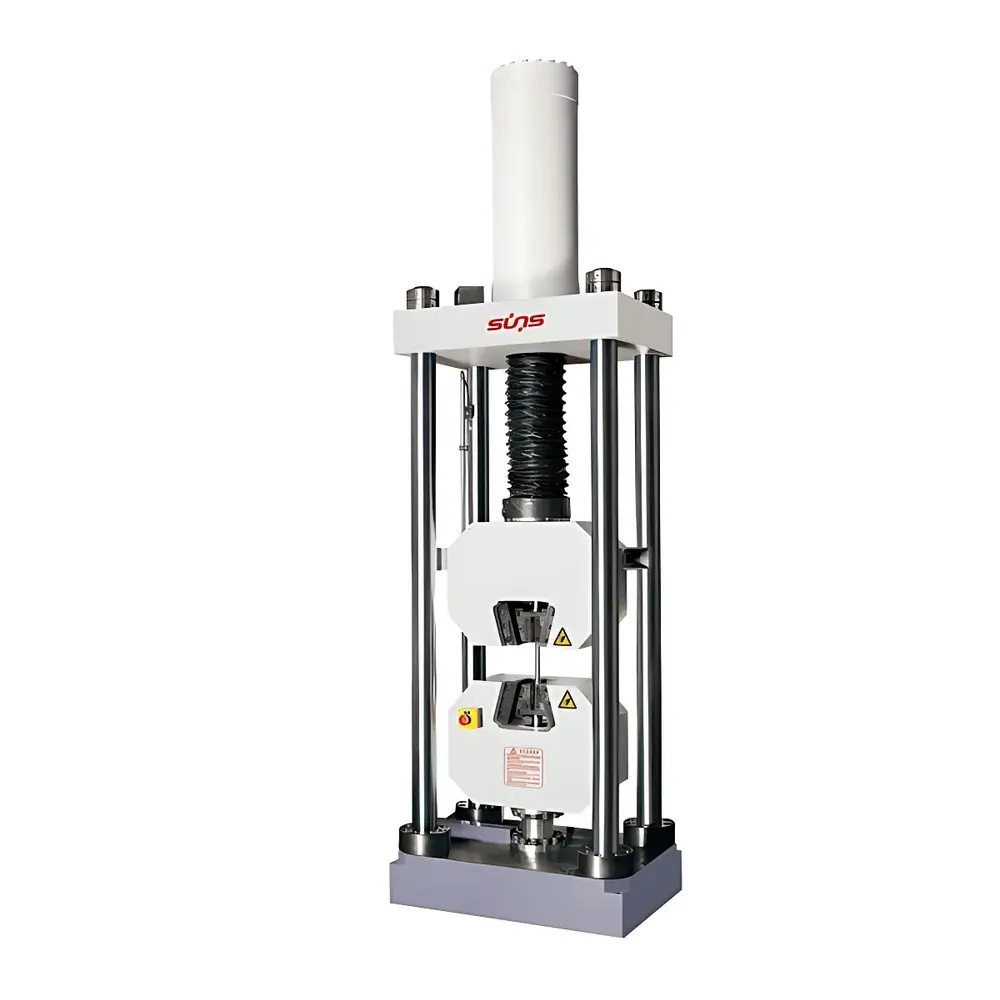
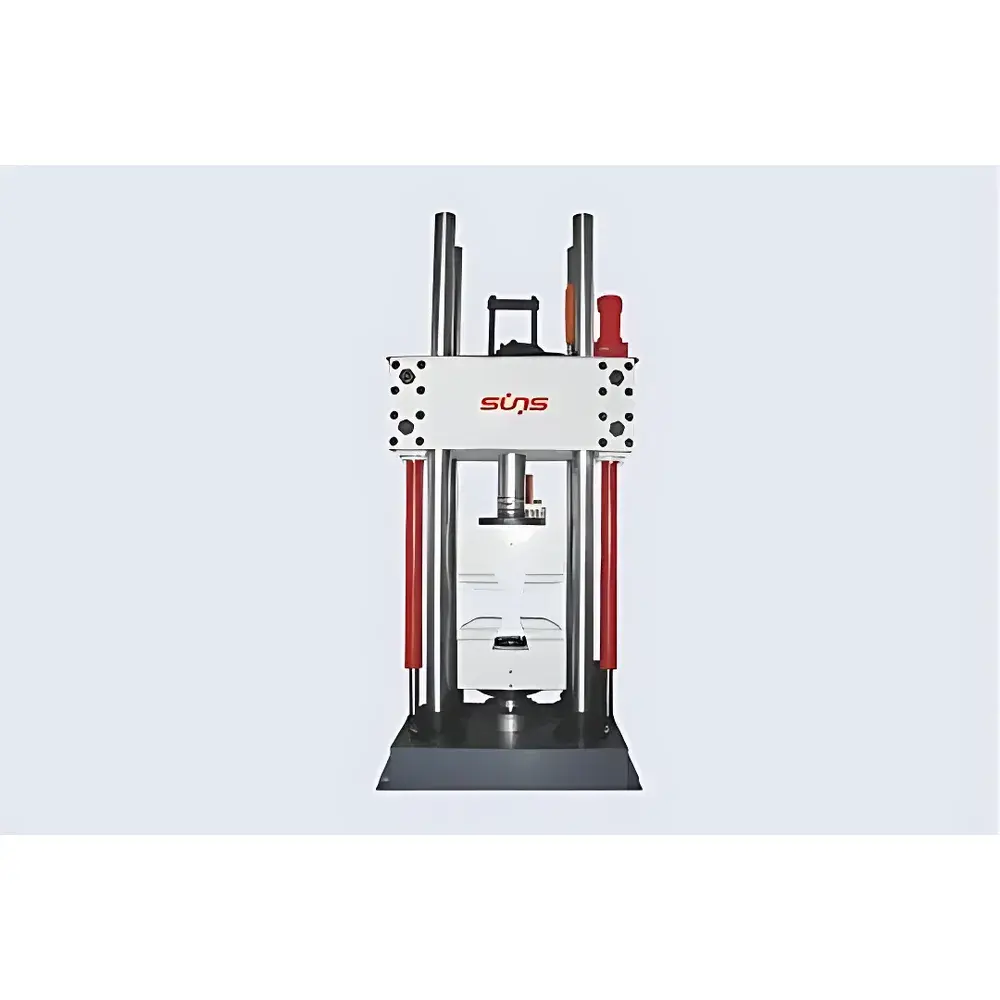
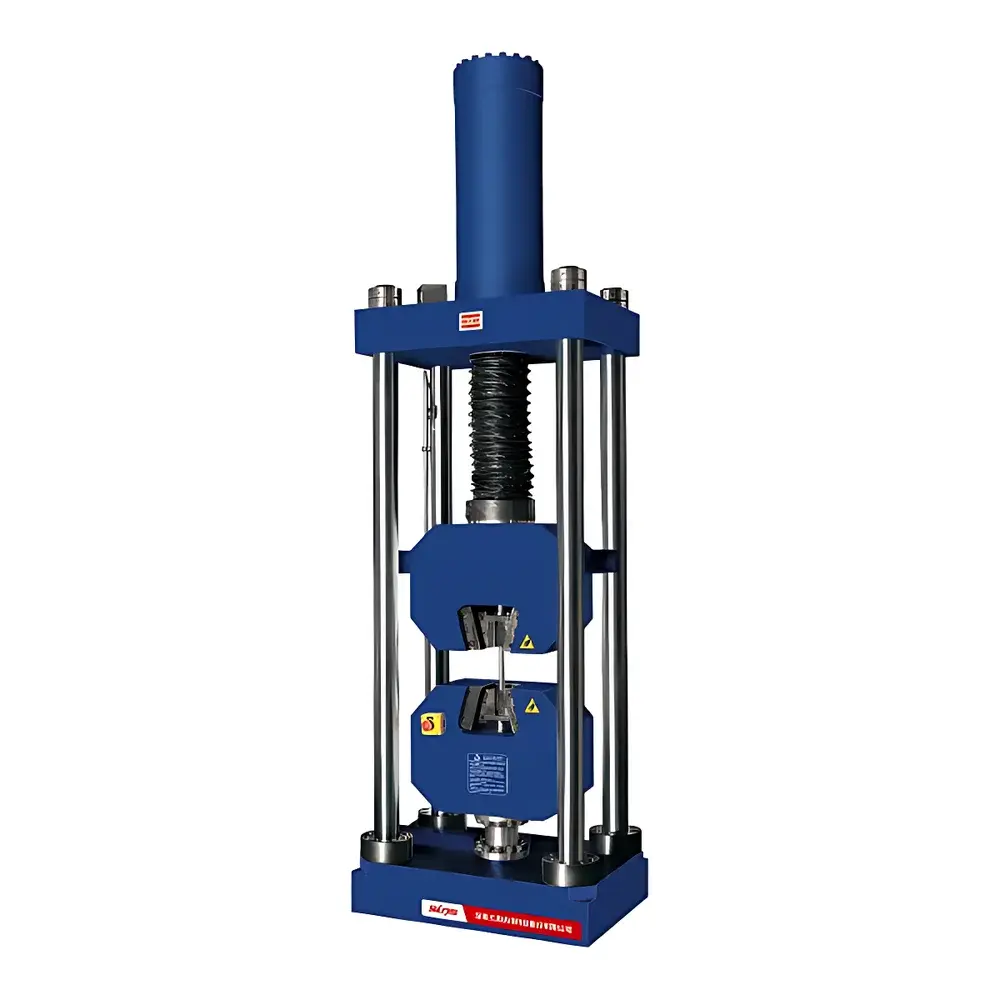
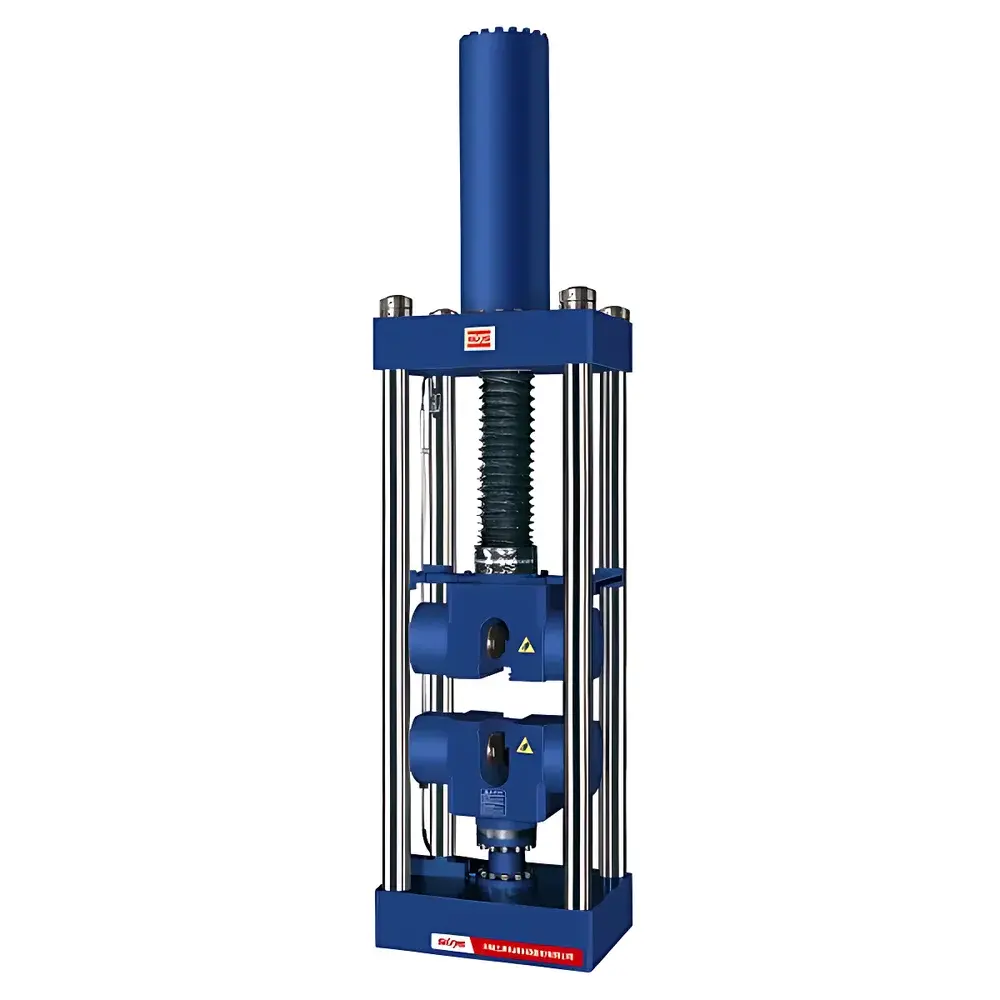
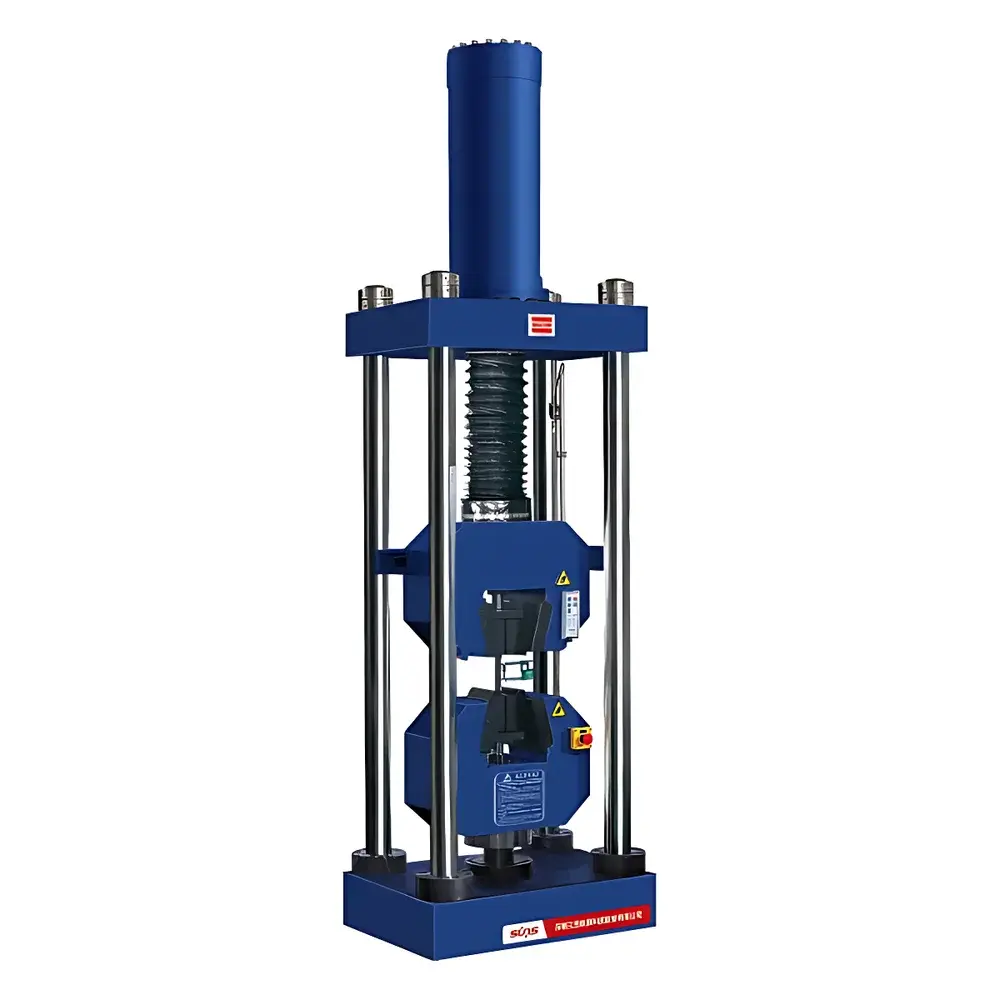
SUNS WAW-D-1 Electro-Hydraulic Servo Universal Testing Machine
| Brand | SUNS |
|---|---|
| Origin | Guangdong, China |
| Manufacturer Type | Manufacturer |
| Product Category | Domestic |
| Model | WAW-D-1 |
| Instrument Type | Electro-Hydraulic Servo Testing Machine |
| Load Capacity Range | 600–2000 kN |
| Load Accuracy | ±0.5% of reading |
Overview
The SUNS WAW-D-1 Electro-Hydraulic Servo Universal Testing Machine is a high-stiffness, single-space, four-column universal testing system engineered for precision mechanical property evaluation of metallic and non-metallic materials under static and quasi-static loading conditions. It operates on the principle of closed-loop electro-hydraulic servo control, where a high-response servo valve regulates hydraulic oil flow to drive a vertically mounted piston actuator—enabling precise force and displacement control across tension, compression, bending, shear, and cyclic loading modes. Designed for structural integrity validation in R&D laboratories, quality control departments, and third-party certification facilities, the WAW-D-1 complies with fundamental mechanical testing frameworks defined in ISO 7500-1 (static calibration of testing machines), ASTM E4 (load verification), and ASTM E8/E21 (tensile testing of metallic materials). Its monolithic steel frame architecture eliminates structural play, ensuring exceptional axial alignment (<0.1 mm/m) and minimal parasitic bending moments during high-force application—critical for generating repeatable, traceable data in accredited environments.
Key Features
- Single-space configuration with adjustable test zone via hydraulic crosshead movement; no mechanical repositioning required between test modes.
- Four-column rigid frame with zero-clearance preloaded tie rods, delivering >95% load path stiffness retention even at 2000 kN full scale.
- High-precision load cell integrated directly into the load train—no lever arms or secondary linkages—to eliminate extraneous bending moments and ensure direct force transduction.
- Friction-lock crosshead positioning mechanism enables rapid, tool-free height adjustment while maintaining positional repeatability within ±0.2 mm.
- Capable of controlled cyclic loading protocols (e.g., low-cycle fatigue simulation) with programmable ramp rates from 200 N/s to 20 kN/s and displacement resolution down to 0.001 mm.
- Hydraulic power unit equipped with dual-stage filtration (10 µm + 3 µm), air-cooled heat exchanger, and variable-frequency pump drive to minimize thermal drift and energy consumption.
Sample Compatibility & Compliance
The WAW-D-1 accommodates a broad spectrum of specimen geometries through interchangeable fixture interfaces conforming to ISO 26203-1 (mechanical testing fixtures) and ASTM E1012 (alignment verification procedures). Standard P-type wedge-action grips support round specimens from φ15 mm to φ60 mm and flat specimens up to 40 mm thick. Optional accessories include flexure fixtures (ASTM D790), shear adapters (ISO 3597), concrete compression platens (φ200 mm, compliant with ASTM C39), bolt tension/proof-load assemblies (ISO 898-1), and modular modular modular modulus-of-elasticity measurement kits. All configurations maintain traceable alignment per ISO 7500-1 Class 0.5 requirements. The system supports compliance workflows aligned with ISO/IEC 17025:2017 (testing laboratory competence), GLP audit trails, and FDA 21 CFR Part 11–ready electronic records when paired with validated software.
Software & Data Management
Control and analysis are executed via SUNS TestMaster™ v5.2—a Windows-based, multi-threaded platform supporting real-time PID parameter tuning, multi-channel synchronized acquisition (force, displacement, extensometer, temperature), and automated test sequencing. Raw data streams are stored in vendor-neutral .csv and .tdms formats with embedded metadata (operator ID, calibration certificate ID, environmental conditions). Audit logs record all user actions—including method edits, calibration events, and result overrides—with time-stamped digital signatures. Export modules generate PDF reports pre-formatted to ISO 6892-1, ASTM E8, and GB/T 228.1-2010 templates, including stress–strain curves, yield point determination (0.2% offset), ultimate tensile strength, elongation at break, and Young’s modulus calculations. Optional integration with LIMS via HL7 or RESTful API enables automated result forwarding to enterprise QA databases.
Applications
- Mechanical characterization of structural steels, aluminum alloys, titanium grades, and high-strength composites per ASTM A370, ISO 6892-1, and GB/T 228.1.
- Compressive strength and elastic modulus testing of cementitious materials (concrete, mortar, grout) in accordance with ASTM C39, C469, and GB/T 50081.
- Proof-load and tensile failure evaluation of fasteners (bolts, studs, anchor rods) per ISO 898-1, ASTM F606, and GB/T 3098.1.
- Bending performance assessment of welded joints, laminated polymers, and ceramic substrates using three- or four-point loading configurations.
- Cyclic loading studies for creep–rupture behavior, relaxation testing, and service-life modeling of elastomeric isolators and civil infrastructure components.
FAQ
What standards does the WAW-D-1 meet for load accuracy verification?
It conforms to ISO 7500-1 Class 0.5 and ASTM E4 requirements for static calibration, with verified linearity, hysteresis, and repeatability within ±0.5% of full scale.
Can the system perform tests requiring high-speed data acquisition?
Yes—the controller supports sampling rates up to 10 kHz on dedicated analog channels, sufficient for dynamic event capture such as fracture initiation or impact-induced load drop.
Is remote diagnostics and firmware updates supported?
Yes—TestMaster™ includes secure SSH-enabled remote maintenance mode with encrypted firmware signing and rollback capability.
How is traceability maintained across calibration cycles?
Each calibration event generates a digitally signed certificate linked to NIST-traceable reference standards; all certificates are archived with version-controlled access rights.
Does the machine support third-party extensometers?
Yes—it provides standardized analog (±10 V) and digital (RS-422) interfaces compatible with major OEM extensometers (e.g., MTS, Zwick, Instron) meeting ISO 9513 Class 1 requirements.



