SunScan Canopy Analyzer System
| Origin | UK |
|---|---|
| Manufacturer Type | Authorized Distributor |
| Origin Category | Imported |
| Model | SunScan |
| Pricing | Upon Request |
| Measurement Principle | Photosynthetically Active Radiation (PAR) Profiling |
Overview
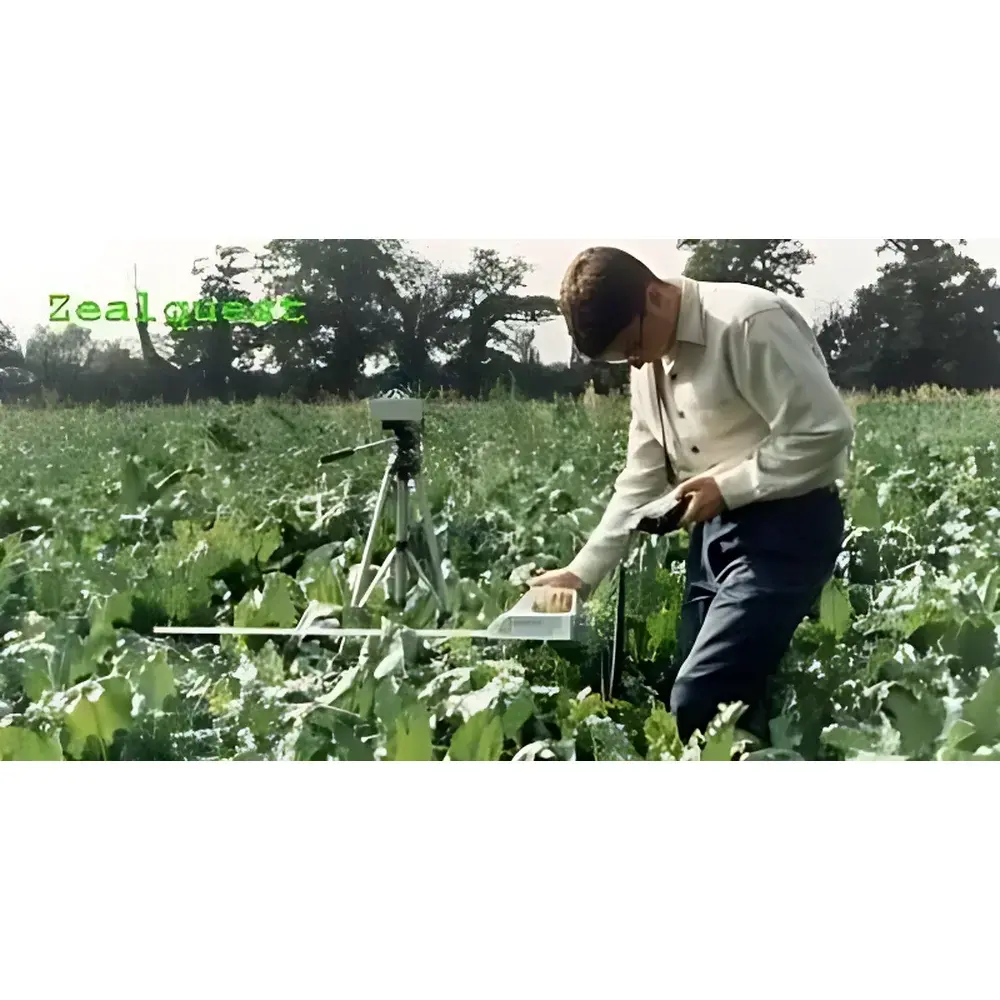
The SunScan Canopy Analyzer System is a field-deployable, precision optical instrument engineered for quantitative assessment of light interception and distribution within plant canopies. It operates on the fundamental principle of photosynthetically active radiation (PAR) profiling—measuring photon flux density (400–700 nm) across a linear sensor array to derive biophysically meaningful canopy structural parameters. By integrating Beer’s law of canopy absorption, Wood’s SunScan inversion algorithm, and Campbell’s ellipsoidal leaf angle distribution (LAD) model, the system computes Leaf Area Index (LAI), gap fraction, light extinction coefficients, and vertical PAR gradients with high reproducibility under natural solar illumination. Unlike passive imaging or indirect estimation methods, SunScan delivers direct, in-situ, spatially resolved PAR measurements—enabling rigorous validation of canopy radiative transfer models and supporting mechanistic studies in crop physiology, agroecology, and climate-resilient breeding programs.
Key Features
- 1-m linear probe housing 64 calibrated quantum sensors (400–700 nm spectral response), spaced at 15.6 mm intervals, enabling high-resolution horizontal PAR profiling across heterogeneous canopies.
- Integrated BF3 reflectance sensor—dual-PAR head measuring incident and transmitted irradiance simultaneously—to compute beam fraction (direct/diffuse PAR ratio) and normalize canopy transmittance without requiring external reference measurements.
- Rugged PDA-based data terminal (RPDA1) running Windows Mobile 6, featuring real-time LAI calculation, on-device averaging of sensor arrays, and robust environmental tolerance (–30 °C to +60 °C; 1.2 m drop-tested).
- High-speed acquisition (120 ms per full scan), resolution of 0.3 µmol·m⁻²·s⁻¹, and dynamic range up to 2500 µmol·m⁻²·s⁻¹—optimized for full-sun conditions and dense vegetation.
- Optional 434 MHz radio link (BF-RL4 + SS1-RL4 modules) eliminates cabling constraints, enabling wireless operation over line-of-sight distances up to 250 m—critical for tall-stature crops (e.g., maize, sugarcane) and large-scale plot monitoring.
- Expandable onboard memory (>100 MB user space; supports CF card expansion) capable of storing >1,000,000 discrete readings, with RS232 (9-pin D-sub) interface for legacy device integration and field data offload.
Sample Compatibility & Compliance
SunScan is validated for use across herbaceous and woody species—including cereals, legumes, vineyards, orchards, and perennial grasslands—under ambient field conditions. Its non-destructive, contactless measurement protocol complies with ISO 11727:2017 (optical measurement of plant structure) and aligns with FAO-recommended protocols for LAI standardization in agronomic trials. The BF3 sensor’s dual-head geometry satisfies ASTM E2915-22 requirements for spectral irradiance ratio measurement accuracy. Data integrity is maintained through timestamped, GPS-tagged (when paired with external module) acquisitions, supporting GLP-compliant field documentation and traceability in regulatory or multi-site phenotyping studies.
Software & Data Management
SunData software provides comprehensive post-processing capabilities: automated LAI inversion using Campbell’s LAD model, gap fraction mapping, PAR extinction profile fitting, and export of time-series and spatial matrices in CSV, Excel, and NetCDF formats. The software supports batch processing of RPDA1-collected datasets, generates publication-ready plots (vertical PAR profiles, LAI heatmaps), and enables comparison against radiative transfer simulations (e.g., SAIL, 4SAIL). All raw sensor outputs retain full metadata (probe orientation, date/time, temperature, battery level), satisfying audit requirements under FDA 21 CFR Part 11 when used in GxP-aligned agricultural research environments.
Applications
- Quantifying canopy architecture dynamics during phenological development (e.g., tillering, silking, senescence) in cereal and oilseed breeding programs.
- Evaluating shade tolerance and light-use efficiency in intercropping systems and agroforestry designs.
- Calibrating and validating satellite-derived LAI products (e.g., Sentinel-2, Landsat) at ground-truth validation sites.
- Assessing microclimate modification by cover crops or mulches in conservation agriculture trials.
- Supporting carbon assimilation modeling via coupling with eddy covariance or chamber-based gas exchange data.
FAQ
What is the minimum recommended sample area for reliable LAI estimation?
A minimum transect length of 3 m is advised to ensure statistical representativeness across spatial heterogeneity; shorter scans may be used for comparative trend analysis but require replication.
Can SunScan operate under cloudy or low-light conditions?
Yes—the system maintains calibration stability down to 50 µmol·m⁻²·s⁻¹; however, LAI inversion accuracy improves under diffuse-dominant conditions where beam fraction correction is minimized.
Is SunData software compatible with modern Windows OS versions?
SunData v4.x runs natively on Windows 10/11 via compatibility mode; exported data files are fully interoperable with Python (NumPy/Pandas), R, and MATLAB for advanced statistical modeling.
How is sensor drift corrected during long-term deployments?
The BF3 reference sensor enables daily zero-point verification; factory recalibration is recommended every 24 months or after mechanical impact, following ISO/IEC 17025-accredited service procedures.
Does the RPDA1 support external GPS or Bluetooth peripherals?
RPDA1 features a serial expansion port compatible with third-party GPS receivers (NMEA 0183); Bluetooth is not natively supported, but USB-to-Bluetooth adapters may be used with driver-level configuration.