
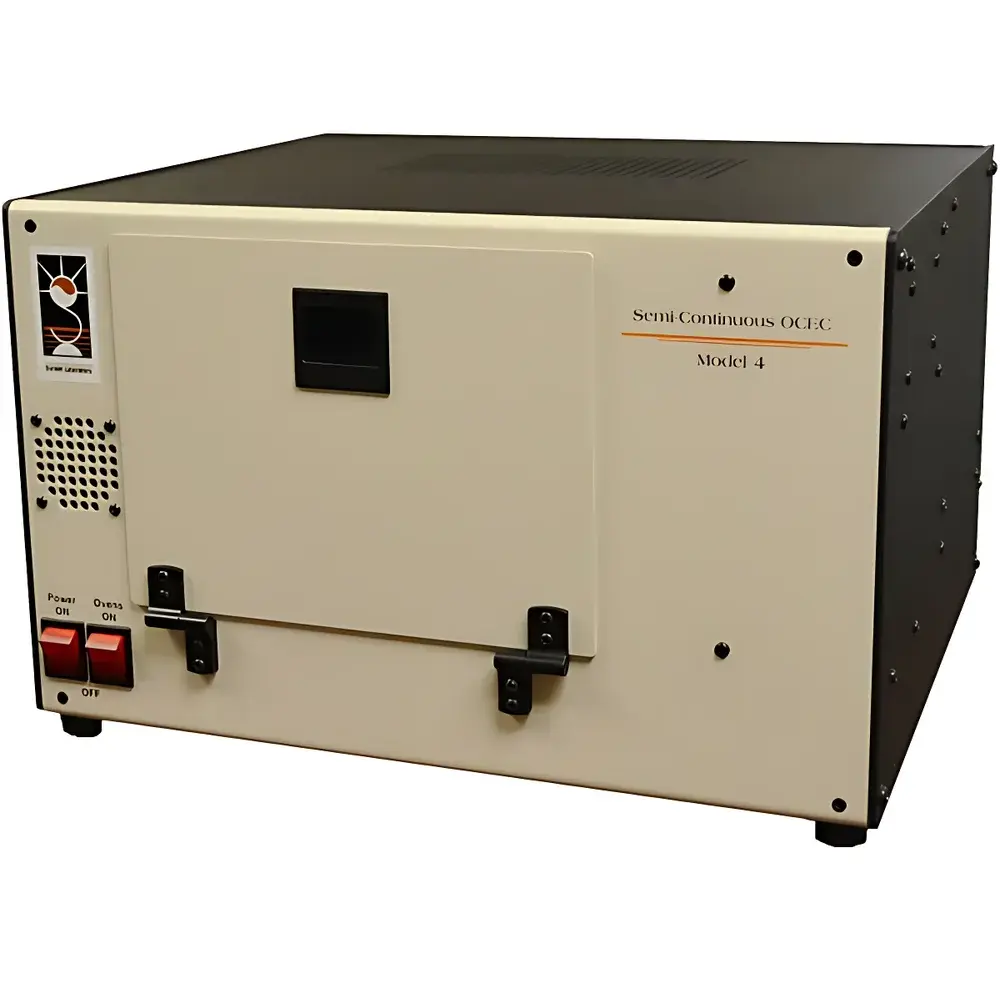
Sunset Laboratory Model 4 Organic Carbon/Elemental Carbon Online Analyzer
| Brand | SAIL HERO (Xianhe Environmental Protection) |
|---|---|
| Origin | USA |
| Manufacturer | Sunset Laboratory, Inc. |
| Instrument Type | Aerosol Carbon Analyzer |
| Compliance | NIOSH Method 5040, IMPROVE, STN protocols |
| Calibration Standards | NIST-traceable sucrose solution and CH₄/He (5% CH₄ in He) calibration gas |
| Detection Principle | Thermal-Optical Transmittance (TOT) with real-time laser transmittance monitoring |
| Operating Mode | Semi-continuous automated cycle (sampling → analysis → sampling → analysis…) |
| Data Output | Continuous real-time OC/EC mass concentrations (µg/m³), split point identification, charring correction |
| Gas Control | Electronically regulated proportional pressure control system with computer-managed flow paths |
| Laser System | High-stability 635 nm diode laser with precision optical alignment and thermal drift compensation |
| Heater Assembly | Long-life quartz tube furnace with adaptive power regulation and ±0.5°C temperature stability |
| Sample Substrate | Pre-baked quartz fiber filter tape (25 mm diameter) |
| Flow Control Accuracy | ±1.5% of setpoint across 0.1–2.0 L/min range |
| Environmental Compensation | Automatic T&P correction using integrated temperature/pressure sensors |
Overview
The Sunset Laboratory Model 4 Organic Carbon/Elemental Carbon Online Analyzer is an industrial-grade, semi-continuous aerosol carbon analyzer engineered for unattended, long-term ambient or stack monitoring of organic carbon (OC) and elemental carbon (EC) mass concentrations. It implements the Thermal-Optical Transmittance (TOT) method—recognized as the reference measurement technique by U.S. EPA, IMPROVE, STN, and NIOSH Method 5040—to thermally separate and quantify carbon fractions through controlled heating in inert (He) and oxidative (He/O₂) atmospheres while simultaneously tracking optical attenuation of a 635 nm laser beam transmitted through the quartz filter substrate. This dual-mode thermal-optical detection enables robust charring correction and precise identification of the OC/EC split point—the critical inflection where pyrolyzed carbon transitions from optically absorbing to oxidized. Designed for regulatory-grade compliance and field-deployable reliability, the Model 4 integrates fully automated sample handling, real-time laser-based EC accumulation monitoring during sampling, and post-analysis optical verification of carbon evolution profiles.
Key Features
- Semi-continuous operation with programmable cycle intervals (e.g., 30–120 min per analysis), enabling high-temporal-resolution time-series data without manual intervention
- Integrated dual-stage thermal desorption: programmable ramped heating (up to 850°C) under helium (OC evolution) followed by oxygen-enriched atmosphere (EC oxidation)
- Real-time laser transmittance monitoring throughout both sampling and analysis phases—providing continuous feedback on EC deposition kinetics and thermal evolution dynamics
- Electronically regulated proportional pressure control system ensuring stable, repeatable carrier gas flows (0.1–2.0 L/min) with ±1.5% accuracy, independent of ambient barometric fluctuations
- Self-calibrating optical path with active thermal stabilization and precision alignment—maintaining laser intensity stability within ±0.3% over 72-hour operation
- Long-life quartz furnace assembly featuring adaptive power regulation, rapid thermal response (<60 s to target temperature), and ±0.5°C isothermal zone stability
- Computer-controlled gas switching manifold supporting up to four independent gas lines (He, O₂, CH₄/He calibration gas, purge)
Sample Compatibility & Compliance
The Model 4 accepts standard 25 mm pre-baked quartz fiber filters (QFF) mounted on proprietary filter tape cartridges, compatible with common PM₂.₅ and PM₁₀ inlet systems. It meets performance criteria outlined in U.S. EPA OTM-11 and ASTM D7520–22 for carbonaceous aerosol speciation. Its analytical output is directly traceable to NIST SRM 1649b (Urban Dust) and NIST-traceable sucrose solutions. The instrument satisfies data integrity requirements for regulatory reporting under 40 CFR Part 58 and supports GLP/GMP-aligned audit trails via timestamped event logging. All operational parameters—including temperature ramps, gas flows, laser voltage, and transmittance signals—are recorded at 1 Hz resolution and archived with metadata compliant with ISO/IEC 17025 documentation standards.
Software & Data Management
Control and data acquisition are managed via Sunset’s proprietary OC/EC Analysis Suite v5.x, a Windows-based application supporting remote configuration, method scheduling, real-time visualization of thermal-optical chromatograms, and automatic split-point determination using NIOSH 5040 algorithm variants. Raw sensor data (laser transmittance, thermocouple readings, flow rates, valve states) are stored in HDF5 format with embedded calibration coefficients and environmental metadata. Export options include CSV, NetCDF, and EPA-compatible .DAT formats. The software enforces 21 CFR Part 11-compliant user access controls, electronic signatures, and immutable audit logs for all method changes, calibration events, and data exports—ensuring full traceability for regulatory submissions and third-party validation.
Applications
- Ambient air quality monitoring networks (e.g., IMPROVE, CASTNET, EMEP) requiring speciated carbon data for source apportionment modeling
- Industrial stack emissions compliance testing for combustion facilities, waste incinerators, and biomass energy plants
- Indoor air quality assessments in occupational health studies involving diesel particulate exposure
- Climate research campaigns measuring light-absorbing carbon (BC/EC) radiative forcing potential
- Method development and intercomparison studies validating new OC/EC measurement techniques against TOT reference
FAQ
What calibration standards are required for routine operation?
Primary calibration uses NIST-traceable sucrose solution nebulized onto blank filters; secondary verification employs certified 5% CH₄/He gas injected post-analysis to correct for instrument drift.
How does the instrument handle charring artifacts during OC pyrolysis?
The TOT algorithm continuously compares laser transmittance loss during heating with concurrent CO₂ signal rise, dynamically adjusting the OC/EC split point to minimize charring-induced bias.
Is the system compatible with existing air sampling infrastructure?
Yes—it interfaces seamlessly with standard PM₂.₅/PM₁₀ inlets, flow controllers, and data loggers via analog (4–20 mA) and digital (RS-232/Ethernet) I/O ports.
What maintenance intervals are recommended for unattended field deployment?
Laser alignment verification every 90 days; quartz furnace inspection and filter tape cartridge replacement every 30 days under continuous operation.
Can the instrument be operated remotely in无人值守 mode?
Yes—fully automated cycle execution, self-diagnostic routines, email/SMS alerting for fault conditions, and secure VPN-enabled remote desktop access ensure reliable 24/7 operation.
Related Products







