
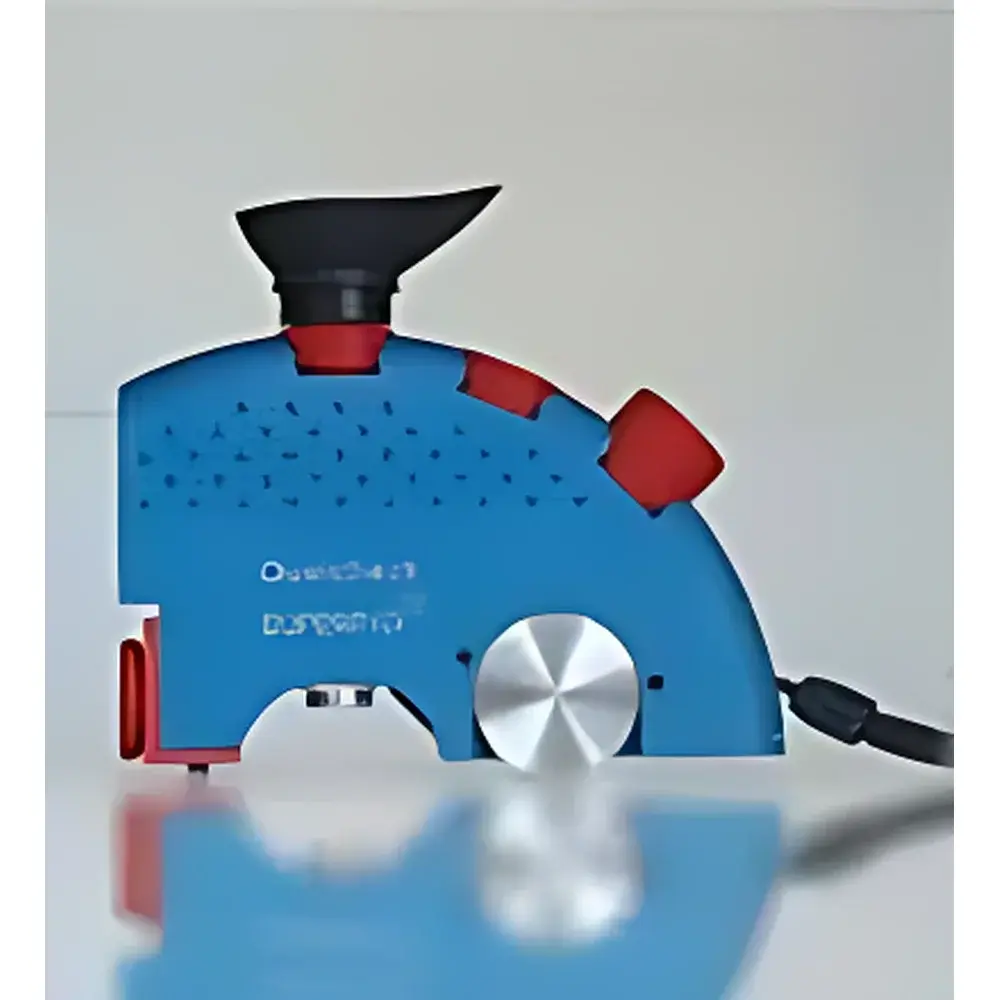
Super-Pig Destructive Dry Film Thickness Gauge
| Origin | Netherlands |
|---|---|
| Manufacturer Type | Authorized Distributor |
| Origin Category | Imported |
| Model | Super-Pig |
| Pricing | Upon Request |
Overview
The Super-Pig Destructive Dry Film Thickness Gauge is a precision-engineered, hand-held mechanical instrument designed for the quantitative measurement of individual layer thicknesses in multi-coat systems applied to rigid substrates. Unlike non-destructive methods (e.g., magnetic induction or eddy current), this gauge operates on the principle of controlled cross-sectional cutting and optical magnification—making it particularly suitable for validation-critical environments where layer-by-layer compositional verification is required. Engineered to ASTM D4138 and ISO 2808 Annex B standards for destructive film thickness measurement, the Super-Pig delivers traceable, repeatable results on metallic, plastic, wood, and composite surfaces—provided substrate rigidity supports stable blade engagement and clean cut formation.
Key Features
- V-groove precision cutting blade with hardened steel geometry, optimized for consistent kerf width and minimal substrate deformation during incision
- Integrated 50× achromatic eyepiece with parfocal design and adjustable focus ring for high-contrast layer boundary resolution
- High-intensity LED illumination system with continuous brightness control and heat-dissipating thermal management
- Ocular shade hood to eliminate ambient light interference—ensuring stable visual contrast under variable laboratory or field lighting conditions
- Anodized aluminum base plate with integrated stainless-steel guide rollers for uniform forward pressure and linear blade travel
- Onboard accessory storage compartment with molded foam inserts, accommodating spare blades, calibration shims, and cleaning tools
Sample Compatibility & Compliance
The Super-Pig is validated for use on flat or gently curved rigid substrates with surface hardness ≥ 2H (pencil hardness scale) and minimum radius of curvature > 50 mm. Compatible coating systems include epoxy, polyurethane, alkyd, acrylic, and powder coatings—provided interlayer adhesion is sufficient to prevent delamination during sectioning. It is not recommended for soft thermoplastics, elastomeric coatings, or substrates exhibiting creep under localized mechanical load. The instrument complies with ISO/IEC 17025 requirements for test equipment used in accredited laboratories and supports GLP documentation workflows through manual logbook integration. Calibration verification is performed using NIST-traceable step-height reference standards (e.g., NIST SRM 2149).
Software & Data Management
As a fully mechanical, analog optical instrument, the Super-Pig requires no firmware, drivers, or proprietary software. All measurements are recorded manually into standardized test reports aligned with ASTM D4138 reporting templates. For digital traceability, users may integrate readings into LIMS or ELN platforms via structured CSV import or direct entry into validated electronic notebooks. Optional accessories—including calibrated stage micrometers and digital image capture adapters—enable semi-automated documentation when paired with compliant microscope imaging systems meeting FDA 21 CFR Part 11 audit trail requirements.
Applications
- Quality assurance of protective coating systems in marine, offshore, and infrastructure maintenance programs
- Failure analysis of delamination or intercoat adhesion defects in automotive OEM and refinish operations
- Validation of coating build-up sequences during aerospace primer/topcoat qualification per AMS-C-83286
- Third-party inspection services requiring physical evidence of compliance with SSPC-PA 2 or ISO 19840 dry film thickness tolerances
- Research and development of multi-layer functional coatings (e.g., anti-corrosion + UV-resistant topcoats) where interlayer thickness ratios impact performance
FAQ
Is the Super-Pig suitable for measuring coatings on flexible substrates such as rubber or thin sheet metal?
No—its mechanical cutting mechanism requires substrate rigidity to maintain dimensional stability during sectioning. Flexible or low-modulus materials will deflect, resulting in inaccurate kerf geometry and unreliable layer delineation.
Does the instrument require periodic recalibration by an external service provider?
No scheduled recalibration is mandated; however, users must verify blade sharpness and optical alignment before each measurement session using certified reference standards. A full metrological check is recommended annually or after 500 cuts.
Can the 50× eyepiece be replaced with higher-magnification optics?
No—the optical train is factory-aligned and sealed. Substitution of components voids traceability and compromises conformance with ISO 2808 Annex B measurement uncertainty budgets.
What safety precautions apply during operation?
Operators must wear ANSI Z87.1-compliant safety glasses and cut-resistant gloves. Blade replacement must be performed using the supplied torque-limited tool to preserve V-groove angular tolerance (±0.5°).



