
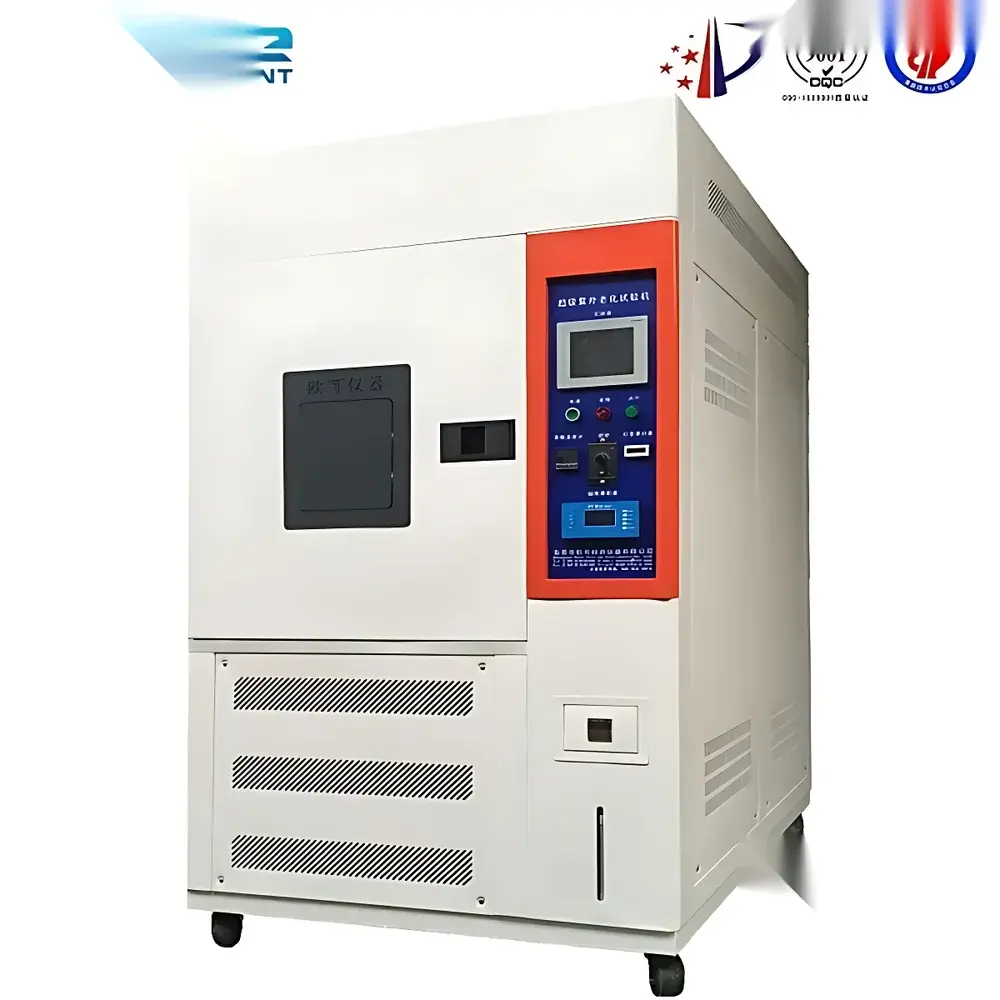
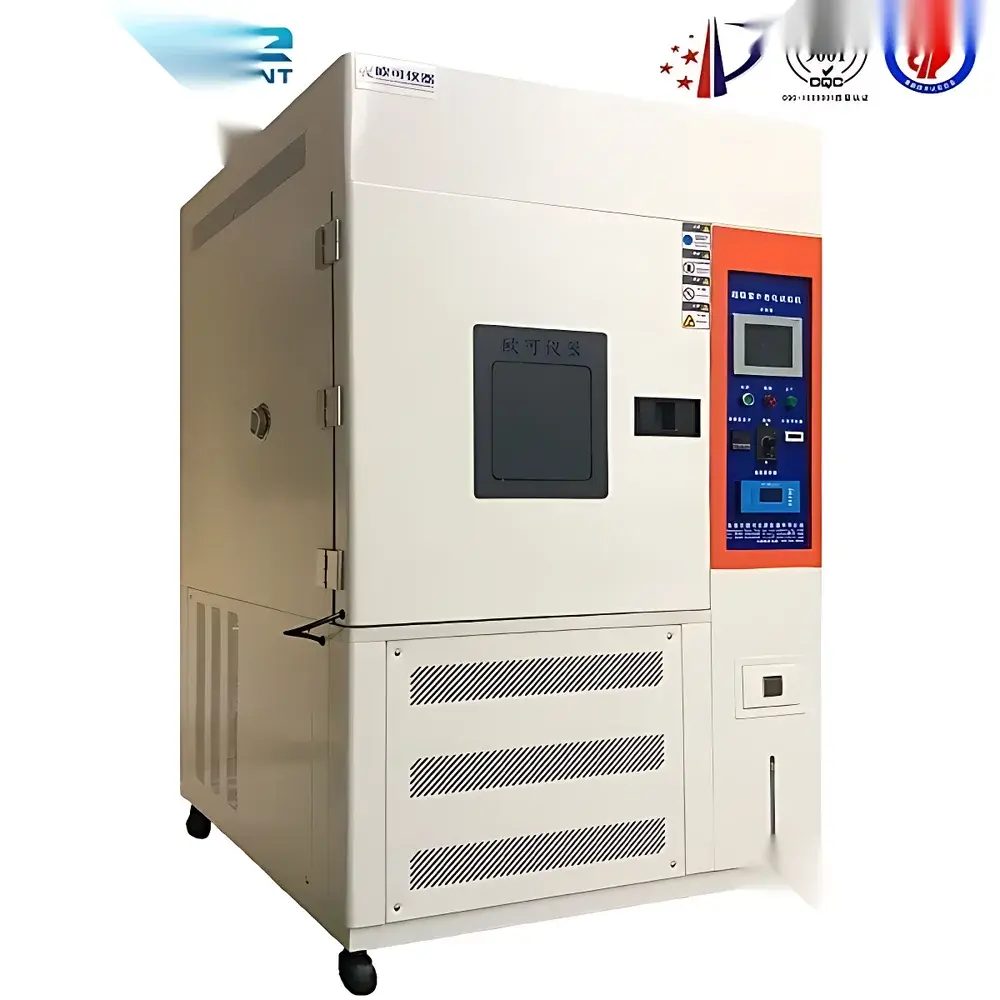
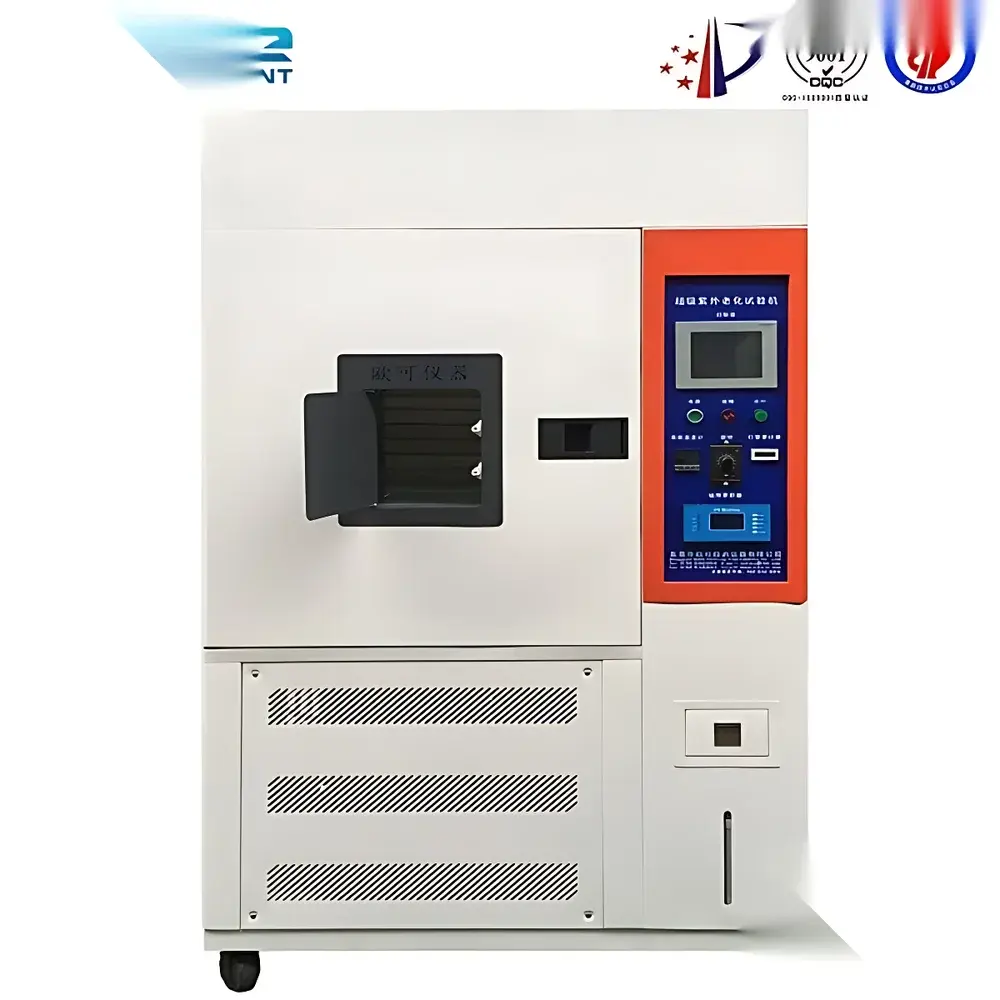
Super QUV UV Aging Test Chamber
| Brand | Other Brands |
|---|---|
| Origin | Imported |
| Manufacturer Type | Authorized Distributor |
| Temperature Range | RT to 85 °C (Operating Range: 50 ±10 °C) |
| Humidity Range | 40–70 % RH (Illuminated), 50–90 % RH (Dark Cycle) |
| Temperature Control Accuracy | ±0.5 °C |
| Humidity Control Accuracy | ±2.0 % RH |
| Temperature Uniformity | ±2.0 °C |
| Humidity Uniformity | ±3.0 % RH |
| Heating Time | ≤25 min (RT → 85 °C) |
| Light Source | 2.5 kW Air-Cooled Metal Halide Lamp (1 unit) |
| Sample Tray Dimensions | 500 × 400 mm |
| Irradiation Geometry | Top-mounted lamp with reflective direct irradiation |
| Spectral Range | 295–450 nm |
| Irradiance Level | 200 ±8 W/m² |
| UV Sensor | Calibrated UV Spectral Irradiance Transmitter (developed by No. 622 Research Institute) |
| Filter Requirement | Optional 30 % IR-reducing filter |
| Irradiance Monitoring | LCD-based integrated radiometric energy integrator |
Overview
The Super QUV UV Aging Test Chamber is an engineered environmental test system designed for accelerated photochemical degradation assessment of materials exposed to solar ultraviolet radiation under controlled thermal and hygrothermal conditions. Unlike fluorescent UV lamps used in conventional QUV testers, this chamber employs a high-intensity air-cooled metal halide lamp whose unfiltered spectral output closely approximates terrestrial solar irradiance between 295 nm and 450 nm—encompassing the biologically and chemically active UV-B and UV-A bands as well as the short-wavelength visible region critical for photopolymerization, pigment fading, and polymer chain scission. The system implements a solar-simulated irradiation profile through a proprietary optical filtering assembly that attenuates ~30 % of infrared energy while preserving spectral fidelity across the target band. This enables reproducible simulation of natural sunlight-driven aging mechanisms—including chalking, gloss loss, color shift, embrittlement, and delamination—in automotive assemblies, photovoltaic modules, aerospace composites, and industrial electronics enclosures.
Key Features
- High-fidelity solar-spectrum irradiation via 2.5 kW air-cooled metal halide lamp, calibrated to deliver 200 ±8 W/m² irradiance across 295–450 nm
- Integrated UV spectral irradiance transmitter (developed by No. 622 Research Institute) enabling real-time, traceable radiometric monitoring
- Precise dual-parameter control: temperature (RT to 85 °C, ±0.5 °C accuracy) and relative humidity (40–90 % RH, ±2.0 % RH accuracy) with independent dark/light cycle programming
- Optimized chamber geometry and reflective irradiation architecture achieving ≥90 % irradiance uniformity over 500 × 400 mm sample plane
- LCD-based radiometric energy integrator with automatic cumulative dose calculation (J/m² or kWh/m²), supporting ISO 4892-2, ASTM G154, and SAE J2020 compliance reporting
- Modular optical filtration system accommodating optional IR-reducing filters for enhanced thermal load management during extended exposure protocols
Sample Compatibility & Compliance
The chamber accommodates full-scale components—including automotive body panels, solar panel laminates, outdoor lighting housings, and large-format printed circuit board assemblies—on its standard 500 × 400 mm sample tray. Its thermal mass and airflow design ensure stable boundary conditions even with high-absorptivity or thermally heterogeneous specimens. The system supports testing per internationally recognized standards including ISO 4892-2 (Plastics — Methods of exposure to laboratory light sources — Part 2: Xenon-arc lamps), ASTM G154 (Standard Practice for Operating Fluorescent Ultraviolet (UV) Lamp Apparatus for Exposure of Nonmetallic Materials), and SAE J2020 (Surface Vehicle Recommended Practice — Accelerated Exposure of Automotive Exterior Materials Using a Controlled Irradiance Water Cooled Xenon Arc Apparatus). While optimized for metal halide-based solar simulation, its programmable irradiance and environmental profiles allow method adaptation for GLP-compliant qualification studies requiring audit-trail-capable exposure logs.
Software & Data Management
The embedded controller provides intuitive touchscreen operation with password-protected parameter locking, multi-step exposure sequencing, and time-stamped event logging. All irradiance, temperature, and humidity measurements are recorded at user-defined intervals (1 s to 60 min resolution) and exportable via USB to CSV format. The system stores ≥10,000 data points per test cycle and maintains a non-volatile history of calibration events, sensor drift corrections, and lamp usage hours. For regulated environments, optional firmware upgrade enables 21 CFR Part 11–compliant electronic signatures, audit trails, and role-based access control—facilitating integration into enterprise quality management systems (QMS) aligned with ISO 17025 and ICH Q5C requirements.
Applications
- Accelerated weathering validation of automotive exterior trim, coatings, and sealants per OEM-specific specifications (e.g., GMW14872, Ford CETP 00.00-L-467)
- Photostability assessment of crystalline silicon PV modules and encapsulant materials (EVA, POE) under combined UV/thermal stress
- Qualification testing of outdoor-rated electrical enclosures, cable jackets, and insulating polymers per UL 746C and IEC 61215
- Material screening for architectural glazing, signage films, and agricultural greenhouse covers subjected to long-term solar exposure
- Research into UV-induced degradation kinetics of biomedical polymers and drug packaging materials under simulated ambient conditions
FAQ
What distinguishes the metal halide lamp in this chamber from standard UV fluorescent lamps?
Metal halide lamps produce a continuous, broadband spectrum closely matching terrestrial solar UV/visible irradiance (295–450 nm), whereas fluorescent UV lamps emit narrow-line spectra centered at 313 nm or 340 nm—limiting their ability to replicate synergistic photochemical effects.
Can irradiance be adjusted during a test cycle?
Yes—the system supports dynamic irradiance ramping and stepwise modulation via programmable exposure profiles, enabling simulation of diurnal intensity variation or seasonal spectral shifts.
Is calibration traceable to national standards?
The UV spectral irradiance transmitter is factory-calibrated against NIM (National Institute of Metrology, China) reference standards; users may perform on-site verification using NIST-traceable reference sensors.
What maintenance is required for long-term operational reliability?
Lamp replacement every 1,200–1,500 operating hours, quarterly verification of humidity sensor response, and annual recalibration of the irradiance transducer are recommended per ISO/IEC 17025 maintenance guidelines.
Does the system support cyclic exposure protocols with condensation phases?
While primarily configured for irradiance-controlled dry/wet cycles, optional humidification and condensate collection accessories enable modified ASTM G154 Cycle 4–type protocols upon request.



