
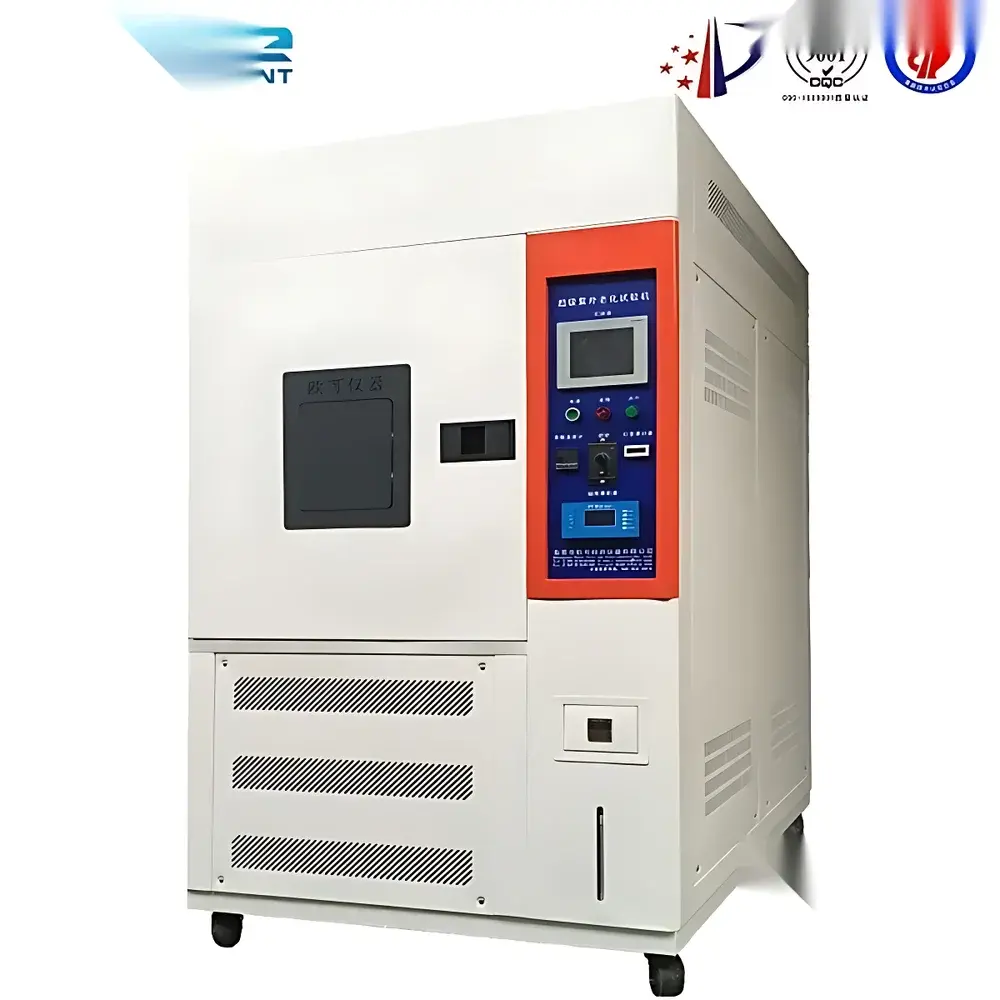
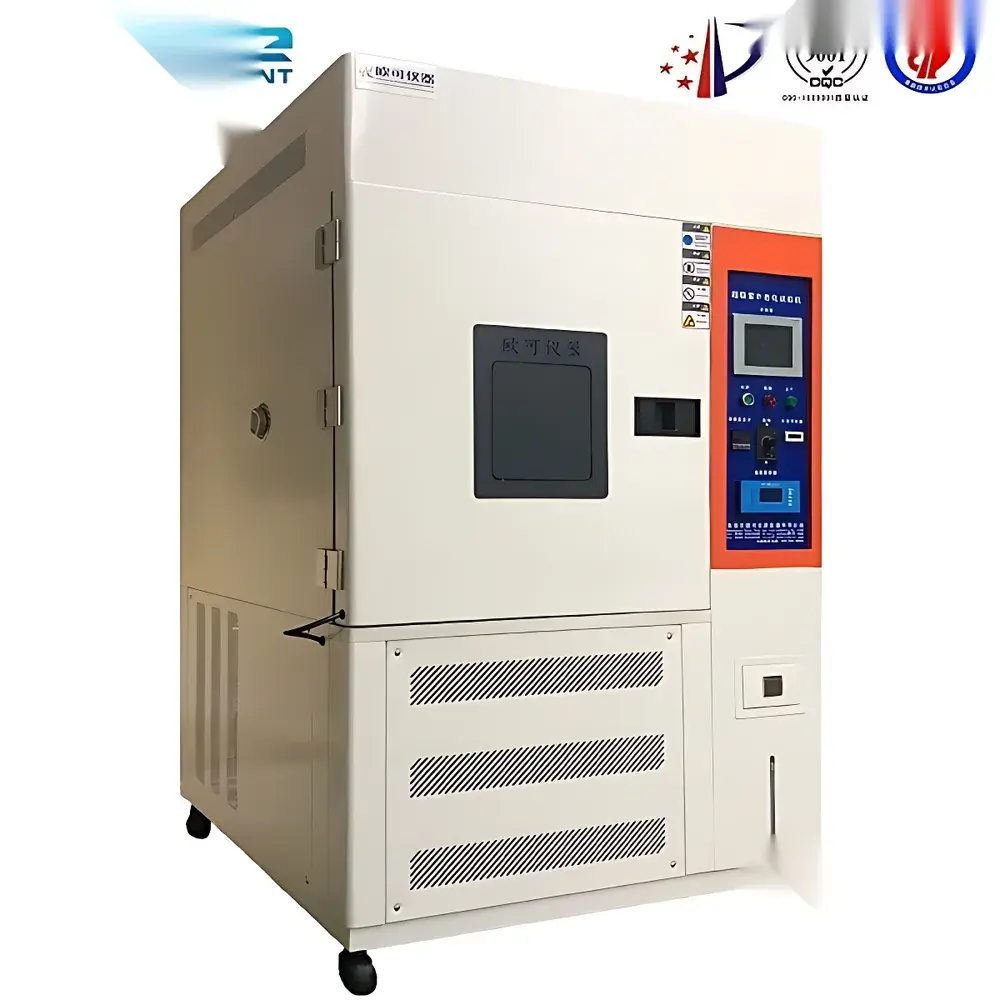
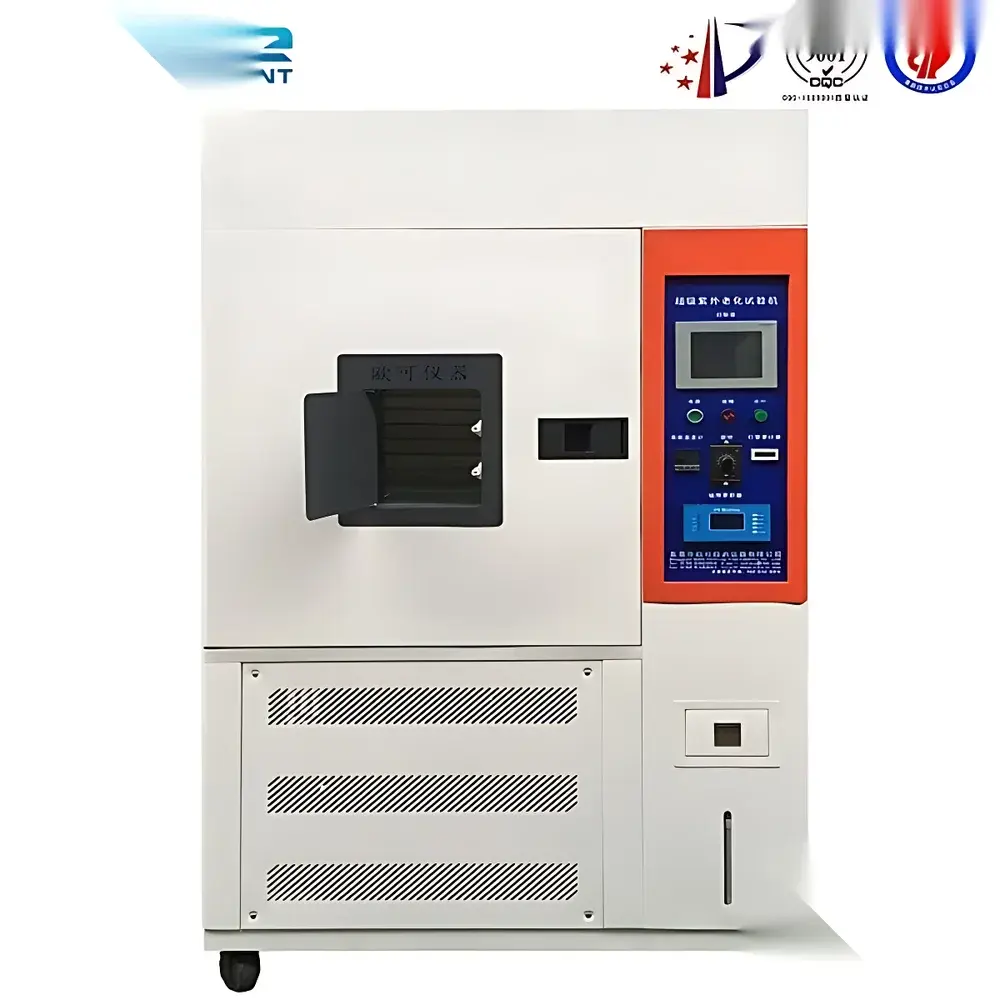
Super QUV UV Aging Test Chamber
| Brand | Other Brands |
|---|---|
| Origin | Imported |
| Manufacturer Type | Authorized Distributor |
| Temperature Range | RT to 85 °C (Operating Range: 50 ± 10 °C) |
| Humidity Range | 40–70 % RH (Illuminated) / 50–90 % RH (Dark Cycle) |
| Temperature Control Accuracy | ±0.5 °C |
| Humidity Control Accuracy | ±2.0 % RH |
| Temperature Uniformity | ±2.0 °C |
| Humidity Uniformity | ±3.0 % RH |
| Heating Rate | ≤25 min (RT → 85 °C) |
| Light Source | 2.5 kW Air-Cooled Metal Halide Lamp (1 unit) |
| Spectral Range | 295–450 nm |
| Irradiance | 200 ± 8 W/m² |
| Irradiance Uniformity | ≥90 % across Sample Plane |
| Sample Tray Dimensions | 500 × 400 mm |
| Illumination Geometry | Top-Mounted Reflector-Based Direct Irradiation |
| UV Radiometer | Calibrated UV Spectral Irradiance Transmitter (Developed by No. 622 Research Institute) |
Overview
The Super QUV UV Aging Test Chamber is an engineered environmental simulation system designed for accelerated weathering evaluation of polymeric materials, coatings, adhesives, and automotive exterior components under controlled ultraviolet (UV) irradiation, thermal cycling, and moisture condensation. Unlike conventional fluorescent UV testers, this chamber employs a high-intensity air-cooled metal halide lamp emitting a continuous spectral output from 295 nm to 450 nm — closely matching the terrestrial solar UV and visible spectrum filtered through 3 mm of borosilicate glass. This spectral fidelity enables realistic simulation of photodegradation mechanisms including photo-oxidation, chain scission, and chromophore degradation. The system integrates synchronized thermal management and humidity control to replicate diurnal cycles: UV exposure at elevated temperature (50 ± 10 °C), followed by condensation-driven dark periods with high relative humidity (50–90 % RH), optionally augmented with programmable water spray cycles to simulate rain erosion and surface wetting effects.
Key Features
- High-fidelity solar-spectrum UV source: 2.5 kW metal halide lamp with optical filtering ensures spectral match to ASTM G155 Class A and ISO 4892-2 xenon arc reference conditions (295–450 nm).
- Precise dual-parameter control: Independent PID-regulated temperature (±0.5 °C accuracy) and humidity (±2.0 % RH accuracy) systems maintain reproducible test environments across the full operational range (RT–85 °C; 40–90 % RH).
- Uniform irradiance distribution: ≥90 % irradiance uniformity across the 500 × 400 mm sample plane, verified per ISO 4892-2 Annex B calibration protocols.
- Integrated real-time UV monitoring: Factory-calibrated UV spectral irradiance transmitter (developed by China’s No. 622 Research Institute) provides traceable, NIST-traceable irradiance feedback at 200 ± 8 W/m² — enabling closed-loop irradiance stabilization and data auditability.
- Robust chamber architecture: Stainless steel interior, double-wall insulation, and forced-air convection ensure thermal stability and long-term repeatability in multi-week continuous operation.
- Programmable test profiles: Supports ASTM D4329, ISO 4892-2, SAE J2020, and GB/T 16422.2-compliant cycles including UV exposure, condensation, and optional water spray phases.
Sample Compatibility & Compliance
The chamber accommodates standard flat-panel specimens up to 500 × 400 mm, compatible with ASTM D618 conditioning requirements and ISO 16750-4 mounting fixtures. Its thermal and humidity performance meets IEC 60068-2-5 and IEC 60068-2-14 environmental stress screening specifications. All control logic and data logging comply with GLP and GMP documentation standards, supporting 21 CFR Part 11-compliant electronic records when integrated with validated software platforms. Calibration procedures follow ISO/IEC 17025 requirements, with annual verification recommended using certified reference radiometers and hygrothermal probes.
Software & Data Management
Equipped with embedded controller firmware supporting RS-485/Modbus RTU and optional Ethernet connectivity, the system logs timestamped temperature, humidity, irradiance, and cycle phase data at user-defined intervals (1–60 s). Export formats include CSV and XML for integration into LIMS or statistical process control (SPC) platforms. Audit trails record all parameter changes, operator logins, and calibration events — fulfilling FDA 21 CFR Part 11 electronic signature and record retention mandates. Optional PC-based software provides real-time graphing, comparative aging curve analysis, and automated report generation aligned with ISO 17025 technical records guidelines.
Applications
- Automotive OEM validation of exterior trim, headlamp lenses, and paint systems per SAE J2527 and GMW14124.
- Photostability assessment of pharmaceutical packaging films (USP , ISO 11607-1).
- Accelerated lifetime prediction of PV module encapsulants and backsheets (IEC 61215-2 MQT10).
- Quality control of architectural coatings and roofing membranes against ASTM D4329 and EN 1062-7.
- Research into polymer degradation kinetics, including carbonyl index evolution measured via FTIR correlation.
- Correlation studies between laboratory QUV exposure and natural outdoor exposure in diverse climatic zones (Arizona, Florida, Jiangsu).
FAQ
What spectral standard does the metal halide lamp emulate?
It replicates the filtered terrestrial solar spectrum (295–450 nm) as defined in ISO 4892-2 for metal halide lamp exposure — distinct from fluorescent UV-B or xenon arc sources.
Is the irradiance value traceably calibrated?
Yes. The integrated UV spectral irradiance transmitter is factory-calibrated against national reference standards and supports periodic recalibration per ISO/IEC 17025.
Can the chamber perform cyclic tests with alternating UV and condensation phases?
Yes. Predefined and custom cycles support sequential UV irradiation, dark condensation, and optional water spray — fully programmable via the onboard controller.
Does the system meet regulatory requirements for quality-controlled laboratories?
It supports GLP, GMP, and 21 CFR Part 11 compliance when used with validated software and documented calibration records.
What is the expected service life of the metal halide lamp?
Rated for ≥1,500 hours at nominal irradiance; output decay is monitored in real time, and lamp replacement is triggered automatically upon deviation beyond ±5 % of setpoint.



