
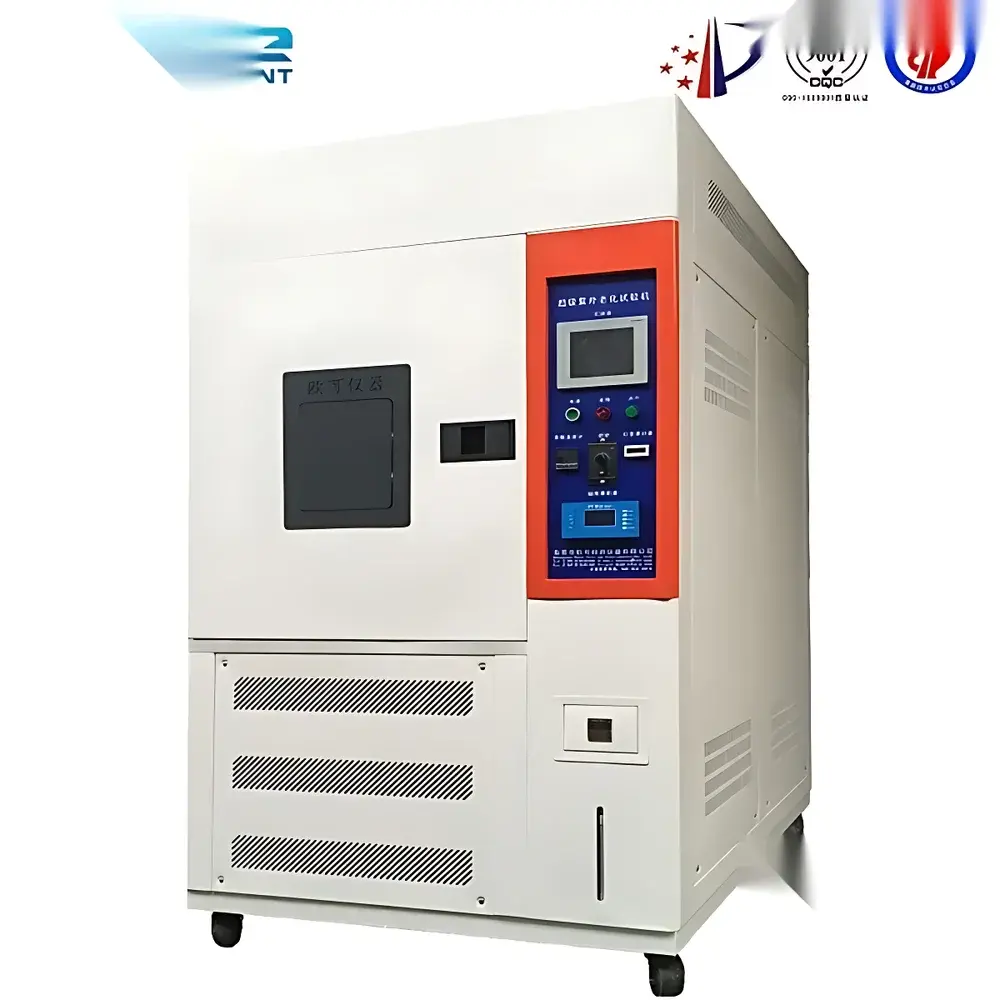
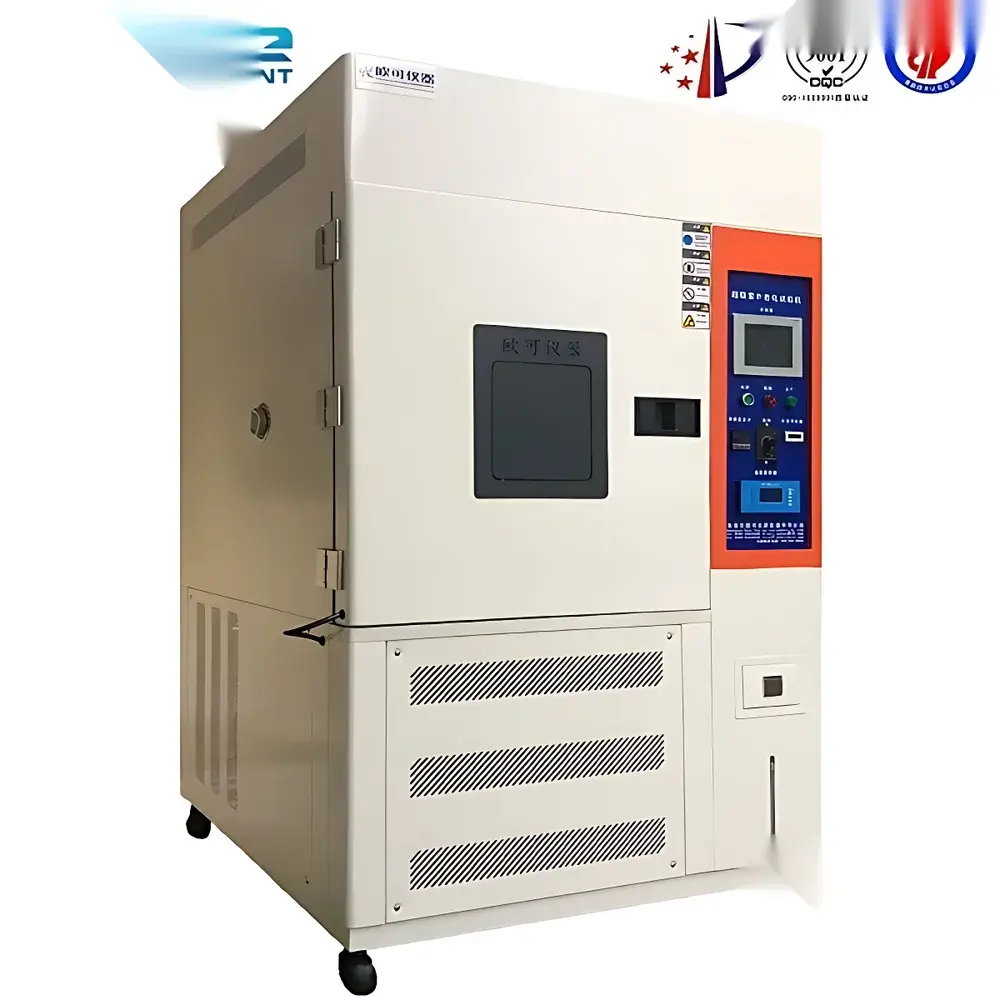
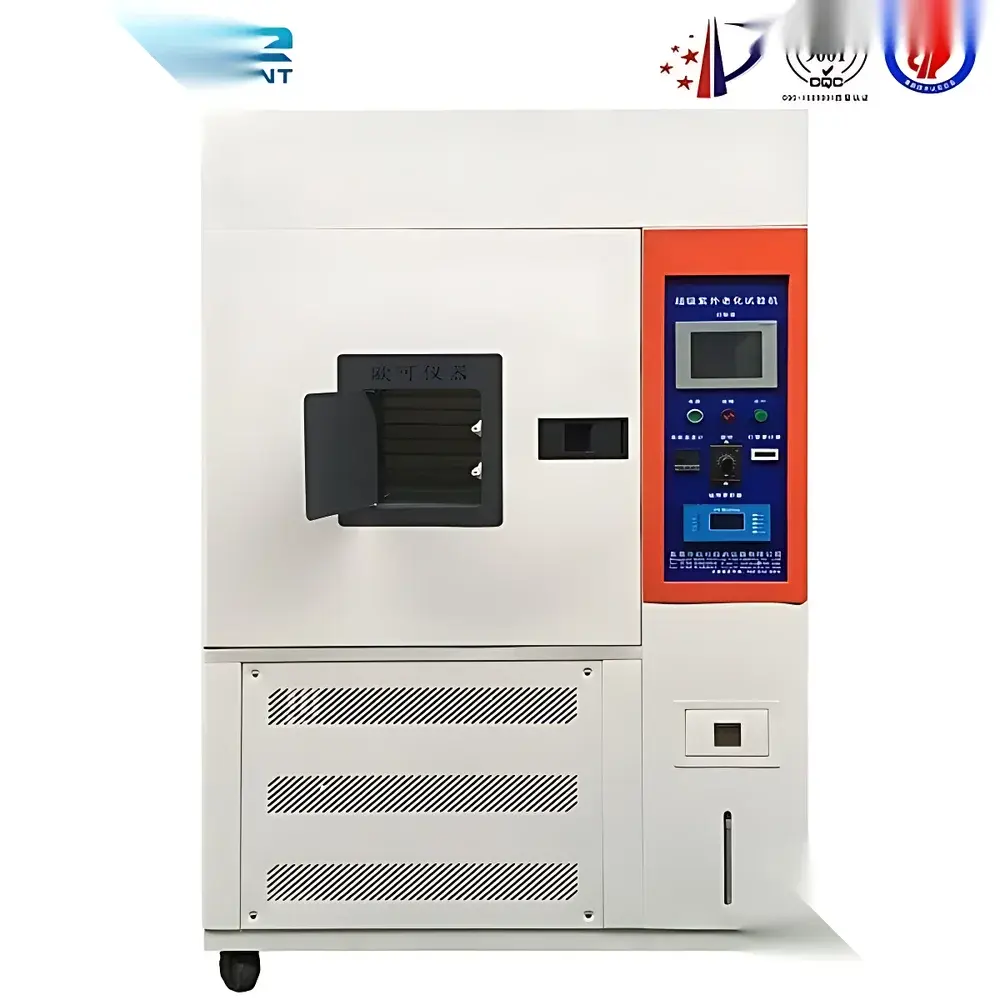
Superfluorescent UV Aging Test Chamber
| Brand | Other Brands |
|---|---|
| Origin | Imported |
| Manufacturer Type | General Distributor |
| Price | USD 21,500 (approx.) |
Overview
The Superfluorescent UV Aging Test Chamber is an advanced environmental test system engineered for accelerated solar radiation simulation under controlled thermal, radiometric, and hygrothermal conditions. Unlike conventional fluorescent UV chambers limited to narrow-band UVA-340 or UVB-313 lamps, this chamber employs air-cooled metal halide (MH) lamps as its primary irradiation source—delivering a continuous spectral output from 295 nm to 450 nm. This spectral range closely replicates the terrestrial solar irradiance profile, including critical UV-B (280–315 nm), UV-A (315–400 nm), and near-visible violet/blue regions (400–450 nm), as defined in ISO 4892-2 Annex A and ASTM G155 Cycle A. The system integrates simultaneous irradiance control, black-panel temperature regulation (up to 80 °C), condensation cycles (via chilled water jacketed specimen holders), and programmable water spray sequences—enabling faithful emulation of diurnal weathering stressors: photolysis, thermal cycling, moisture absorption/desorption, and surface erosion. It is explicitly designed for high-fidelity, repeatable artificial aging of large-format specimens where spectral fidelity—not just UV intensity—is paramount for correlation with real-world outdoor exposure.
Key Features
- Air-cooled metal halide lamp array with spectral output spanning 295–450 nm, filtered to match the relative spectral power distribution (SPD) of sunlight after 3 mm borosilicate glass transmission (per ISO 4892-2, Clause 6.2)
- Real-time irradiance monitoring and closed-loop control via calibrated broadband UV sensor (290–400 nm), traceable to NIST standards
- Black-panel temperature control range: 40 °C to 80 °C ±1.5 °C, with dual-zone PID regulation for uniform thermal loading across specimen plane
- Condensation cycle generation via refrigerated specimen backing plates (5 °C to 15 °C surface temp), enabling controlled dew formation without internal humidity sensors
- Programmable water spray module with adjustable duration (1–120 min), frequency (1–24 cycles/day), and pressure (0.05–0.3 MPa) compliant with ISO 20671-2 wetting requirements
- Stainless steel 316L chamber interior with quartz-glass viewing window and interlocked safety shutoff for lamp service access
Sample Compatibility & Compliance
The chamber accommodates specimens up to 1,200 mm × 600 mm × 200 mm (W × D × H), supporting full-vehicle components, PV modules, architectural cladding panels, and industrial electronics enclosures. Specimen mounting uses non-reflective, thermally stable aluminum racks with adjustable tilt (0°–25°) to replicate field-angle exposure geometry. All operational profiles comply with international aging test standards including ISO 4892-2 (metal halide method), IEC 61215-2 MQT10 (PV module UV pre-conditioning), SAE J2527 (automotive exterior materials), and ASTM D4329 (plastics). Data logging meets GLP/GMP audit requirements per 21 CFR Part 11 when paired with validated software—supporting electronic signatures, change history, and secure user role management.
Software & Data Management
The embedded controller runs on a real-time Linux OS with a 7-inch capacitive touchscreen interface. Test programs are defined using a hierarchical step editor supporting irradiance ramping, temperature profiling, condensation timing, and spray sequencing—all synchronized to millisecond resolution. Raw sensor data (irradiance, black-panel temp, chamber ambient, spray status) is logged at 1 Hz and exported in CSV/Excel format with ISO 8601 timestamps. Optional PC-based software provides statistical trend analysis (e.g., ΔE* color shift vs. radiant exposure), pass/fail threshold mapping against reference degradation curves, and automated report generation compliant with ISO/IEC 17025 documentation requirements.
Applications
- Accelerated weathering validation of automotive exterior trim, headlights, and paint systems per OEM-specific protocols (e.g., Ford CETP 00.00-L-467, GMW14124)
- UV preconditioning of crystalline silicon and thin-film photovoltaic modules prior to thermal cycling and damp heat testing (IEC 61215-2)
- Long-term stability assessment of polymer-based optical films, OLED encapsulants, and aerospace-grade composites
- Correlation studies between laboratory-aged samples and natural exposure sites (e.g., Arizona, Florida) using radiant exposure dosimetry (kJ/m² @ 340 nm)
- Formulation screening for UV stabilizers, HALS additives, and pigment dispersion systems in coatings and plastics
FAQ
What spectral standard does the metal halide lamp output follow?
It conforms to the relative spectral irradiance distribution specified in ISO 4892-2 Annex A for “Metal Halide Lamp” exposure method, matching terrestrial sunlight through 3 mm borosilicate glass.
Can the chamber operate without water spray or condensation cycles?
Yes—each stressor (UV, heat, moisture, spray) is independently programmable; users may configure dry-heat UV-only or UV/condensation-only profiles.
Is calibration traceable to national metrology institutes?
Irradiance sensors are factory-calibrated against NIST-traceable reference detectors; annual recalibration services include certificate of conformance with uncertainty budget.
What is the typical radiant exposure dose required to simulate 1 year of Florida exposure?
Based on Q-SUN and Atlas correlation data, 1,500–2,200 MJ/m² @ 340 nm typically corresponds to 12 months of Miami outdoor exposure for most polymeric substrates.
Does the system support remote monitoring and alarm notification?
Optional Ethernet/IP interface enables Modbus TCP integration with facility SCADA systems; email/SMS alerts trigger on deviation from setpoint tolerances or safety interlock activation.
Related Products



