
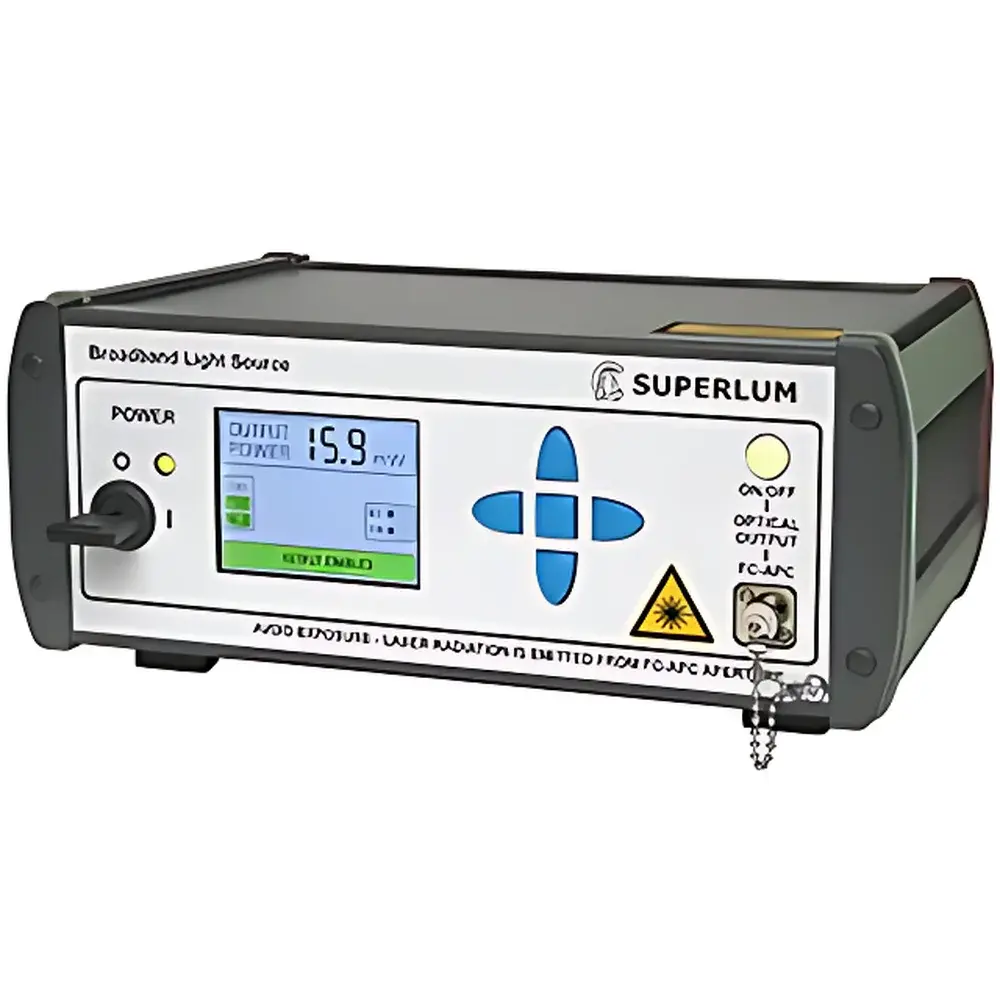
Superlum M-S Series Benchtop Broadband Light Source
| Brand | Superlum |
|---|---|
| Origin | Russia |
| Product Type | Imported Optical Light Source |
| Model | M-S |
| Light Source Type | Infrared SLD-based Broadband Source |
| Illumination Mode | External Illumination |
| Output Power Range | Up to 35 mW (SMF-coupled) |
| Spectral Bandwidth (FWHM) | 15–70 nm |
| Center Wavelength Options | 670–1050 nm |
| Coherence Length | < 20 µm (typ.) |
| Optical Isolation | ≥30 dB |
| Power Adjustment | 0–100% in 10% steps |
| Control Interface | USB & TTL |
| Input Power | 100–240 V AC, 50/60 Hz, ≤40 VA |
| Dimensions (W×H×D) | 251 × 112 × 192 mm |
| Weight | ≤4 kg |
| Safety Class | IEC/EN 60825-1:2014 Class 3B |
Overview
The Superlum M-S Series Benchtop Broadband Light Source is a second-generation high-stability, fiber-coupled superluminescent diode (SLD)-based illumination system engineered for precision optical metrology, interferometry, and biomedical imaging applications. Unlike conventional thermal or arc-lamp sources, the M-S Series leverages proprietary single-mode fiber-pigtailed SLD modules to deliver spatially coherent, low-coherence broadband emission with exceptional spectral stability and minimal temporal coherence—critical for optical coherence tomography (OCT), fiber-optic sensor characterization, and white-light interferometry. Its design emphasizes deterministic spectral behavior across power modulation, enabling reproducible calibration and traceable measurement workflows in regulated R&D and industrial QA environments.
Key Features
- High output power: Up to 35 mW coupled into single-mode fiber (SMF), supporting signal-to-noise ratio–sensitive detection schemes.
- Wide spectral coverage: Configurable center wavelengths from 670 nm to 1050 nm, with FWHM bandwidths ranging from 15 nm (narrow Gaussian-like spectra) to 70 nm (broad multi-peak spectra).
- Ultra-low temporal coherence: Typical coherence lengths below 20 µm—ideal for OCT axial resolution control and dispersion-compensated interferometric setups.
- Two power control architectures: Standard models modulate SLD drive current; optional -VA variants integrate a broadband variable optical attenuator (VOA) downstream of the isolator to preserve spectral shape and centroid wavelength across the full 0–100% output range.
- Integrated optical isolation: ≥30 dB built-in isolator suppresses back-reflected light, ensuring source stability in reflective or interferometric configurations.
- Dual control interface: Local front-panel operation plus remote control via USB (SCPI-compliant commands) or TTL-triggered analog/digital input for synchronization with data acquisition systems.
- Class 3B laser safety compliance: Full IEC/EN 60825-1:2014 implementation including key-switch interlock, audible/visual fault alerts, and permanent safety labeling.
Sample Compatibility & Compliance
The M-S Series is compatible with standard SMF-28, HI1060, and other single-mode fibers (FC/APC or FC/PC connectors optional). All units are CE-marked and comply with EMC Directive 2014/30/EU and Low Voltage Directive 2014/35/EU. For laboratory quality assurance, the source supports GLP/GMP-aligned operational documentation: factory spectral calibration reports (NIST-traceable reference detectors), coherence function measurements, and spectral stability logs (±0.2 nm center wavelength drift over 8 h at constant temperature) are provided per unit. While not FDA-cleared as a medical device, its performance parameters meet typical requirements for preclinical OCT system integration under ISO 13485–aligned development protocols.
Software & Data Management
Superlum provides the free, cross-platform SLD Control Suite for Windows, macOS, and Linux. The application enables real-time power monitoring, spectral snapshot capture (via optional external spectrometer integration), and automated power ramping sequences. All configuration changes—including attenuation level, TTL trigger thresholds, and safety lockout states—are logged with timestamps and user identifiers, satisfying basic 21 CFR Part 11 audit trail requirements for non-clinical research use. Firmware updates are delivered via signed binary packages with SHA-256 verification. Raw spectral data exports support CSV, SDF, and HDF5 formats for downstream analysis in MATLAB, Python (NumPy/SciPy), or LabVIEW.
Applications
- OCT System Development: Stable broadband illumination across 800–1050 nm windows enables axial resolution tuning and dispersion matching in spectral-domain and swept-source OCT prototypes.
- Fiber Optic Gyroscope (FOG) Testing: Low-coherence output minimizes parasitic interference in closed-loop interferometric sensing paths.
- Optical Component Characterization: Used for spectral loss mapping of filters, WDM couplers, and FBGs due to high spectral flatness (< ±1.5 dB ripple in Gaussian variants) and polarization-maintaining options.
- Calibration of Spectrometers & CCD Linearity: Certified spectral irradiance data allows radiometric calibration traceable to national standards laboratories.
- Biophotonics Research: Supports diffuse reflectance spectroscopy and time-resolved fluorescence lifetime measurements where controlled spectral bandwidth and power stability are essential.
FAQ
What distinguishes the -VA variant from the standard M-S model?
The -VA version incorporates a broadband variable optical attenuator placed after the internal isolator. This preserves the intrinsic SLD spectrum during power reduction—critical for applications requiring invariant spectral centroid and shape, such as dispersion-sensitive interferometry.
Can the M-S Series be integrated into automated test benches?
Yes. TTL-compatible digital inputs accept external triggers for on/off and power-step commands; USB interface supports SCPI command sets for scripting in Python, LabVIEW, or MATLAB.
Is spectral calibration data supplied with each unit?
Yes. Each shipped unit includes a PDF report containing measured spectral power density (mW/nm), FWHM, center wavelength, and coherence length, acquired using a calibrated OSA with ±0.1 nm wavelength accuracy.
Does the source support polarization-maintaining (PM) fiber output?
PM-fiber versions (e.g., PANDA or Bow-Tie) are available as custom configurations—contact engineering support for extinction ratio (>20 dB) and alignment specifications.
What is the recommended warm-up time for spectral stability?
Thermal stabilization is achieved within 15 minutes of power-on; spectral drift remains within ±0.15 nm over subsequent 4 hours under ambient temperature fluctuations of ±1 °C.




