
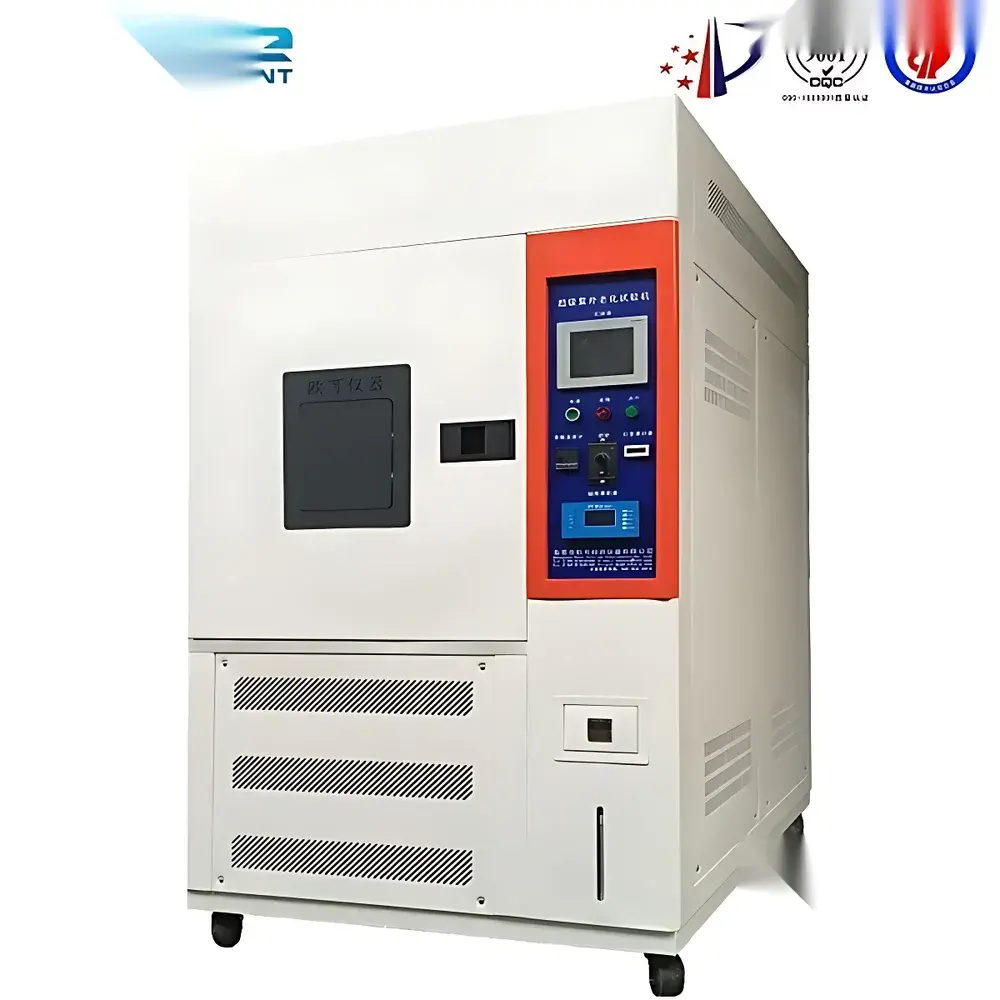
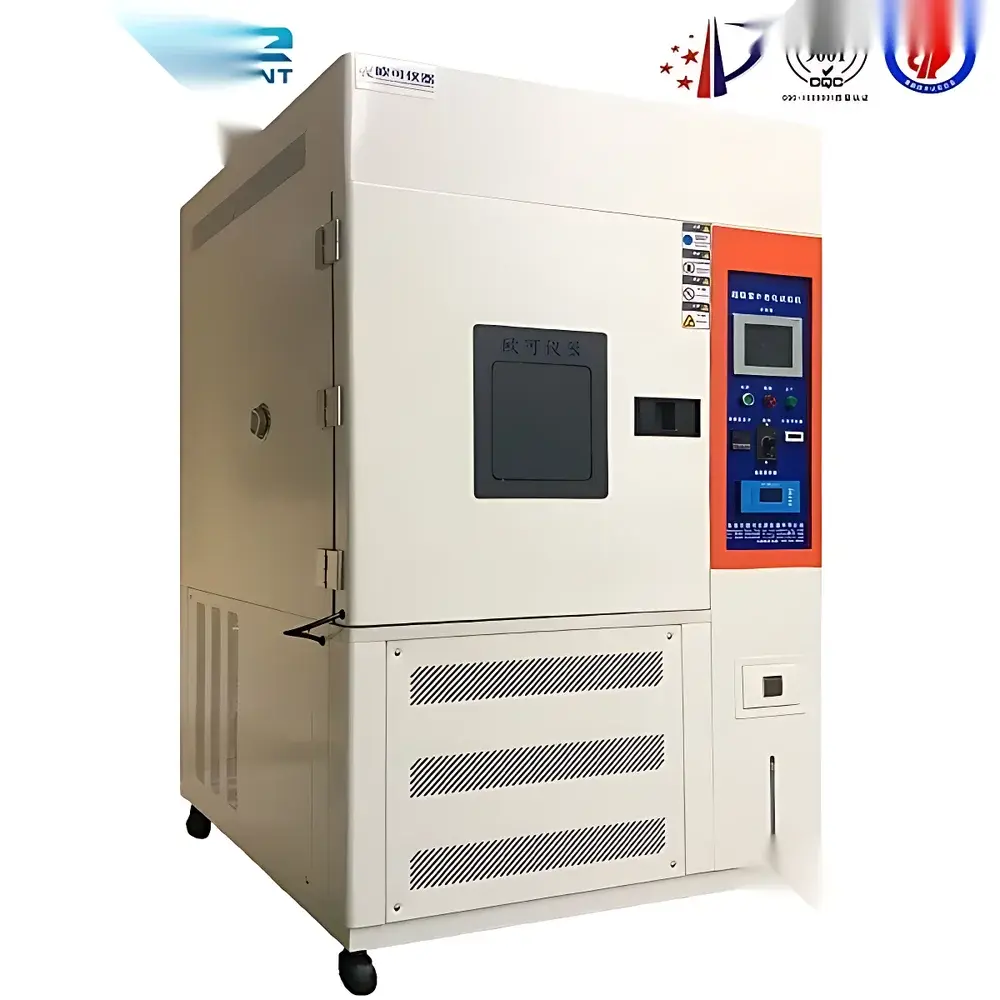
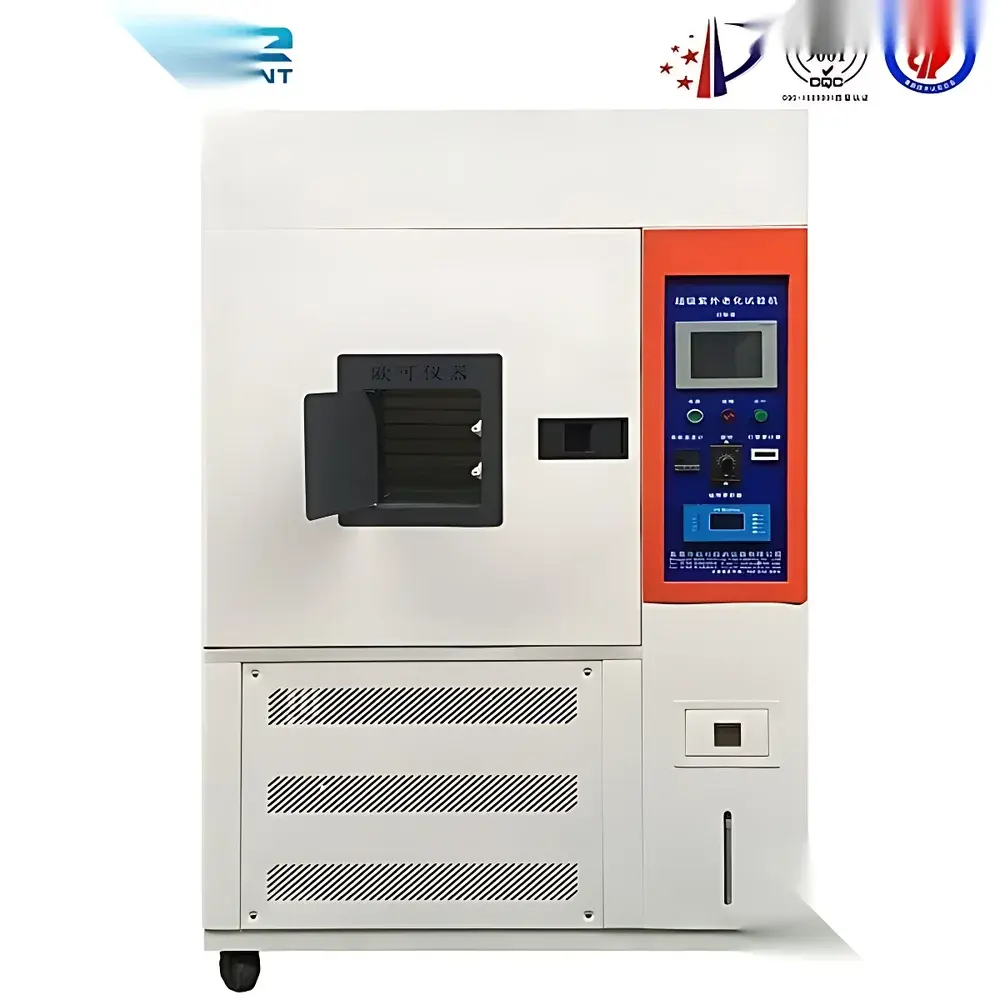
SuperUV Advanced Metal Halide UV Accelerated Weathering Test Chamber
| Brand | Other Brands |
|---|---|
| Origin | Imported |
| Manufacturer Type | General Distributor |
| Heating Time | ≤25 min (RT → 85°C) |
| Light Source | 2.5 kW Air-Cooled Metal Halide Lamp (1 unit) |
| Sample Tray Dimensions | 500 × 400 mm |
| Irradiation Configuration | Top-mounted, Reflective Direct Illumination |
| Irradiance Uniformity | ≥90% |
| Spectral Range | 295–450 nm (UV-A/UV-B/VIS) |
| Irradiance Level | 200 ± 8 W/m² |
| UV Radiometer | Integrated Spectral Irradiance Transmitter (developed by China Academy of Engineering Physics – Institute 622) |
| IR Filter | Optional 30% Infrared Energy Blocking Filter |
| Irradiance Monitoring | LCD-Based Cumulative Irradiance Integrator with Real-Time Calculation |
Overview
The SuperUV Advanced Metal Halide UV Accelerated Weathering Test Chamber is an engineered environmental simulation system designed to replicate and accelerate the photochemical degradation mechanisms induced by solar radiation, thermal cycling, and moisture exposure—key stressors in real-world outdoor aging of polymeric coatings, automotive finishes, architectural sealants, and composite materials. Unlike conventional fluorescent UV systems limited to narrow-band UVA-340 or UVB-313 emission, this chamber employs a high-intensity 2.5 kW air-cooled metal halide lamp, delivering a continuous, spectrally broad output from 295 nm to 450 nm. This spectral profile closely matches terrestrial solar irradiance—including both direct and diffuse components—as defined in ISO 4892-2 Annex A and ASTM G155 Cycle 1, enabling more physiologically relevant photodegradation kinetics. The chamber integrates controlled condensation (via bottom-mounted water reservoir and heated chamber floor), optional water spray (simulating rain-induced thermal shock and surface leaching), and precise temperature regulation (RT to 85°C in ≤25 minutes), thereby fulfilling multi-stress synergistic aging protocols required for ISO 11341, SAE J2527, and GMW 14124 validation.
Key Features
- High-fidelity solar spectrum simulation using a single 2.5 kW metal halide lamp, engineered for stable spectral power distribution across UV-A, UV-B, and visible regions (295–450 nm)
- Top-mounted lamp configuration with reflective direct irradiation geometry, ensuring minimal shadowing and optimal sample exposure uniformity (≥90% irradiance homogeneity over 500 × 400 mm test area)
- Integrated spectral irradiance transmitter (developed by Institute 622, China Academy of Engineering Physics), calibrated traceably to national radiometric standards for real-time, absolute irradiance measurement (200 ± 8 W/m² at sample plane)
- LCD-based cumulative irradiance integrator with auto-calculated joule-per-square-meter (J/m²) dosimetry, supporting audit-ready exposure logging per GLP-compliant test records
- Optional 30% infrared energy blocking filter—designed to reduce non-photochemical heating effects while preserving UV-driven reaction pathways, aligning with ISO 4892-2 Clause 7.3 requirements for spectral filtering
- Rugged stainless-steel interior chamber with corrosion-resistant construction, compatible with extended humidity cycling and aqueous spray operation under IEC 60068-2-30 Ed. 4 testing conditions
Sample Compatibility & Compliance
The chamber accommodates standard flat-panel specimens up to 500 × 400 mm on a removable tray, supporting ISO 1514, ASTM D610, and EN ISO 2813 substrate geometries. It is validated for use in qualification testing per automotive OEM specifications (e.g., Ford CETP 00.00-L-467, VW TL 226), aerospace coating standards (e.g., Boeing BMS 10-60), and regulatory submissions requiring documented irradiance traceability. All irradiance measurements comply with NIST-traceable calibration practices; system-level performance verification follows ISO/IEC 17025 principles. Data integrity meets FDA 21 CFR Part 11 requirements when paired with compliant laboratory information management systems (LIMS), including electronic signature support and immutable audit trails for irradiance logs and thermal profiles.
Software & Data Management
While the base configuration features embedded LCD control with manual parameter entry, optional RS-485/Modbus RTU interface enables integration with third-party SCADA or LIMS platforms. Irradiance accumulation, chamber temperature, and operational runtime are timestamped and exportable as CSV files for post-test analysis. The cumulative irradiance integrator retains ≥30 days of rolling data with battery-backed memory, satisfying ISO 17025 clause 7.7.2 for raw data retention. For regulated environments, optional software modules provide 21 CFR Part 11-compliant user access control, electronic signatures, and change history tracking—fully aligned with GMP/GLP documentation workflows.
Applications
This system is routinely deployed in R&D laboratories and QC departments for comparative durability assessment of: exterior automotive clearcoats under SAE J2527 cyclic exposure; PV module encapsulant yellowing per IEC 61215-2 MQT10; architectural silicone sealant cracking per ASTM C920; and aerospace primer adhesion loss after UV/humidity cycling. Its spectral fidelity makes it especially suitable for failure root-cause analysis where fluorescent UV chambers yield non-representative degradation morphology (e.g., excessive chalking vs. realistic microcracking). It also supports accelerated qualification of UV-stabilized polymers used in medical device housings subject to ISO 10993-12 extractables profiling.
FAQ
Does this chamber meet ISO 4892-2 requirements for xenon arc or metal halide exposure methods?
Yes—it is configured per ISO 4892-2 Annex A for metal halide lamp operation, including spectral bandwidth, irradiance level, and monitoring methodology.
Is the irradiance sensor NIST-traceable?
The spectral irradiance transmitter is calibrated against reference standards maintained by Institute 622, with calibration certificates traceable to the National Institute of Metrology (NIM) of China.
Can the system operate without the IR filter during high-temperature UV exposure tests?
Yes—the IR filter is optional and field-installable; removal allows full-spectrum thermal loading, appropriate for applications requiring combined photothermal stress per ASTM D4329 Annex A.
What maintenance intervals are recommended for the metal halide lamp?
Lamp life is rated at ≥1,200 hours under continuous operation; we recommend irradiance verification every 200 hours and lamp replacement after 1,000 hours to maintain ±8 W/m² stability.
Is condensation cycle programmable independently of UV irradiation?
Yes—condensation is generated via controlled chamber-floor heating and ambient humidity saturation, fully decoupled from lamp operation, enabling ISO 4892-2 Cycle 3 (dark condensation only) execution.



