
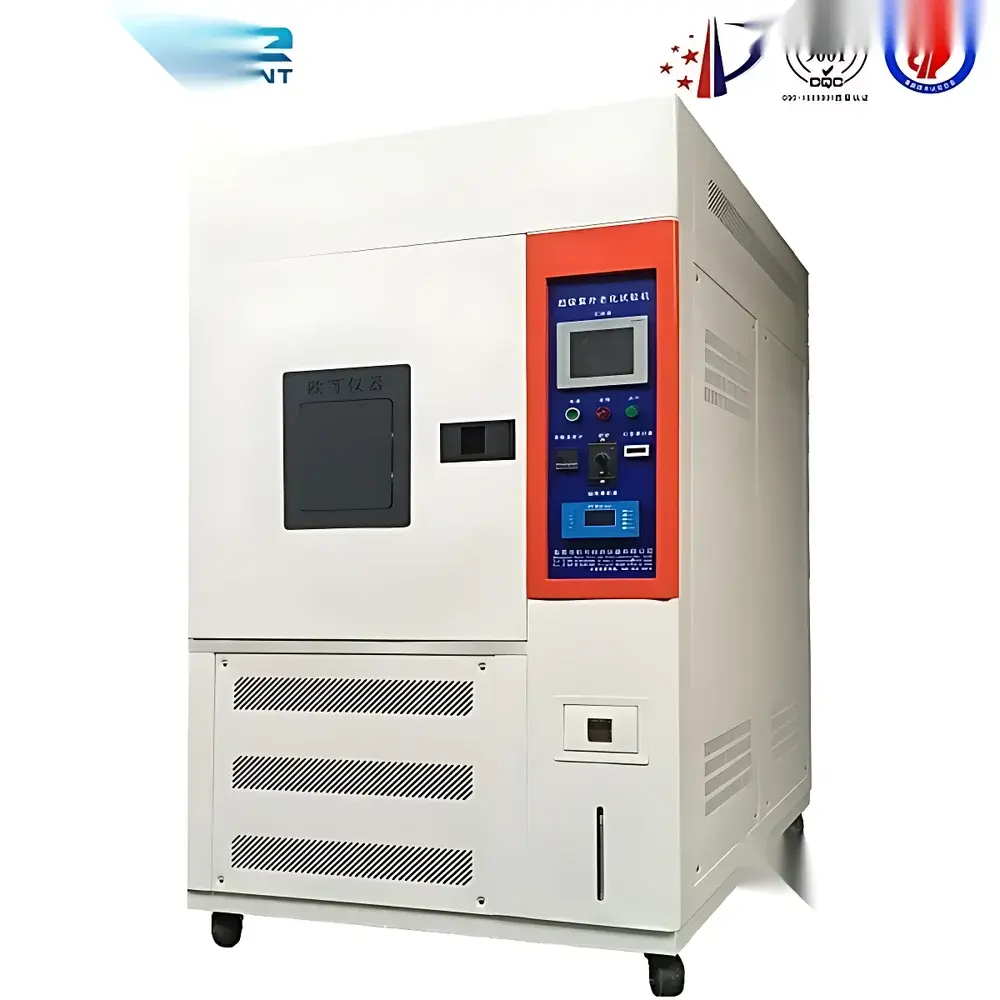
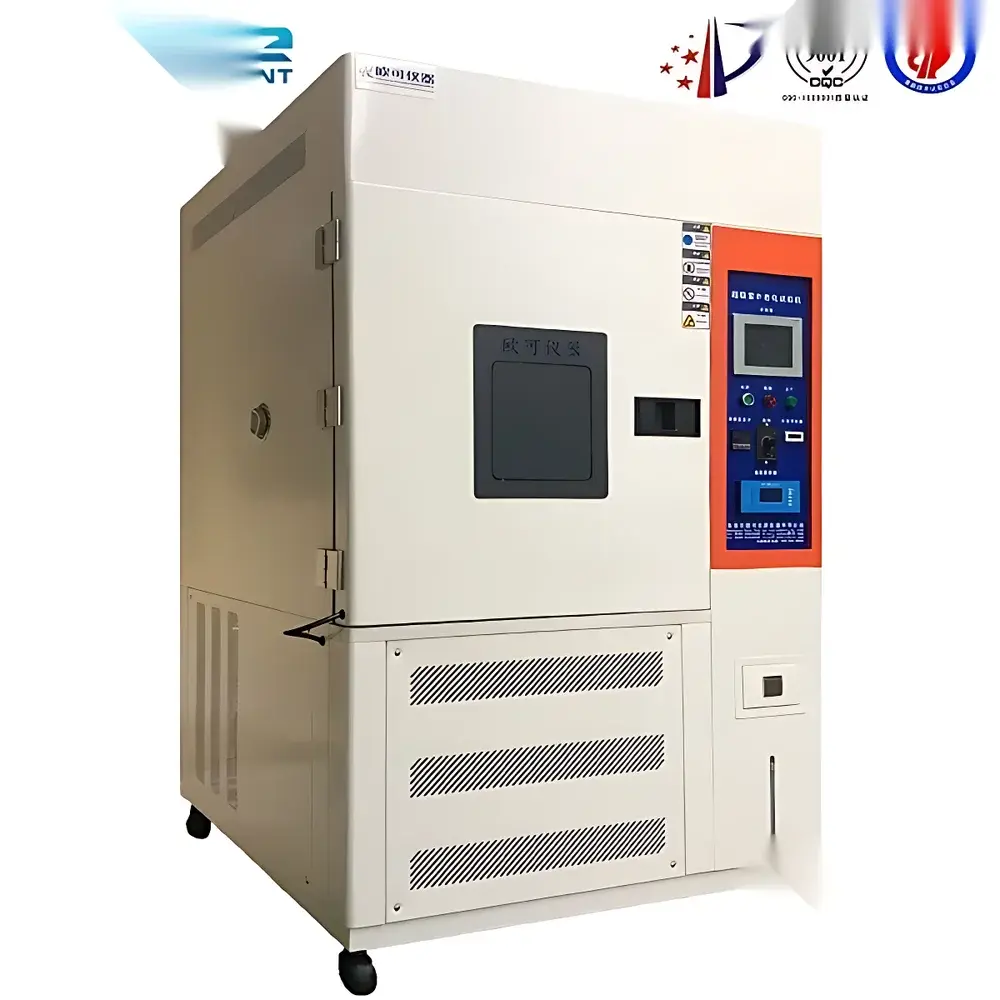
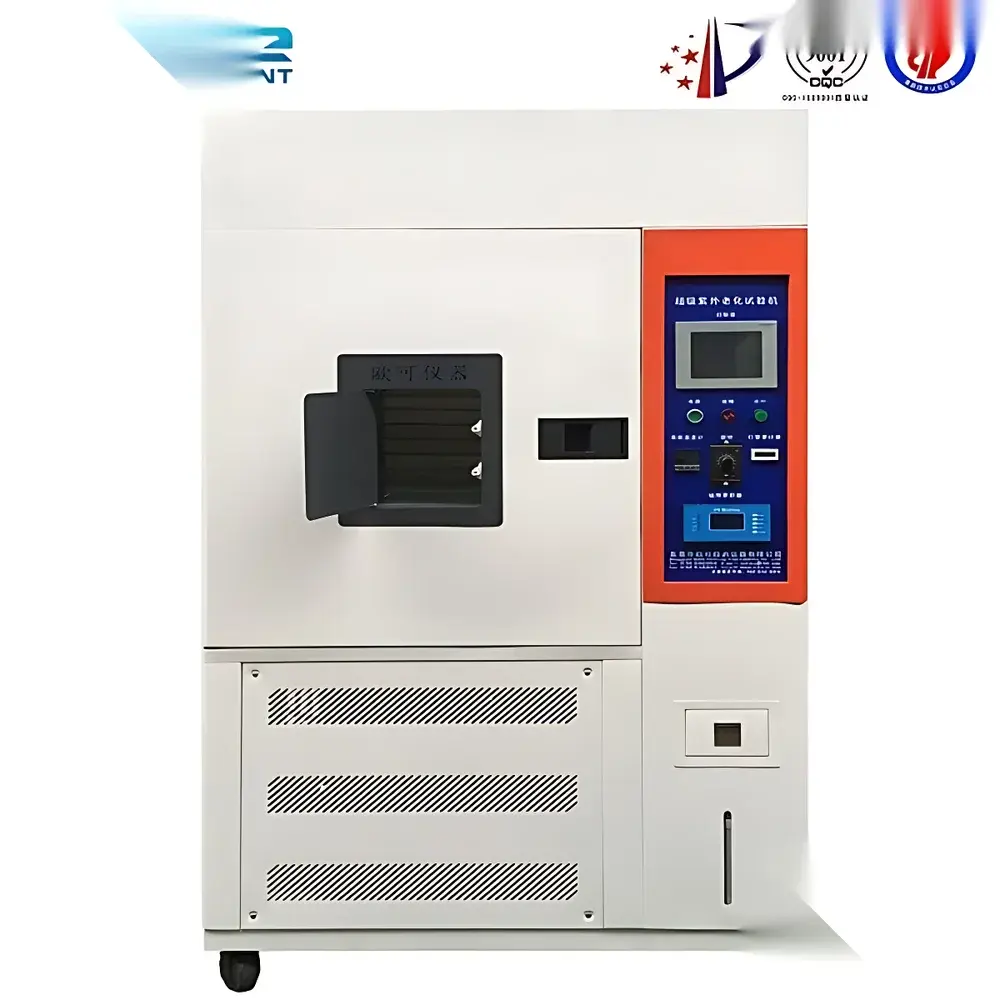
SuperUV Advanced Metal Halide UV Accelerated Weathering Test Chamber
| Brand | OEM / Custom-Built |
|---|---|
| Origin | Imported |
| Manufacturer Type | Authorized Distributor |
| Price | USD 21,000 (FOB) |
| Light Source | 2.5 kW Air-Cooled Metal Halide Lamp (Single) |
| Sample Rack Dimensions | 500 × 400 mm |
| Irradiation Geometry | Top-Mounted Reflector-Based Direct Illumination |
| Spectral Range | 295–450 nm |
| Irradiance Level | 200 ± 8 W/m² (at sample plane) |
| Irradiance Uniformity | ≥90% across rack surface |
| UV Monitoring | Integrated UV Spectral Irradiance Transmitter (developed by China Academy of Engineering Physics – Institute 622) |
| Filter System | Custom High-Borosilicate Glass + IR-Blocking Filter (removes ~30% infrared energy) |
| Control Interface | LCD-based Irradiance Accumulation Meter with Real-Time Dose Integration |
| Cooling Method | Internal Forced-Air Circulation System |
| Compliance | Designed per ISO 4892-2, ASTM G155, SAE J2527, and GB/T 16422.2 requirements |
Overview
The SuperUV Advanced Metal Halide UV Accelerated Weathering Test Chamber is an engineered environmental simulation system designed to replicate the photochemical degradation mechanisms induced by solar ultraviolet (UV) radiation, thermal cycling, and moisture exposure—key stressors in outdoor service life prediction. Unlike fluorescent UV lamp-based systems, this chamber employs a high-intensity 2.5 kW air-cooled metal halide lamp as its primary radiation source, delivering a continuous spectral output from 295 nm to 450 nm. This spectral profile closely matches the terrestrial solar irradiance distribution after atmospheric filtering—particularly the critical UV-A and visible-edge region—enabling high-fidelity simulation of photodegradation pathways including polymer chain scission, chromophore bleaching, and oxidative crosslinking. The chamber integrates controlled condensation cycles and optional water spray functionality to emulate diurnal humidity fluctuations and rain-induced surface wetting, supporting full-cycle accelerated aging protocols aligned with international weathering standards.
Key Features
- High-fidelity solar-spectrum simulation using a single 2.5 kW metal halide lamp, spectrally filtered via custom high-borosilicate glass and an IR-reducing filter (removing ~30% infrared energy to prevent non-photochemical thermal overload)
- Precision irradiance control: real-time monitoring via a calibrated UV spectral irradiance transmitter (developed by Institute 622, China Academy of Engineering Physics), with automatic integration of radiant exposure (J/m²) displayed on an LCD-based dose meter
- Optimized optical geometry: top-mounted lamp with parabolic reflector ensures direct, uniform illumination across the 500 × 400 mm sample rack; irradiance uniformity ≥90% across the test plane per ISO 4892-2 Annex B verification
- Thermally stable operation: internal forced-air circulation system maintains consistent lamp cooling and chamber thermal equilibrium, minimizing thermal gradient effects on material response
- Modular compliance-ready architecture: pre-configured for ASTM G155 Cycle 1 (light/dark/condensation) and Cycle 3 (light/spray), as well as SAE J2527 extended automotive exposure profiles
Sample Compatibility & Compliance
The chamber accommodates flat-panel specimens up to 500 × 400 mm and is routinely deployed for evaluating coatings, polymeric composites, automotive exterior trim, photovoltaic encapsulants, and aerospace sealants. Its spectral fidelity and irradiance stability support testing under ISO 4892-2 (Plastics — Methods of exposure to laboratory light sources — Part 2: Xenon-arc lamps), ASTM G155 (Standard Practice for Operating Xenon Arc Light Apparatus for Exposure of Non-Metallic Materials), and SAE J2527 (Surface Vehicle Recommended Practice for Calculating Solar Irradiance for Automotive Exterior Materials). While not a xenon-arc system, its metal halide spectrum has been validated against reference solar data (ASTM E490 AM1.5G) within the 295–450 nm band for UV-driven degradation modeling. The system supports GLP-compliant data logging when integrated with external PC-based acquisition software.
Software & Data Management
The chamber operates via embedded microcontroller logic with local LCD interface for irradiance setpoint, exposure time, condensation duration, and spray interval configuration. For traceable, audit-ready operation, it outputs analog 4–20 mA signals from the UV irradiance transmitter and digital RS-485 Modbus RTU protocol for integration into centralized LIMS or SCADA platforms. Optional firmware upgrades enable timestamped irradiance logging at 1-second resolution, compliant with FDA 21 CFR Part 11 requirements when paired with validated third-party software. All exposure parameters—including cumulative radiant dose, peak irradiance deviation, and thermal history—are exportable as CSV files for post-test statistical analysis (e.g., Arrhenius modeling of degradation kinetics).
Applications
This system is widely applied in R&D and QC laboratories for predictive durability assessment of materials exposed to outdoor environments. Key use cases include: evaluating UV stabilizer efficacy in automotive clearcoats; quantifying yellowing index (ASTM D1925) and gloss retention (ASTM D523) in architectural PVC; assessing delamination resistance in multilayer PV backsheets under cyclic UV/moisture stress; validating colorfastness of textile dyes per ISO 105-B02; and screening encapsulant browning in silicon-based photovoltaic modules. Its ability to deliver high irradiance levels (>200 W/m²) enables rapid screening—typically achieving 1 year of Florida-equivalent UV exposure in ≤10 days under standard cycle conditions.
FAQ
What standards does this chamber comply with?
It is configured to meet the operational requirements of ISO 4892-2, ASTM G155, SAE J2527, and GB/T 16422.2. Spectral validation reports and irradiance uniformity test certificates are available upon request.
Can the system be upgraded for xenon-arc compatibility?
No—this is a dedicated metal halide platform. Xenon-arc and metal halide systems differ fundamentally in spectral generation, thermal management, and optical filtering; retrofitting is not supported.
Is NIST-traceable calibration provided?
Yes—the UV spectral irradiance transmitter is factory-calibrated against NIST-traceable reference detectors; annual recalibration services are offered through authorized metrology partners.
What maintenance intervals are recommended?
Lamp replacement every 1,200 hours; filter inspection every 300 hours; airflow path cleaning quarterly; full optical alignment verification annually.
Does the chamber support automated pass/fail reporting?
Not natively—but its Modbus RTU interface allows seamless integration with LabVIEW, Python-based QA dashboards, or commercial MES platforms for rule-based pass/fail logic based on cumulative dose thresholds.



