
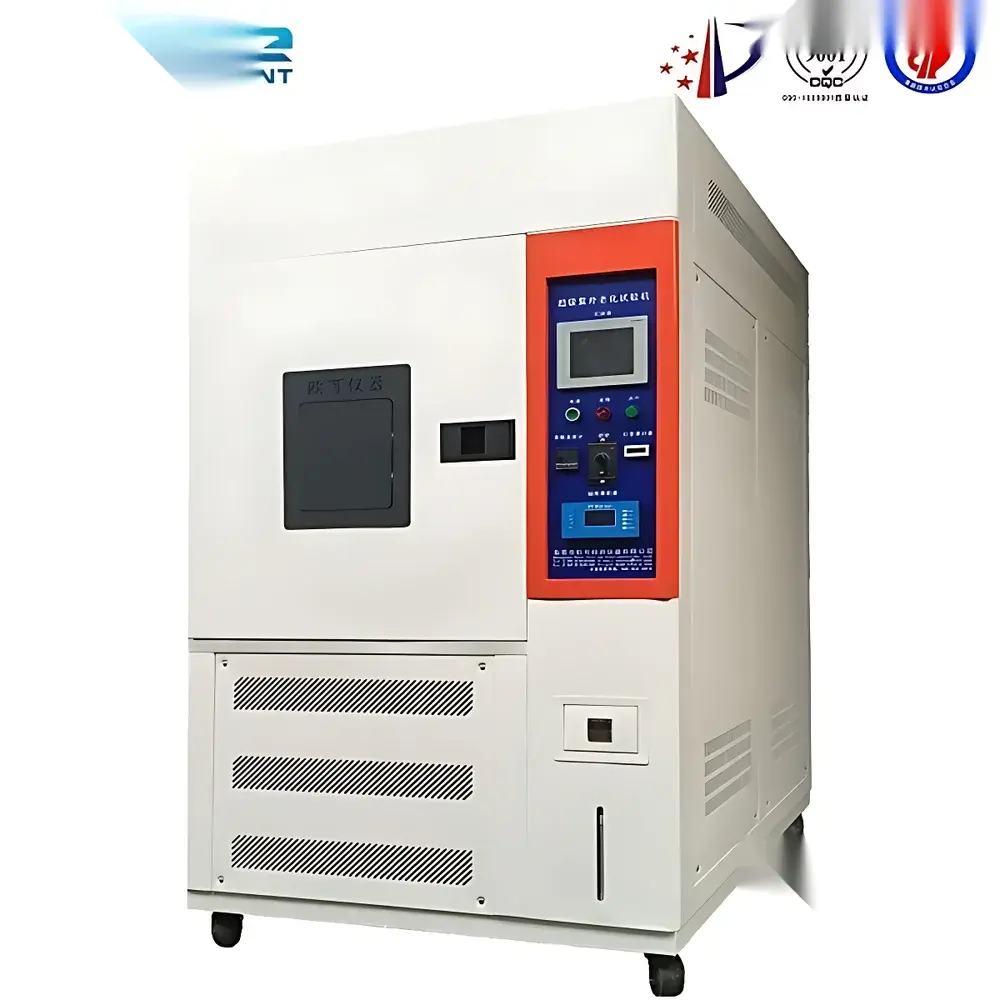
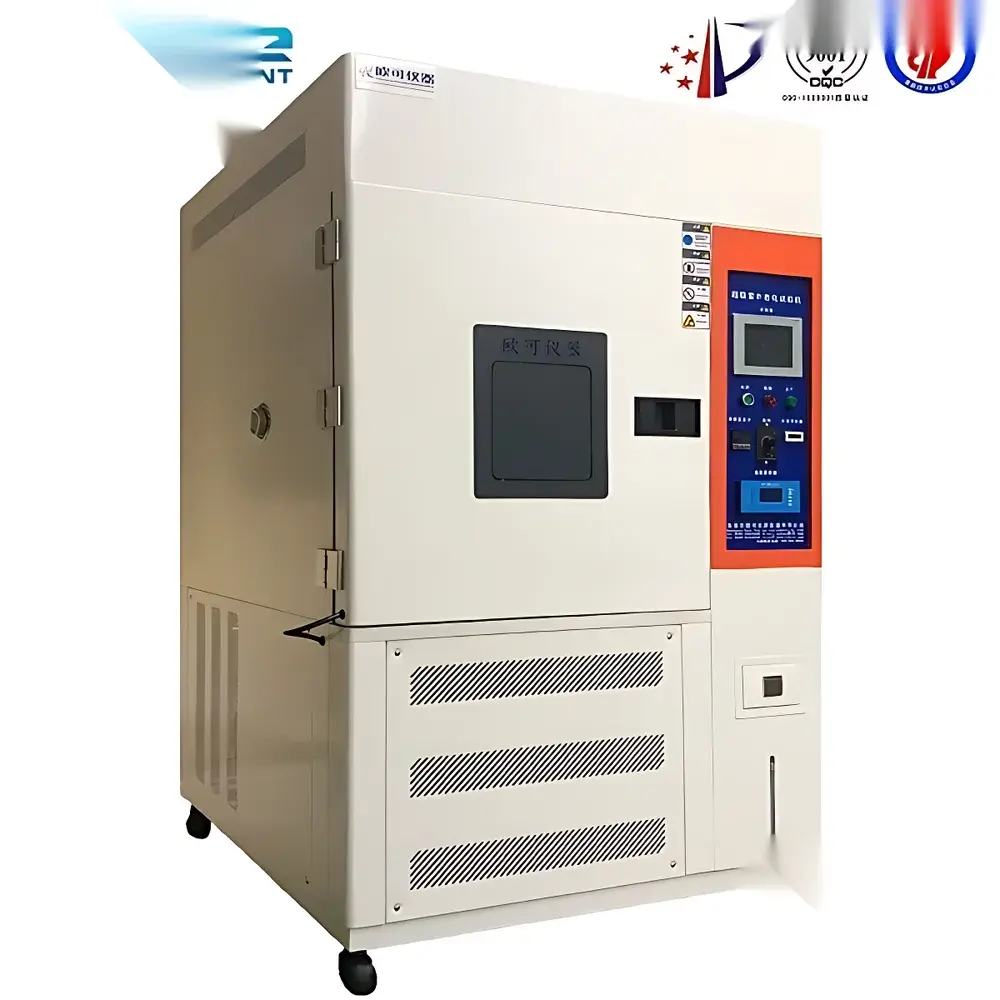
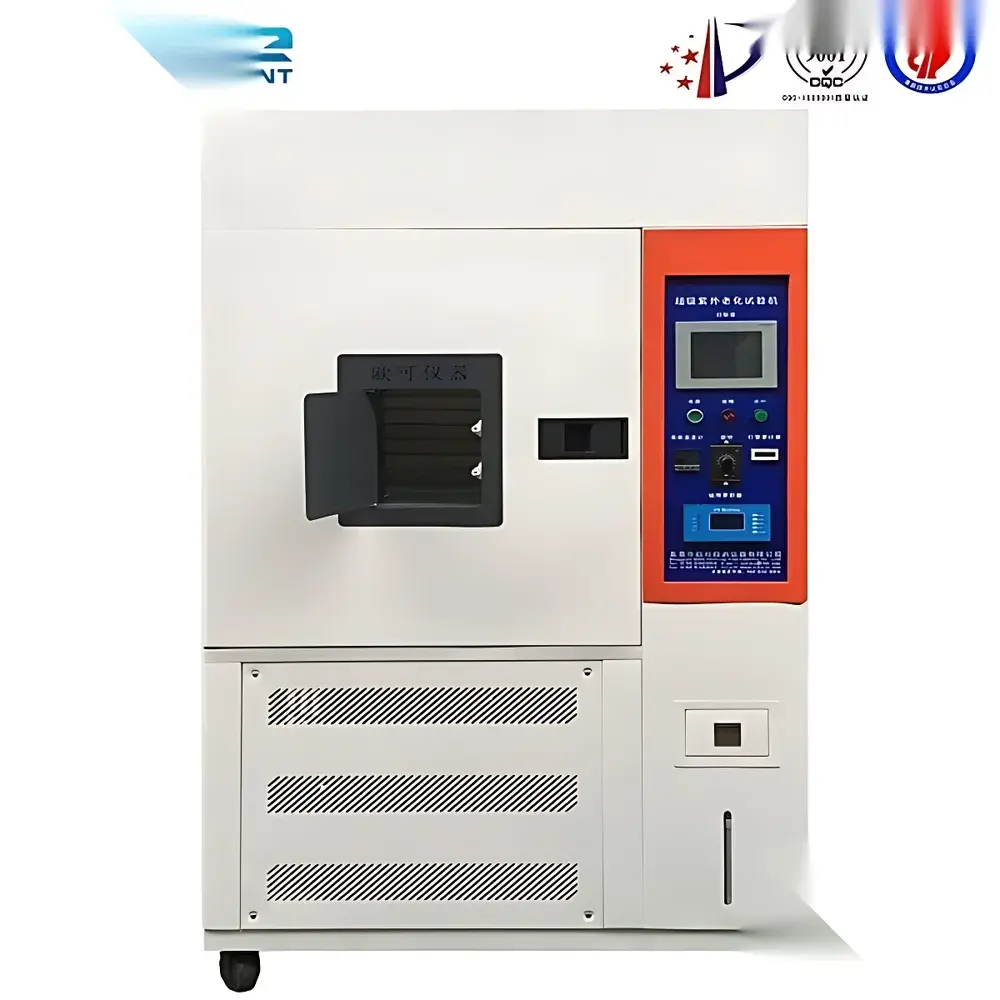
SuperUV Advanced Metal Halide UV Weathering Test Chamber
| Brand | Other Brands |
|---|---|
| Origin | Imported |
| Manufacturer Type | Authorized Distributor |
| Price | USD 21,500 (FOB) |
| Sample Capacity | 500 × 400 mm Test Tray |
| Irradiation Source | Air-Cooled Metal Halide Lamp(s) |
| Spectral Range | 295–450 nm |
| Irradiance | 200 ± 8 W/m² |
| Uniformity | ≥90% across Exposure Plane |
| Cooling Method | Internal Forced-Air Circulation |
| Filter | Custom High-Borosilicate Glass + Optional IR-Reduction Filter (30% IR attenuation) |
| UV Monitoring | Integrated Spectral Irradiance Transmitter (developed by No. 622 Research Institute) |
| Control Interface | LCD-Based Irradiance Accumulation Meter with Real-Time Dose Integration |
Overview
The SuperUV Advanced Metal Halide UV Weathering Test Chamber is an engineered environmental simulation system designed to accelerate material degradation under controlled, reproducible conditions that replicate key outdoor stressors—primarily solar ultraviolet radiation, thermal cycling, and moisture exposure. Unlike fluorescent UV lamps limited to narrow UVA/UVB bands, this chamber employs air-cooled metal halide lamps emitting a continuous, broadband spectrum from 295 nm to 450 nm—spanning the biologically and chemically active UV-C, UV-B, UV-A, and near-visible violet/blue regions. When combined with precision optical filtering (including high-borosilicate glass and optional infrared-reduction filters), the resulting spectral power distribution closely matches terrestrial solar irradiance filtered through 3 mm of standard atmospheric path—enabling highly relevant photochemical aging assessment per ISO 4892-2, ASTM G155, and SAE J2527. The system supports three distinct exposure modes: UV irradiation only, UV + condensation (via controlled humidity and cold surface condensation), and UV + water spray—mimicking dew formation, rain wash-off, and thermal shock effects critical for evaluating coating adhesion, polymer embrittlement, pigment stability, and encapsulant yellowing in automotive, photovoltaic, and electronics applications.
Key Features
- High-fidelity solar-spectrum simulation using stabilized metal halide arc lamps with real-time spectral irradiance feedback
- Dual-mode moisture control: programmable condensation cycle (cold plate condensation at 10–60°C) and calibrated water spray system (flow rate: 0.5–2.0 L/min, droplet size distribution compliant with IEC 60529 IPX3/IPX4)
- Uniform irradiance distribution (>90% uniformity across 500 × 400 mm test plane) verified per ASTM G151 Annex A3
- Integrated UV spectral irradiance transmitter (developed by China Academy of Engineering Physics, No. 622 Research Institute) enabling traceable, NIST-traceable calibration paths
- Intelligent irradiance dosimetry: LCD-based cumulative radiant exposure meter with auto-integration, configurable dose thresholds, and non-volatile memory for audit-ready exposure logs
- Thermal management architecture: internal forced-air convection system maintaining lamp stability and chamber wall temperature consistency (±2°C tolerance during steady-state operation)
- Modular optical train: interchangeable filter set including standard high-borosilicate quartz and optional IR-reduction filters (30% infrared attenuation) for application-specific spectral tailoring
Sample Compatibility & Compliance
The chamber accommodates flat-panel specimens up to 500 mm × 400 mm × 50 mm (W × D × H) on a fixed horizontal exposure rack. Its open-top irradiation geometry and top-mounted lamp array support testing of large-format components—including automotive exterior trim, PV module laminates, architectural cladding panels, and printed circuit board assemblies—without requiring sample segmentation. The system meets functional compliance requirements for accelerated weathering validation under ISO 4892-2 (Methods A and B), ASTM G155 (Cycle A, B, C), SAE J2527 (Class A/B), and GB/T 16422.2. All irradiance measurements are referenced to SI-traceable standards; sensor calibration certificates are provided with each unit. The control firmware supports GLP-compliant data integrity: time-stamped irradiance logs, user-access level controls, and immutable event history—facilitating FDA 21 CFR Part 11 readiness when paired with validated third-party data archiving software.
Software & Data Management
While the base configuration features a dedicated embedded LCD controller for manual operation, optional Ethernet-enabled PC interface modules enable remote monitoring and automated test sequencing via Windows-based software. This software provides full programmability of multi-step cycles (e.g., 4-h UV @ 60°C → 4-h condensation @ 50°C → 2-h spray @ 25°C), real-time graphing of irradiance, chamber temperature, and humidity, and export of CSV-formatted datasets compatible with MATLAB, JMP, and Minitab. Audit trails include operator ID, parameter changes, alarm events, and calibration timestamps—all stored locally and exportable for regulatory review. Firmware updates are delivered via secure HTTPS and require digital signature verification to maintain system integrity.
Applications
This chamber is routinely deployed in R&D laboratories and quality assurance departments for comparative durability benchmarking of organic coatings (automotive clearcoats, marine antifouling paints), polymeric substrates (PC, ABS, TPO, ETFE), photovoltaic encapsulants (EVA, POE), and printed electronics. It supports failure mode analysis—including gloss loss (measured per ISO 2813), color shift (ΔE* ab per CIE 1976), microcrack propagation (via optical microscopy post-test), tensile strength retention (ASTM D638), and interfacial delamination (cross-sectional SEM). Validated use cases include Tier-1 automotive supplier PPAP submissions, UL 746C tracking for polymeric enclosures, and IEC 61215-2 MQT10 qualification of solar module backsheets.
FAQ
What spectral standard does the lamp/filter combination emulate?
It replicates the global solar spectral irradiance (AM1.5G) filtered through 3 mm of atmospheric path, as defined in ISO 4892-2 Annex B and ASTM G155 Cycle A.
Is the irradiance sensor NIST-traceable?
Yes—the UV spectral irradiance transmitter is calibrated against reference detectors certified by the National Institute of Metrology (NIM, China), with calibration certificates included.
Can the system operate without water supply?
Yes. Condensation and spray functions are independently programmable; UV-only or UV+condensation modes require no external water connection.
What maintenance intervals are recommended for the metal halide lamps?
Lamp replacement is recommended every 1,200 hours of accumulated UV-on time, with output degradation monitored via the integrated irradiance sensor.
Does the chamber support custom spectral filtering?
Yes—optional bandpass filters (e.g., 340 nm peak, 313 nm peak) and IR-reduction filters can be factory-installed upon order specification.



