
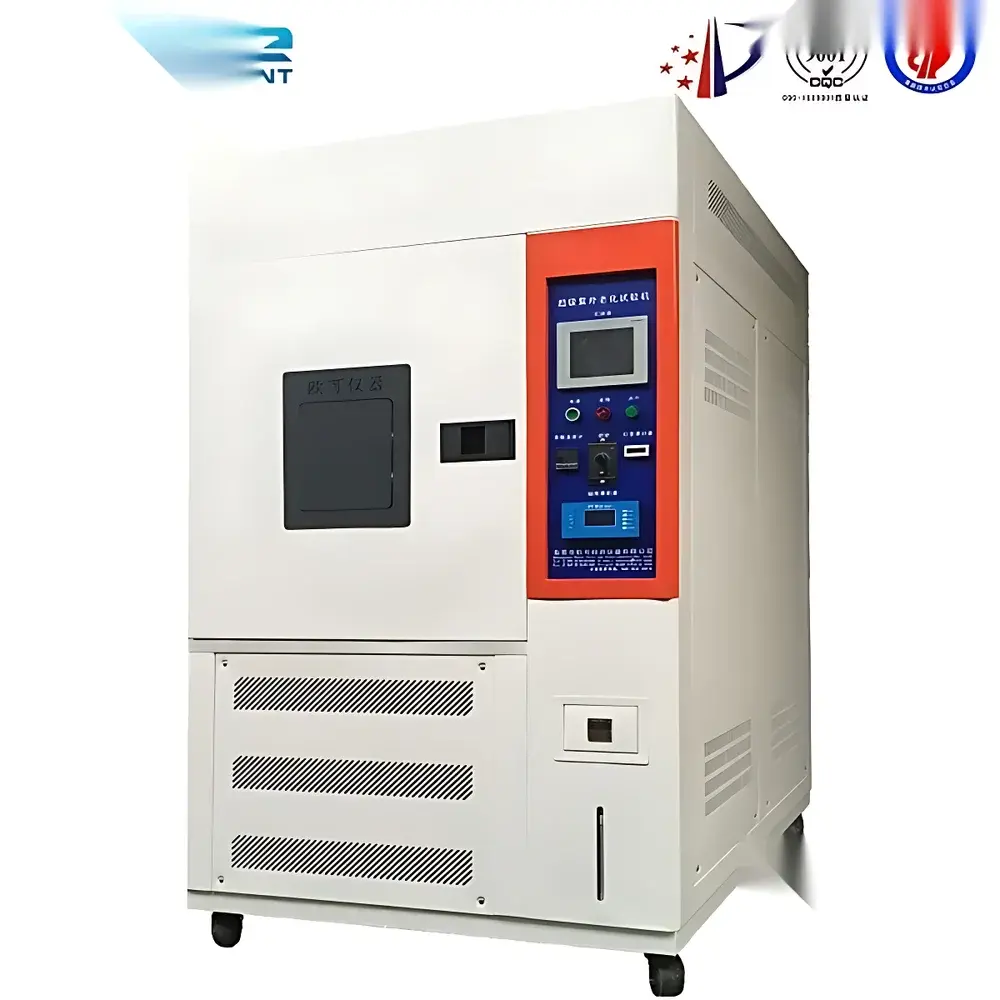
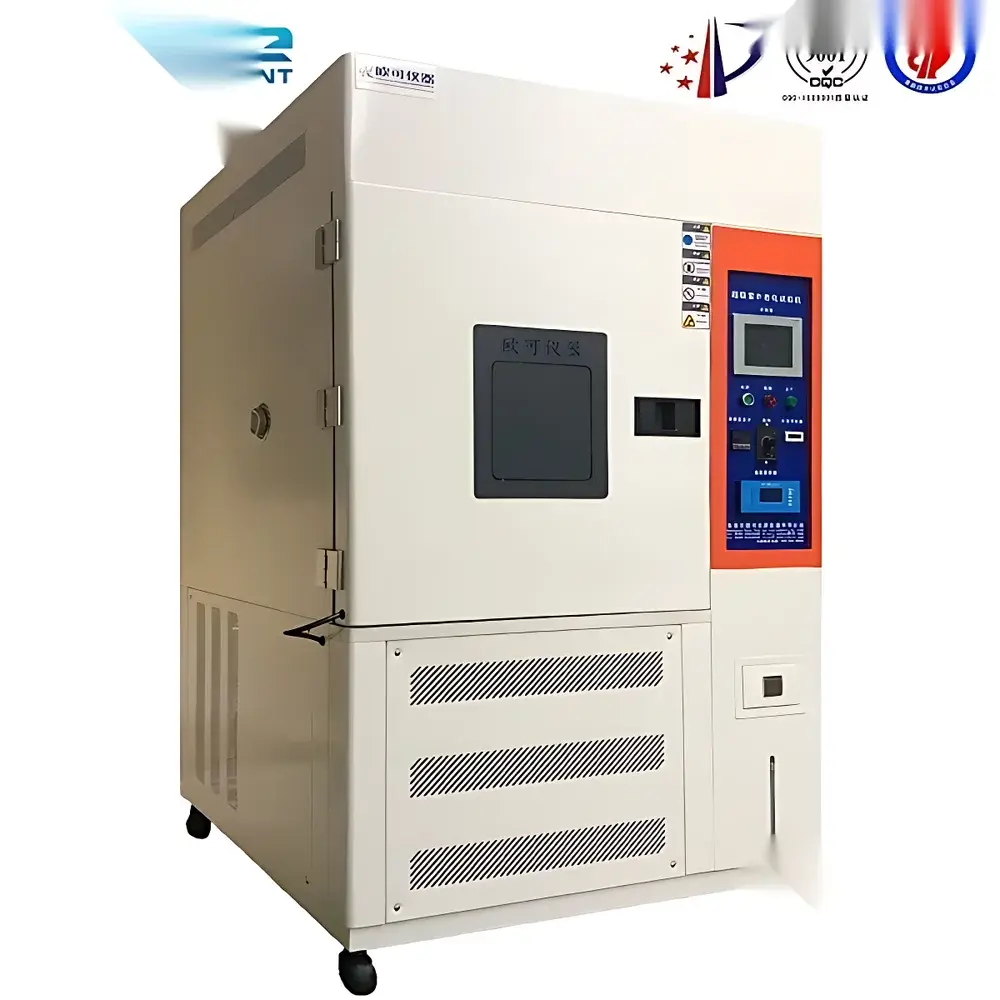
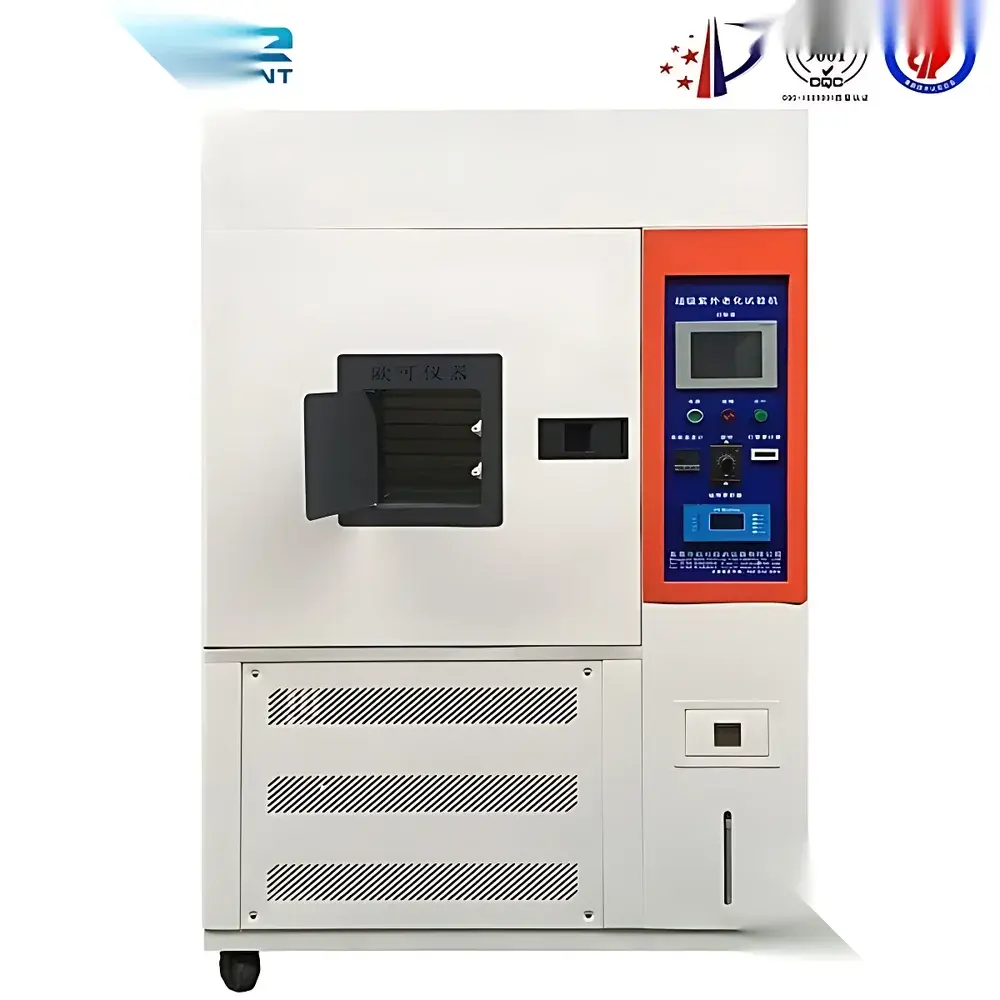
SuperUV Advanced UV Accelerated Weathering Test Chamber
| Brand | Other Brands |
|---|---|
| Origin | Imported |
| Manufacturer Type | Authorized Distributor |
| Temperature Range | RT to 85°C (Operating Range: 50°C ±10°C) |
| Humidity Range | 40–70% RH (Illumination), 50–90% RH (Dark Cycle) |
| Temperature Control Accuracy | ±0.5°C |
| Humidity Control Accuracy | ±2.0% RH |
| Temperature Uniformity | ±2.0°C |
| Humidity Uniformity | ±3.0% RH |
| Heating Rate | ≤25 min (RT → 85°C) |
| Light Source | 2.5 kW Air-Cooled Metal Halide Lamp (1 unit) |
| Irradiance | 200 ±8 W/m² (295–450 nm) |
| Spectral Range | 295–450 nm (UV-A/UV-B/VIS) |
| Irradiance Uniformity | ≥90% |
| Sample Tray | 500 × 400 mm Stainless Steel Rack |
| Illumination Geometry | Top-Mounted Reflector-Based Direct Irradiation |
| UV Radiometer | Integrated Spectral Irradiance Transmitter (Calibrated per ISO 17025 Traceable Standards) |
Overview
The SuperUV Advanced UV Accelerated Weathering Test Chamber is an engineered environmental simulation system designed for accelerated evaluation of material degradation under controlled solar-spectrum ultraviolet radiation, thermal stress, and cyclic humidity exposure. It employs a high-intensity, air-cooled 2.5 kW metal halide lamp whose spectral output (295–450 nm) closely replicates the terrestrial solar UV and near-visible irradiance profile—enabling realistic simulation of natural daylight-induced photochemical aging. Unlike fluorescent UV lamps with narrowband emission, this broadband source facilitates multi-mechanism degradation assessment—including photo-oxidation, polymer chain scission, pigment bleaching, and surface microcracking—under thermally regulated and hygrothermally cycled conditions. The chamber operates within a temperature range of ambient to 85°C (with standard test setpoint at 50°C ±10°C) and dynamically modulates relative humidity between 40–70% RH during irradiation and 50–90% RH during dark condensation phases. This dual-stress methodology aligns with internationally recognized accelerated weathering protocols such as ISO 4892-2, ASTM G155, and SAE J2527.
Key Features
- High-fidelity solar-spectrum simulation using a traceable 2.5 kW metal halide lamp (295–450 nm), delivering stable irradiance of 200 ±8 W/m² at specimen plane
- Precision climate control with ±0.5°C temperature accuracy and ±2.0% RH accuracy across full operational ranges
- Uniform irradiance distribution (≥90% spatial uniformity) achieved via top-mounted reflector optics and optimized lamp positioning
- Integrated UV radiometer calibrated against ISO/IEC 17025-accredited reference standards for real-time, closed-loop irradiance monitoring
- Stainless steel 500 × 400 mm sample tray compatible with standardized specimen holders and thickness-variable mounting fixtures
- Rapid thermal response architecture: achieves 85°C from ambient in ≤25 minutes, supporting tight thermal cycling profiles
- Robust chamber construction with double-wall insulation, quartz-glass viewport, and corrosion-resistant internal surfaces for long-term stability
Sample Compatibility & Compliance
The SuperUV chamber accommodates rigid and semi-flexible flat specimens up to 500 × 400 mm and 50 mm thickness, including polymer films, automotive coatings, architectural sealants, textile laminates, and outdoor signage substrates. Specimen mounting allows for angled or vertical orientation to simulate real-world exposure geometry. All operational parameters—including irradiance setpoints, temperature ramps, humidity dwell times, and cycle sequencing—are programmable to meet requirements of ISO 4892-2 (Method A/B), ASTM D4329 (UV Fluorescent), ASTM G155 (Xenon Arc), and IEC 61215-2 (PV module qualification). The system supports GLP-compliant data logging with timestamped environmental records and irradiance traceability—fully compatible with FDA 21 CFR Part 11 audit trail requirements when integrated with validated software platforms.
Software & Data Management
Control and monitoring are executed via an embedded industrial-grade PLC-based interface with touchscreen HMI, offering intuitive cycle programming, real-time parameter visualization, and event-triggered alarms. Raw sensor data—including chamber temperature, relative humidity, irradiance intensity, and lamp operating hours—is logged at user-defined intervals (minimum 1-second resolution) and exportable in CSV or XML formats. Optional Ethernet/IP or Modbus TCP connectivity enables integration into centralized LIMS or MES environments. When paired with third-party validation packages (e.g., IQ/OQ documentation kits), the system meets regulatory expectations for instrument qualification under ISO/IEC 17025 and GxP frameworks. All firmware updates undergo version-controlled release management with documented change logs and backward-compatible configuration preservation.
Applications
- Automotive OEMs evaluating paint chip resistance, headlamp lens yellowing, and interior trim UV stability per GMW14124 and Ford CETP
- Photovoltaic manufacturers conducting IEC 61215-2 MQT10 UV preconditioning tests on encapsulants and backsheets
- Coatings R&D labs assessing gloss retention, color shift (ΔE*), and adhesion loss in architectural acrylics and fluoropolymers
- Medical device packaging developers validating sterile barrier integrity and ink legibility after accelerated shelf-life simulation
- Aerospace suppliers qualifying polyimide films, silicone elastomers, and composite matrix resins per AMS 2700 and ASTM D7869
FAQ
What standards does this chamber comply with?
It supports testing protocols aligned with ISO 4892-2, ASTM G155, ASTM D4329, SAE J2527, and IEC 61215-2. Full compliance requires proper calibration, operator training, and documented procedure execution.
Is lamp spectral output independently certified?
Yes—the metal halide lamp’s spectral irradiance curve is characterized per CIE 85:2018 and supplied with a manufacturer’s spectral power distribution (SPD) report traceable to NIST or PTB reference standards.
Can humidity be controlled independently during irradiation cycles?
Yes. The system implements decoupled PID control loops for temperature and humidity, enabling precise RH maintenance even under active UV load and elevated thermal conditions.
What maintenance intervals are recommended for the lamp and sensor?
Lamp replacement is advised every 1,200–1,500 operational hours; the UV radiometer requires annual recalibration against a certified reference detector per ISO/IEC 17025 guidelines.
Is remote monitoring supported?
Standard Ethernet connectivity allows secure remote access via VPN-configured networks using industry-standard SCADA protocols; optional cloud telemetry modules provide SMS/email alerting for critical fault events.



