
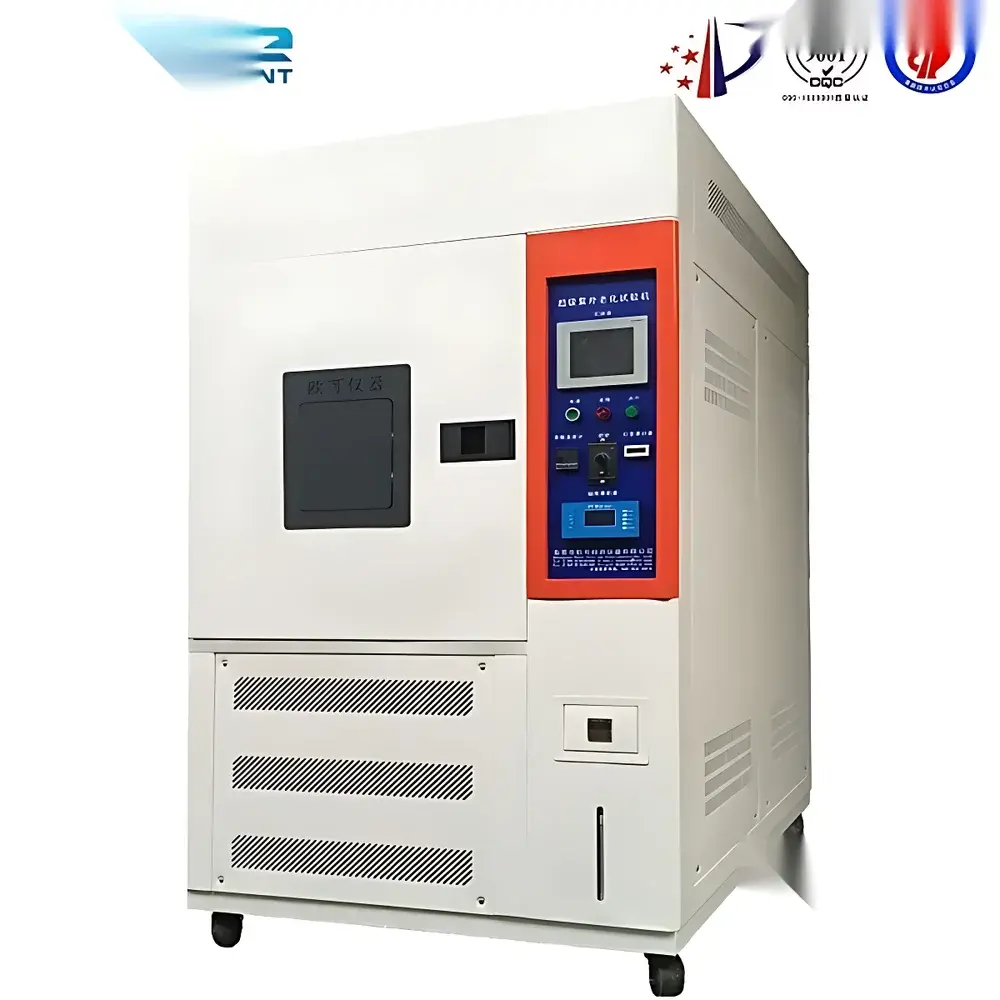
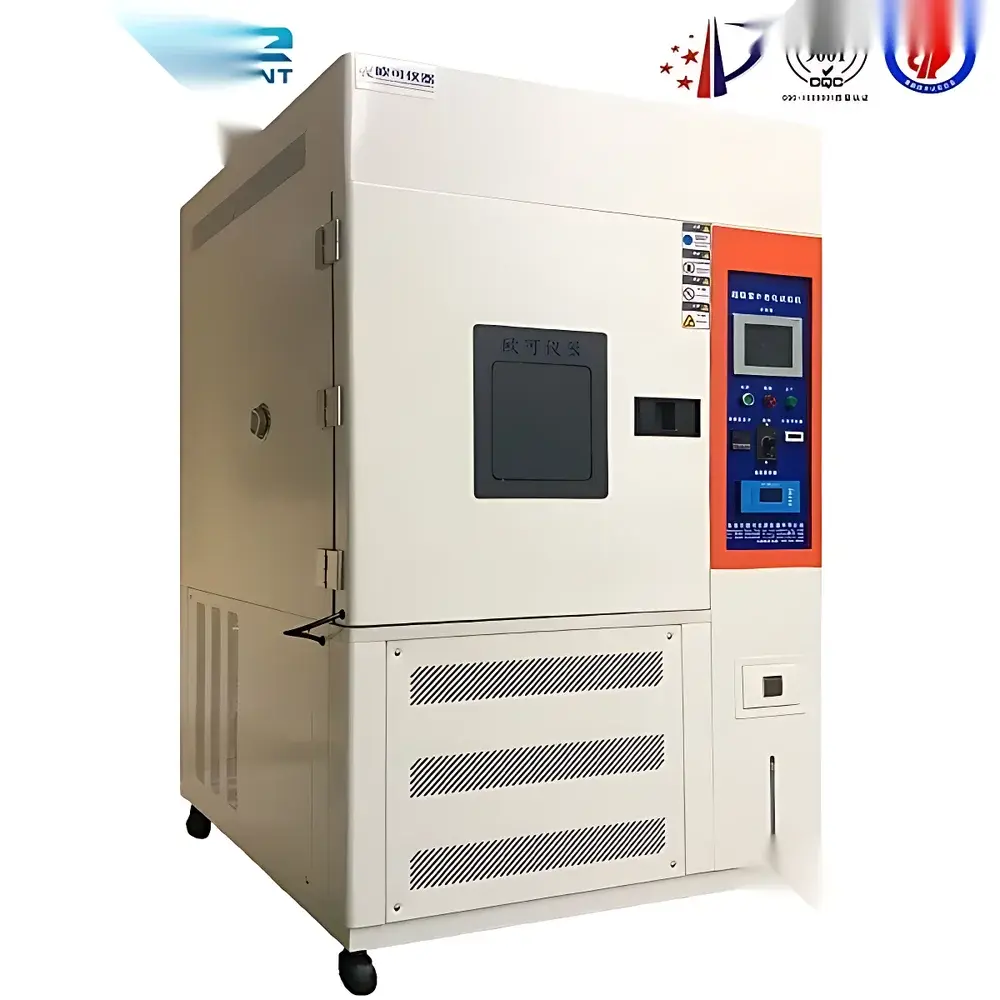
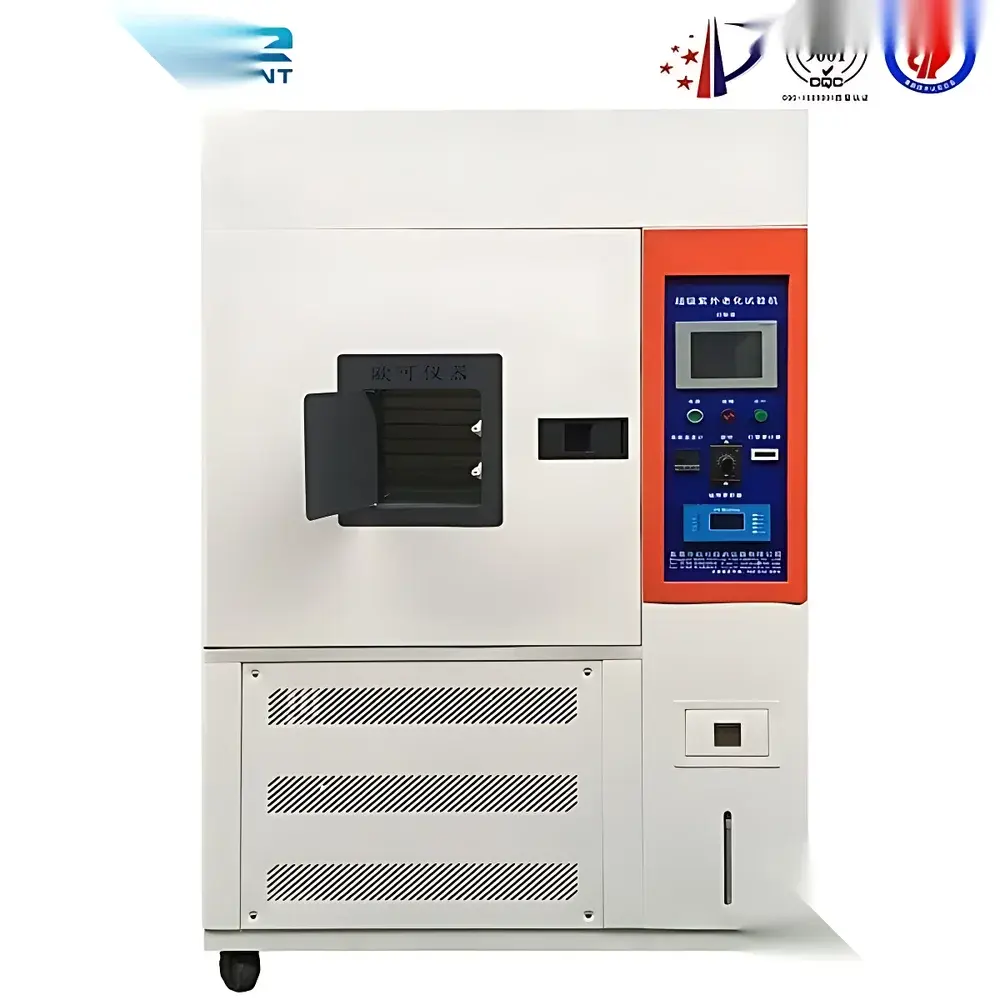
SuperUV Advanced UV Weathering Test Chamber
| Brand | Other Brands |
|---|---|
| Origin | Imported |
| Manufacturer Type | Authorized Distributor |
| Temperature Range | RT to 85 °C (Operating Range: 50 ± 10 °C) |
| Humidity Range | 40–70 % RH (Illuminated) / 50–90 % RH (Dark Cycle) |
| Temperature Control Accuracy | ±0.5 °C |
| Humidity Control Accuracy | ±2.0 % RH |
| Temperature Uniformity | ±2.0 °C |
| Humidity Uniformity | ±3.0 % RH |
| Heating Rate | ≤25 min (RT → 85 °C) |
| Light Source | 2.5 kW Air-Cooled Metal Halide Lamp (1 unit) |
| Sample Tray Dimensions | 500 × 400 mm |
| Irradiation Geometry | Top-mounted lamp with reflective direct irradiation |
| Spectral Range | 295–450 nm (UV-A/UV-B broadband) |
| Irradiance Level | 200 ± 8 W/m² |
| UV Radiometer | Integrated Spectral UV Irradiance Transmitter (developed by China Academy of Engineering Physics, Institute 622) |
| IR Filtering | Optional 30 % infrared energy rejection filter (custom order required) |
Overview
The SuperUV Advanced UV Weathering Test Chamber is an engineered environmental simulation system designed for accelerated evaluation of material degradation under controlled ultraviolet radiation, thermal cycling, and moisture exposure. It employs a high-intensity air-cooled metal halide lamp (2.5 kW) emitting a broadband UV spectrum from 295 nm to 450 nm—encompassing critical UV-A and UV-B wavelengths responsible for photochemical bond scission, polymer chain oxidation, and chromophore breakdown. Unlike narrowband fluorescent UV sources, this spectral profile replicates the more aggressive short-wavelength irradiance found in terrestrial sunlight, enabling realistic simulation of outdoor weathering effects—including color fading, gloss loss, surface cracking, chalking, embrittlement, and mechanical property decay—in days or weeks rather than months or years. The chamber integrates precise temperature and humidity control across both irradiated and dark condensation cycles, supporting ASTM G154, ISO 4892-2, and SAE J2020 test protocols for non-metallic materials used in automotive, aerospace, coatings, plastics, and architectural applications.
Key Features
- High-fidelity UV spectrum (295–450 nm) generated by a single 2.5 kW air-cooled metal halide lamp, delivering stable irradiance at 200 ± 8 W/m² across the test plane
- Top-mounted lamp configuration with reflective optics ensures ≥90 % irradiance uniformity over the 500 × 400 mm sample area
- Dual-mode environmental control: independent regulation of temperature (RT to 85 °C, ±0.5 °C accuracy) and relative humidity (40–70 % RH during irradiation; 50–90 % RH during condensation phases)
- Integrated spectral UV radiometer developed by the China Academy of Engineering Physics (Institute 622), providing real-time, traceable irradiance feedback for closed-loop control
- Optional 30 % infrared-rejection filter available for applications requiring reduced thermal loading without compromising UV dose delivery
- Rapid thermal response: achieves 85 °C from ambient in ≤25 minutes, minimizing cycle transition delays
- Robust stainless-steel interior with corrosion-resistant construction, compliant with long-term operation under humid and UV-exposed conditions
Sample Compatibility & Compliance
The chamber accommodates flat-panel specimens up to 500 × 400 mm on its standard tray, suitable for rigid plastics, painted metal substrates, elastomers, textile laminates, and coated composites. Its operational envelope meets the environmental stress requirements of multiple international standards, including ASTM G154 (Cycle A1, A2, B1), ISO 4892-2 (Method A, B), and SAE J2020 (for automotive exterior materials). While not certified to IEC 60068-2-5 or MIL-STD-810H out-of-the-box, its control fidelity and spectral traceability support validation against GLP-compliant internal test methods. All humidity and temperature sensors are calibrated per ISO/IEC 17025-accredited procedures, and data logging supports audit-ready records for quality assurance systems aligned with ISO 9001 and IATF 16949.
Software & Data Management
The chamber operates via an embedded industrial controller with intuitive touchscreen interface, supporting pre-programmed test profiles and user-defined multi-step sequences (e.g., UV exposure → condensation → water spray). Real-time irradiance, temperature, and humidity values are logged at 1-second intervals and exportable as CSV or Excel-compatible files. Optional Ethernet/IP or Modbus TCP connectivity enables integration into centralized laboratory information management systems (LIMS) and automated QA workflows. For regulated environments, optional 21 CFR Part 11-compliant software modules provide electronic signatures, audit trails, and role-based access control—ensuring full data integrity and traceability throughout the testing lifecycle.
Applications
- Accelerated aging of automotive clearcoats, interior trim, and headlamp lenses per OEM specifications (e.g., Ford CETP, GM W3173)
- UV stability assessment of architectural sealants, roofing membranes, and PVC window profiles under ISO 4892-2 cyclic conditions
- Photostability qualification of medical device packaging polymers exposed to ambient UV during storage and transport
- Correlation studies between laboratory UV exposure and field performance data for solar reflectance coatings and photovoltaic encapsulants
- Material screening for aerospace interior components subjected to high-altitude UV flux and thermal-humidity cycling
FAQ
What is the spectral output difference between this metal halide lamp and standard UVA-340 fluorescent lamps?
The metal halide source delivers continuous broadband UV from 295 nm upward, including higher-energy UV-B photons absent in UVA-340 tubes. This enables faster degradation kinetics for UV-sensitive pigments and additives, particularly relevant for outdoor durability prediction.
Is the UV irradiance sensor NIST-traceable?
The integrated spectral radiometer is calibrated against reference standards maintained by Institute 622 (CAEP), with calibration certificates traceable to national metrology institutes in China. Third-party NIST-traceable recalibration services are available upon request.
Can the chamber perform water spray cycles in addition to condensation?
Yes—the system supports programmable water spray functionality using deionized water, enabling full compliance with ASTM G154 Cycle B1 (UV + water spray) and ISO 4892-2 Method B.
What maintenance is required for the metal halide lamp?
Lamp life is rated at ≥1,200 hours under continuous operation. Replacement requires re-calibration of the UV sensor due to spectral drift; lamp alignment and reflector cleaning are recommended every 200 operating hours.
Does the chamber meet CE or UKCA marking requirements?
As supplied, the unit complies with EN 61000-6-2 (immunity) and EN 61000-6-4 (emissions). CE documentation—including DoC, risk assessment, and wiring diagrams—is provided upon order confirmation. UKCA marking requires additional conformity assessment by a UK-recognized body.



