
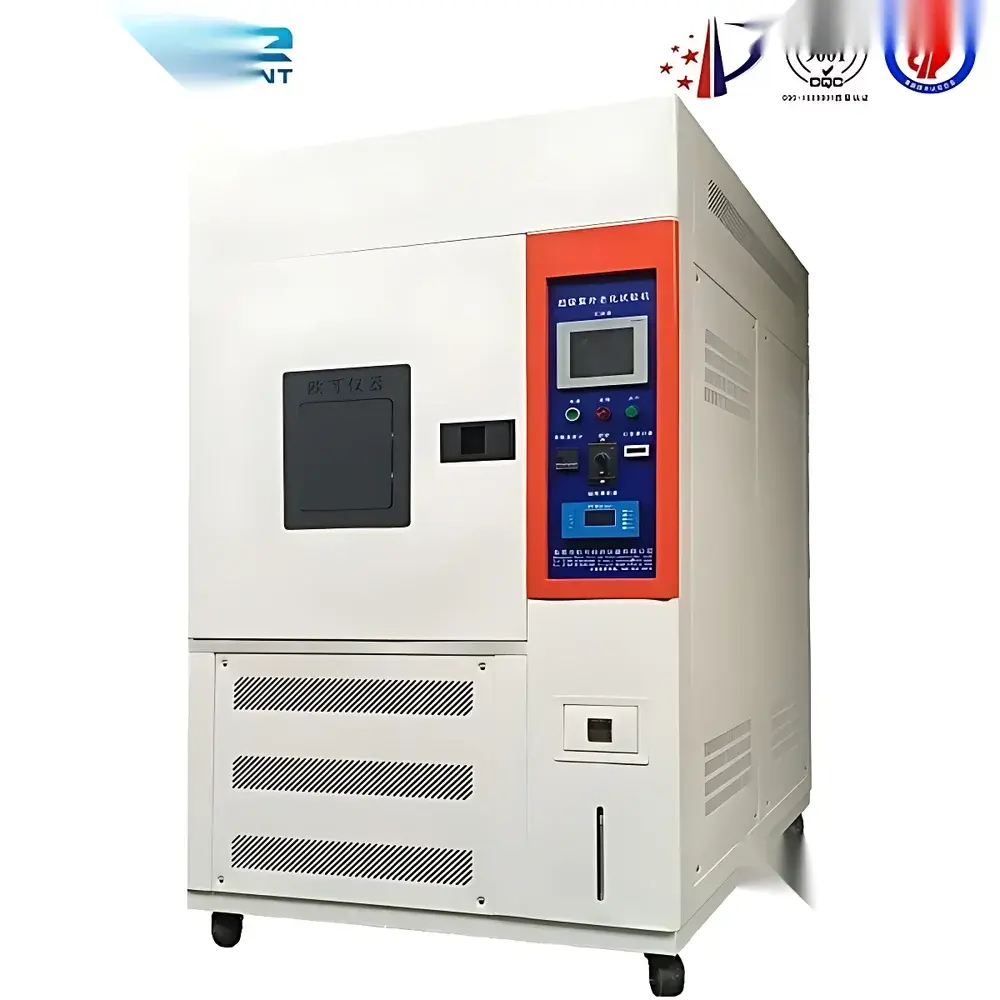
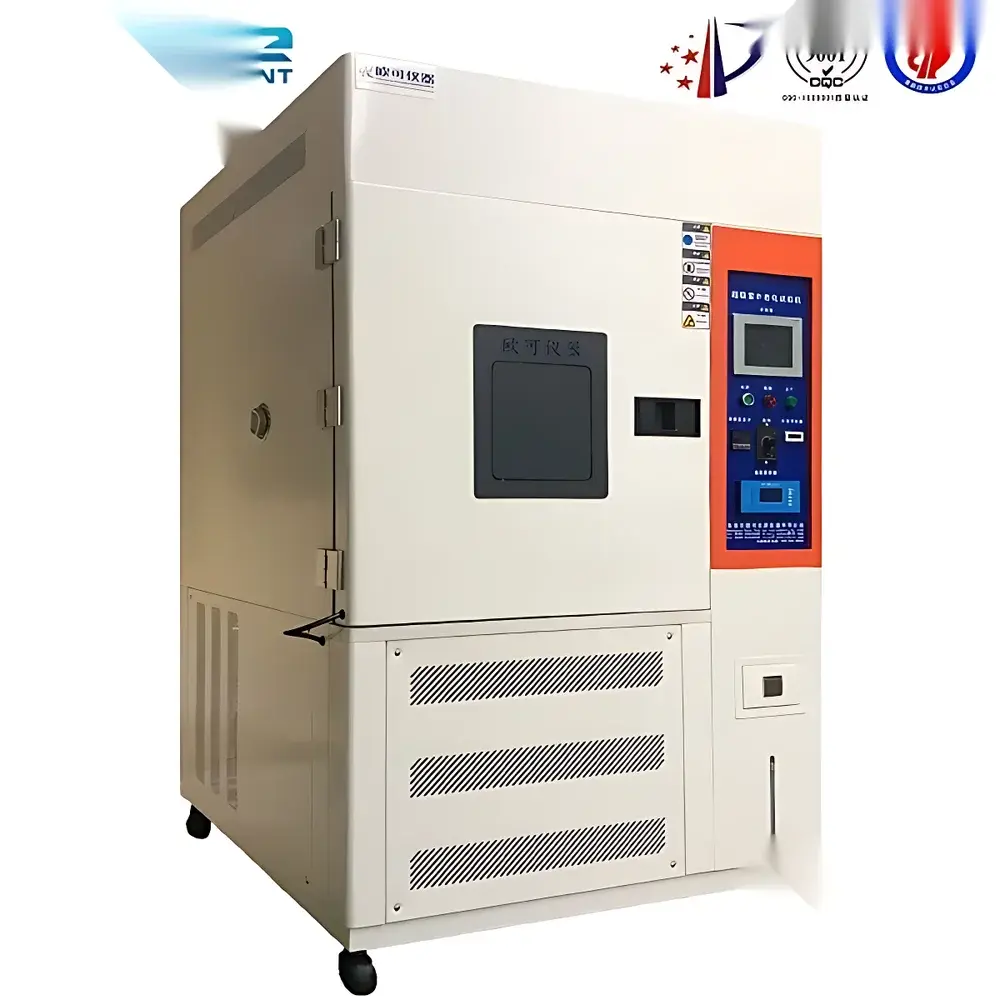
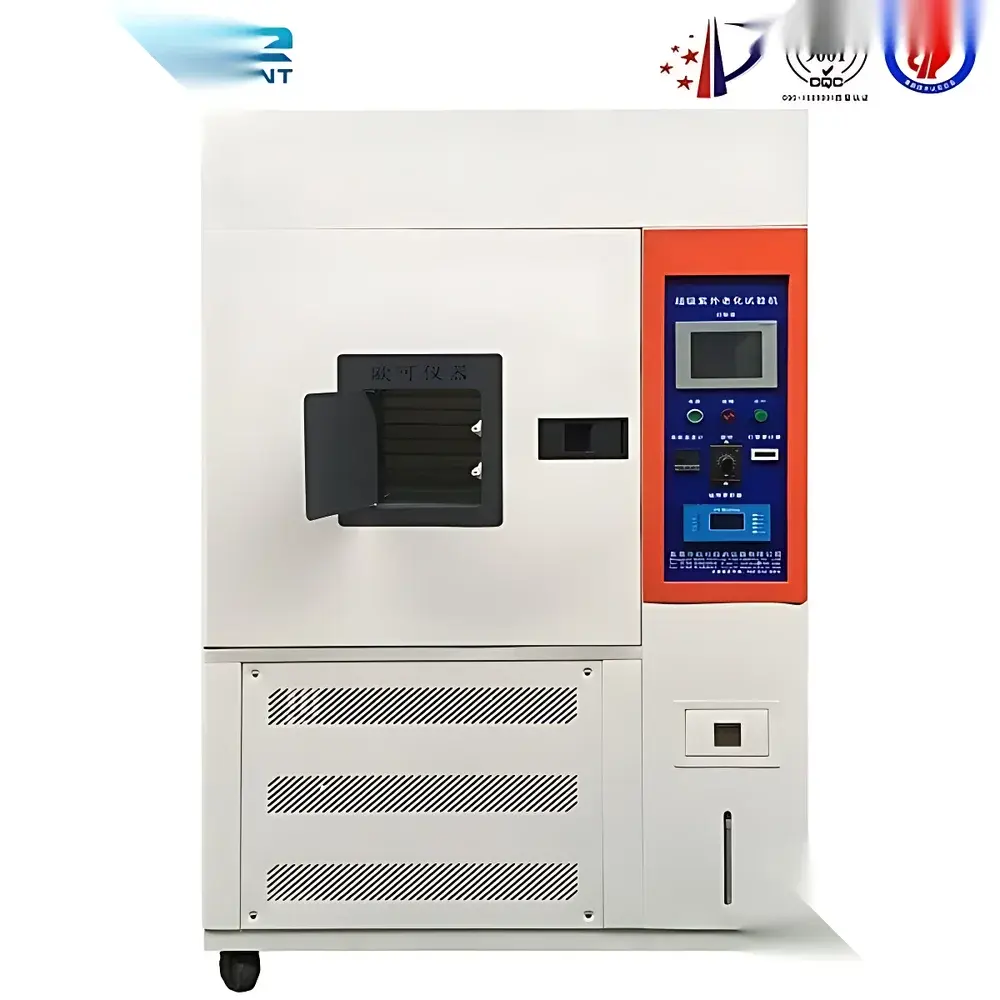
SuperUV Metal Halide UV Aging Test Chamber
| Key Features | Temperature Range: RT to 85°C (Operating Range: 50 ±10°C) |
|---|---|
| Humidity Range | 40–70% RH (Illumination), 50–90% RH (Dark Cycle) |
| Temp. Control Accuracy | ±0.5°C |
| Humidity Control Accuracy | ±2.0% RH |
| Temp. Uniformity | ±2.0°C |
| Humidity Uniformity | ±3.0% RH |
| Heating Rate | RT → 85°C in ≤25 min |
| Light Source | Single 2.5 kW Air-Cooled Metal Halide Lamp |
| Spectral Output | 295–450 nm (UV–Visible) |
| Irradiance at Sample Plane | 200 ±8 W/m² |
| Irradiance Uniformity | ≥90% |
| Sample Tray | 500 × 400 mm Stainless Steel Rack |
| Illumination Geometry | Top-Mounted Reflector-Based Direct Irradiation |
| Compliance | Designed per ISO 4892-2, ASTM G154, IEC 60068-2-5, and GB/T 16422.2 |
Overview
The SuperUV Metal Halide UV Aging Test Chamber is an advanced environmental test system engineered for accelerated weathering simulation of polymeric materials, coatings, adhesives, and automotive exterior components. Unlike conventional fluorescent UV systems, this chamber employs high-intensity air-cooled metal halide lamps to replicate the full spectral profile of terrestrial solar radiation—spanning the critical 295–450 nm ultraviolet and visible range. The optical output closely matches the relative spectral power distribution (SPD) of sunlight filtered through 3 mm of borosilicate glass, enabling realistic simulation of both direct and diffuse insolation effects. By integrating controlled thermal cycling, programmed humidity modulation, and intermittent water spray or condensation cycles, the chamber accelerates degradation mechanisms—including photooxidation, chain scission, pigment bleaching, and interfacial delamination—within days or weeks rather than months or years under natural exposure.
Key Features
- High-fidelity spectral replication: 2.5 kW metal halide lamp delivers continuous broadband irradiance (295–450 nm), with optical filtering to emulate solar transmission through standard glazing.
- Precise environmental control: Dual-zone PID-controlled heating and humidification system maintains temperature within ±0.5°C and relative humidity within ±2.0% RH across the test volume.
- Uniform irradiance distribution: Optimized reflector geometry and lamp positioning ensure ≥90% irradiance uniformity over the 500 × 400 mm sample plane—critical for comparative testing and ISO-compliant validation.
- Multi-mode exposure protocols: Supports simultaneous or sequential operation of UV irradiation, thermal soak, dark condensation (via bottom-mounted water reservoir and heated chamber floor), and programmable water spray cycles.
- Robust chamber architecture: Constructed from SUS304 stainless steel interior with double-wall insulation; front-view tempered quartz window enables real-time visual monitoring without interrupting test conditions.
- Thermal performance: Achieves ramp rates from ambient to 85°C in ≤25 minutes, facilitating rapid transition between light/dark and dry/wet phases per ASTM G154 Cycle 4 or ISO 4892-2 Method A.
Sample Compatibility & Compliance
The chamber accommodates flat-panel specimens up to 500 × 400 mm and 50 mm thickness, with standardized mounting via non-reactive stainless-steel fixtures. It supports both horizontal and angled sample orientation to simulate real-world exposure geometries. All operational parameters—including irradiance setpoint, temperature ramp profiles, humidity dwell times, and spray duration—are fully programmable and logged with time-stamped audit trails. The system is designed to meet the technical requirements of ISO 4892-2 (Plastics — Methods of exposure to laboratory light sources — Part 2: Xenon-arc lamps), ASTM G154 (Standard Practice for Operating Fluorescent Ultraviolet (UV) Lamp Apparatus for Exposure of Nonmetallic Materials), and IEC 60068-2-5 (Environmental testing — Part 2-5: Tests — Test Sa: Simulated solar radiation at ground level). While not a xenon-arc source, its metal halide spectrum has been validated against CIE Standard Illuminant D65 for UV–visible energy distribution below 450 nm, making it suitable for qualification testing where spectral fidelity within the photoactive band is prioritized over full-spectrum matching.
Software & Data Management
Control and data acquisition are managed via a dedicated industrial-grade touchscreen HMI running embedded Linux firmware. The interface provides real-time visualization of irradiance (W/m²), chamber temperature, relative humidity, and spray status, with automatic calibration reminders for lamp aging compensation. All test logs—including setpoints, actual values, alarm events, and manual interventions—are stored internally and exportable via USB or Ethernet as CSV files compliant with GLP documentation standards. Optional PC-based software enables remote monitoring, multi-chamber synchronization, statistical analysis of degradation kinetics (e.g., ΔE* color shift, gloss retention %, tensile strength loss), and generation of PDF test reports aligned with ISO/IEC 17025 traceability frameworks. Audit trail functionality satisfies FDA 21 CFR Part 11 requirements for electronic records when configured with user authentication and digital signature modules.
Applications
- Automotive OEMs and Tier-1 suppliers evaluating paint durability, headlamp lens yellowing, and interior trim UV resistance.
- Coating manufacturers validating weatherability claims for architectural, marine, and industrial finishes per AAMA 2605 or ISO 12944.
- Photovoltaic module encapsulant R&D teams assessing EVA discoloration and backsheet embrittlement under combined UV/thermal/humidity stress.
- Medical device packaging developers qualifying Tyvek® and blister foil laminates for shelf-life compliance under ICH Q1B photostability guidelines.
- Academic research laboratories conducting mechanistic studies on polymer photodegradation pathways using time-resolved FTIR or gel permeation chromatography post-exposure.
FAQ
What distinguishes this metal halide UV chamber from standard fluorescent UV testers?
Metal halide lamps provide significantly higher irradiance intensity and broader spectral coverage (295–450 nm) compared to UVA-340 or UVB-313 fluorescent tubes, enabling more realistic simulation of solar photon flux and improved correlation with outdoor field data—particularly for materials sensitive to visible-light-driven degradation.
Is lamp spectral output calibrated and traceable to national standards?
Yes. Each lamp batch undergoes pre-installation spectral radiometric characterization using a NIST-traceable spectroradiometer. In-chamber irradiance is monitored continuously with a calibrated silicon photodiode sensor referenced to ISO/CIE spectral weighting functions.
Can the chamber operate unattended for extended cycles (e.g., 1000+ hours)?
Yes. The system includes redundant safety interlocks (overtemperature, overhumidity, lamp arc failure), automatic lamp hour logging, and configurable email/SMS alerts for critical alarms—supporting fully autonomous long-term testing under ISO 17025-accredited QA environments.
Does it support cyclic testing per ASTM D4329 or ISO 4892-3?
While optimized for ISO 4892-2 metal halide protocols, the controller allows custom cycle definition—including alternating UV/dark, wet/dry, and thermal ramp segments—enabling implementation of ASTM D4329 (plastics in fluorescent UV-condensation apparatus) and modified ISO 4892-3 (fluorescent UV/xenon hybrid) test sequences via user-defined program steps.
What maintenance is required for sustained irradiance accuracy?
Lamp output declines gradually over service life (~1500 hours); the system compensates via automatic irradiance feedback control. Quarterly verification of sensor calibration and annual replacement of optical filters and humidity sensors are recommended to maintain measurement integrity per ISO/IEC 17025 clause 6.4.



