
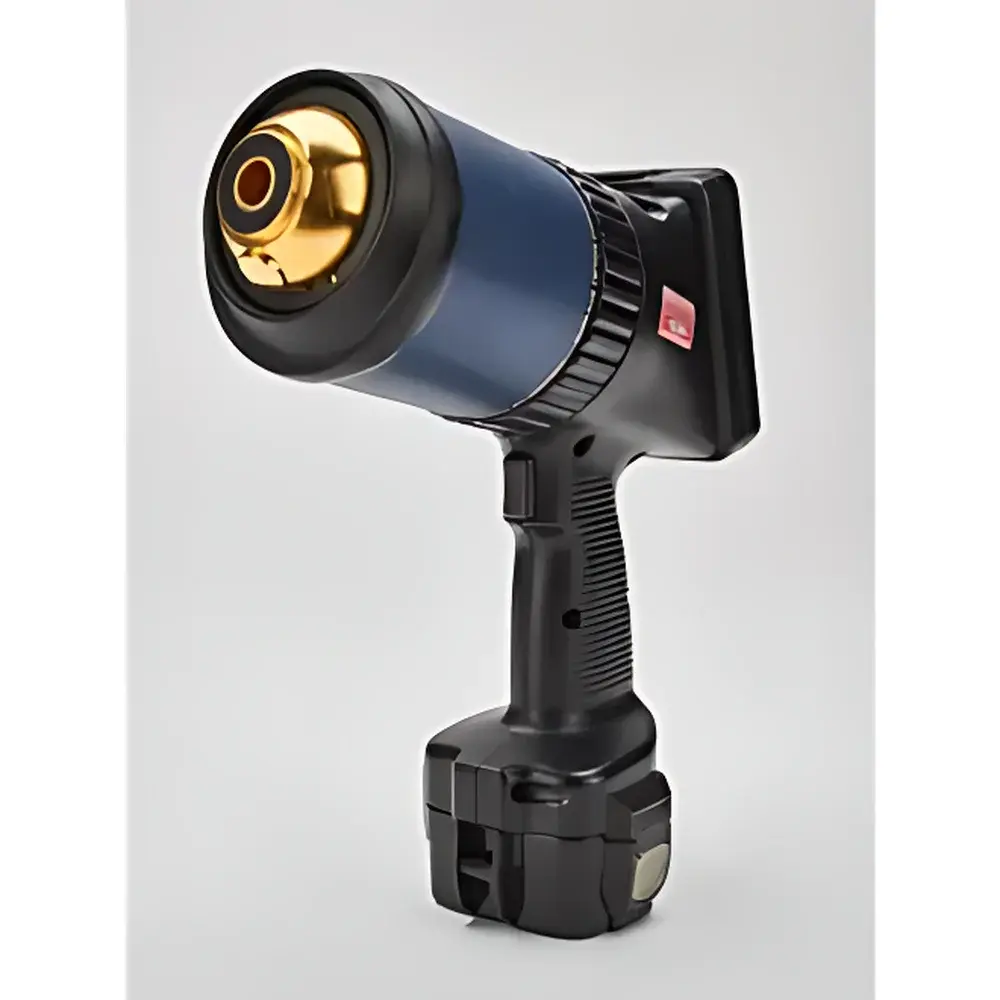
SurfaceOptics 410 DHR Portable Directional-Hemispherical Reflectometer
| Brand | SurfaceOptics |
|---|---|
| Origin | USA |
| Model | 410 DHR |
| Wavelength Bands | 0.9–1.1, 1.9–2.4, 3.0–4.0, 3.0–5.0, 4.0–5.0, 8.0–12.0 µm |
| Wavelength Resolution | Fixed-band spectral filtering (no scanning monochromator) |
| Measurement Time | 10 s per acquisition (after 90 s warm-up) |
| DHR Repeatability | ±0.5% absolute reflectance (typical, under controlled ambient conditions) |
| Incident Angles | 20° and 60° from normal |
| Sample Geometry Support | Flat, convex (≥6″ radius), concave (≥12″ radius) |
| IR Source | Kanthal® alloy resistive emitter |
| Probe Design | Modular, swappable optical heads |
| Display | Integrated touchscreen PDA with embedded control firmware |
| Operating Temperature | 0–40 °C (non-condensing) |
| Storage Temperature | −25–70 °C |
| Power | Dual rechargeable NiMH batteries |
| Weight | 2.1 kg (including batteries) |
| Calibration | NIST-traceable gold mirror reference standard included |
Overview
The SurfaceOptics 410 DHR is a field-deployable, handheld directional-hemispherical reflectometer engineered for rapid, in-situ measurement of absolute spectral reflectance across six discrete mid- to long-wave infrared (MWIR–LWIR) bands. Unlike scanning spectroradiometers or Fourier-transform instruments, the 410 DHR employs fixed-band, thermally stabilized optical filters coupled with a broadband Kanthal® resistive source and calibrated integrating sphere detection geometry. This architecture enables robust, repeatable DHR measurements—defined as the ratio of total hemispherical reflected radiant flux to incident directional flux—without requiring cryogenic cooling or external power supplies. The instrument complies with ASTM E903 and ISO 9050 definitions of solar-weighted and spectral reflectance, and its measurement geometry adheres to the CIE 15:2018 framework for directional–diffuse reflectance characterization. Designed for thermal management validation, spacecraft thermal control coating verification, and military-grade surface emissivity assessment, the 410 DHR delivers traceable, physics-based optical constants without laboratory infrastructure.
Key Features
- True portable operation: self-contained unit with integrated PDA, touchscreen interface, and dual NiMH battery pack enabling >4 hours of continuous field use
- Modular probe architecture: interchangeable optical heads optimized for specific band combinations or angular configurations (20° or 60° incidence)
- NIST-traceable calibration: shipped with certified gold-coated mirror reference standard; optional annual recalibration services available with full uncertainty budget documentation
- Ruggedized mechanical design: magnesium alloy housing rated IP54 for dust and light moisture resistance; operational within 0–40 °C non-condensing environments
- Thermal stabilization protocol: 90-second pre-heat cycle ensures source emissivity stability and detector baseline consistency prior to each 10-second acquisition
- No moving parts in optical path: eliminates alignment drift and mechanical wear associated with grating or filter wheel mechanisms
Sample Compatibility & Compliance
The 410 DHR accommodates diverse sample geometries—including flat substrates, convex surfaces with radii ≥6 inches, and concave surfaces with radii ≥12 inches—without requiring sample masking or auxiliary collimation optics. Its 20° and 60° incidence options support both near-normal and oblique-angle reflectance evaluation per MIL-STD-461G and ASTM C1371 for thermal barrier coatings. All firmware and calibration data comply with FDA 21 CFR Part 11 requirements for electronic records and signatures when operated in validated environments. Measurement protocols align with ISO/IEC 17025:2017 general requirements for competence of testing and calibration laboratories, and raw reflectance outputs are compatible with GLP/GMP audit trails when exported via USB or SD card.
Software & Data Management
Embedded firmware provides real-time display of absolute reflectance values per band, with on-device averaging (1–10 scans), statistical summary (mean, std dev, min/max), and timestamped metadata logging (operator ID, GPS coordinates if enabled, ambient temperature/humidity). Data export supports CSV and XML formats compliant with ASTM E2917 and ISO 14255 standards for spectral data interchange. Optional SurfaceOptics DataLink™ desktop software enables batch processing, spectral interpolation between bands, and generation of ASTM E1980-compliant solar absorptance (αsolar) and thermal emittance (εthermal) reports. All calibration certificates include expanded uncertainties (k=2) derived from NIST SRM 1937 and SRM 2001 methodologies.
Applications
- Validation of low-emissivity coatings on aerospace thermal blankets and satellite radiators
- Quality assurance of architectural cool roof materials per CRRC and ENERGY STAR® specifications
- In-field verification of camouflage netting and multispectral signature suppression systems
- Research-grade optical constant derivation (n, k) for thin-film IR absorbers using Kramers–Kronig constrained inversion
- Thermal performance auditing of industrial insulation systems and refractory linings
- Supporting DOE Building Technologies Office (BTO) initiatives for building envelope energy modeling
FAQ
What standards does the 410 DHR conform to for reflectance measurement?
The instrument implements measurement geometry and data reporting conventions aligned with ASTM E903, ISO 9050, CIE 15:2018, and MIL-STD-461G Annex G for directional–hemispherical reflectance.
Can the 410 DHR measure bidirectional reflectance distribution function (BRDF)?
No—it is specifically configured for DHR only; BRDF requires goniometric angular sampling beyond the fixed 20°/60° incidence and hemispherical collection capability.
Is spectral interpolation between the six bands supported?
Yes, via optional DataLink™ software using constrained cubic spline interpolation validated against NIST-traceable blackbody reference spectra.
How often must the gold reference standard be recertified?
SurfaceOptics recommends annual NIST-traceable recalibration; certificate includes measurement uncertainty analysis per ISO/IEC 17025 Annex A.3.
Does the 410 DHR require external PC connectivity for basic operation?
No—all measurement, display, storage, and export functions are fully autonomous via the integrated PDA and touchscreen interface.



