
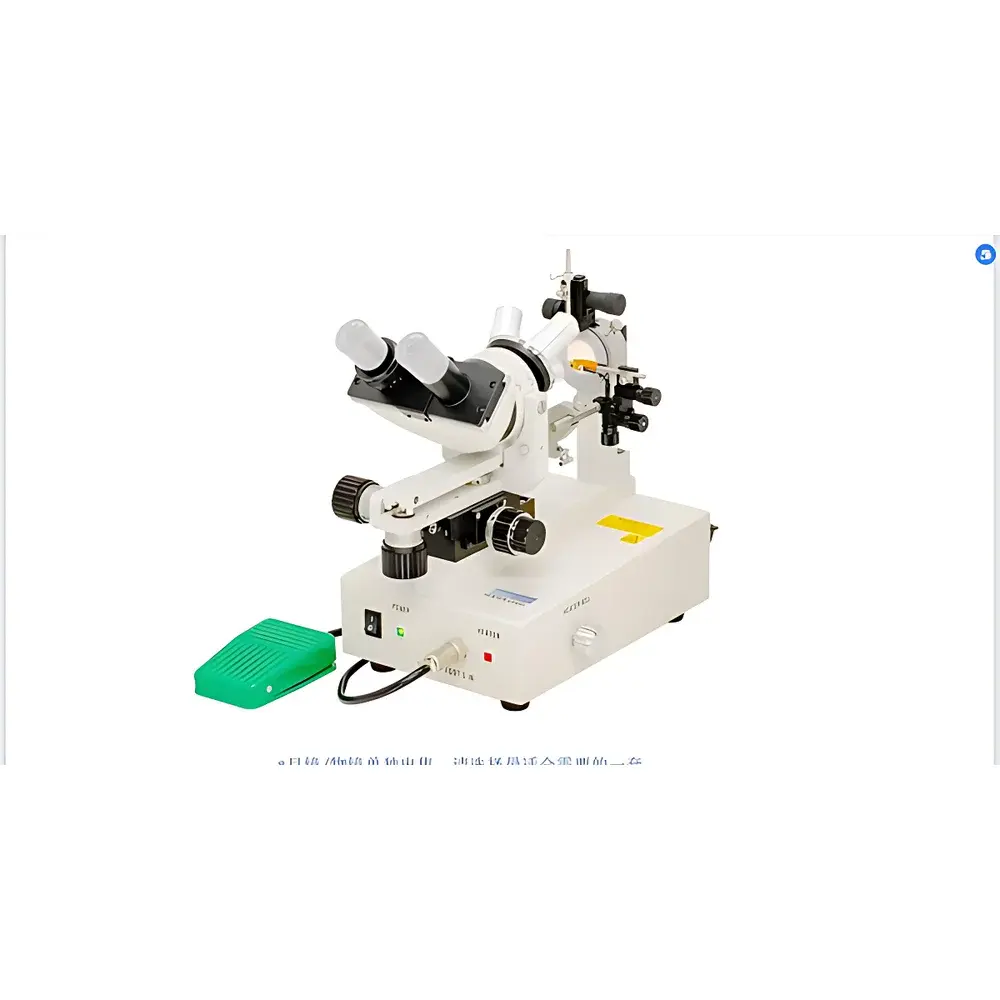
Sutter MF2 Microelectrode Puller & Micromanipulator
| Brand | Sutter |
|---|---|
| Origin | USA |
| Model | MF2 Microforge |
| Heating Manipulator Travel | X/Y/Z ±14 mm |
| Pipette Manipulator Travel | X/Y/Z ±12 mm |
| Microscope Stage Travel | X ±7 mm, Y ±30 mm, Z ±8 mm |
| Max Bending Angle | ≤90° |
| Compatible Capillary OD | 1.0–1.5 mm |
| Magnification Options | 50×, 75×, 100×, 525× (via interchangeable objectives/eyepieces) |
| Heating Power Control | Adjustable rotary knob |
| Footswitch | Integrated for hands-free heating activation |
| Illumination | Continuously variable brightness LED ring light |
| Input Power | AC 220 V ±5% / 240 V ±5%, 50/60 Hz |
| Power Consumption | 35 W |
| Compliance | CE-marked, RoHS-compliant, designed for GLP-aligned lab environments |
Overview
The Sutter MF2 Microforge is a precision-engineered, dual-manipulator microfabrication workstation designed for the reproducible fabrication of micrometer-scale glass electrodes, injection needles, aspiration pipettes, and custom microtools used in electrophysiology, single-cell manipulation, microinjection, and microfluidic interfacing. Unlike conventional pullers that rely solely on thermal drawing, the MF2 operates on a microforging principle—applying localized resistive heating to soften borosilicate or quartz capillaries while simultaneously enabling real-time mechanical deformation under optical guidance. Its integrated high-magnification stereo microscope (with selectable objectives and eyepieces supporting up to 525× total magnification) provides direct visual feedback during tip shaping, bending, polishing, and bevelling operations. The system’s modular architecture supports both upright and inverted configurations, and its rigid aluminum-alloy frame ensures mechanical stability critical for sub-micron repeatability across repeated fabrication cycles.
Key Features
- Dual independent manipulators: A heated micromanipulator (X/Y/Z ±14 mm travel) and a non-heated pipette manipulator (X/Y/Z ±12 mm travel), each rotatable through 360° and lockable at arbitrary relative orientations—including orthogonal or co-linear alignment.
- Real-time angular metrology: On-screen digital protractor overlay calibrated against the microscope’s optical axis, enabling quantitative measurement and replication of tip bend angles up to 90° with ±1° resolution.
- Adjustable thermal control: Continuously variable heating power via front-panel rotary potentiometer, compatible with standard platinum-iridium or tungsten filament heaters (included as spares); optimized for controlled softening of 1.0–1.5 mm OD borosilicate capillaries without thermal runaway.
- Ergonomic hands-free operation: Integrated footswitch for momentary or latched heating activation, minimizing hand movement during delicate tip formation.
- Variable-intensity coaxial illumination: Brightness-tunable LED ring light with uniform Köhler illumination geometry, eliminating glare and shadow artifacts during fine-tip observation.
- Modular optical path: Interchangeable objective lenses (5×, 10×, 25×, 50×) and wide-field eyepieces (10×, 15×) support magnifications from 50× to 525×; all optics are anti-reflection coated and parfocalized.
- Stable mechanical platform: Precision-ground XYZ translation stage for the microscope head (X ±7 mm, Y ±30 mm, Z ±8 mm), facilitating rapid repositioning between fabrication zones and long-term focus retention.
Sample Compatibility & Compliance
The MF2 is validated for use with standard thin-wall and thick-wall borosilicate glass capillaries (1.0–1.5 mm outer diameter), including those coated with filament or metal layers for recording/stimulation applications. It accommodates quartz capillaries up to 1.2 mm OD when paired with higher-power heater elements. All electrical components comply with IEC 61010-1 safety standards and bear CE marking. The instrument is designed to operate within ISO 14644-1 Class 5 cleanroom environments and meets RoHS Directive 2011/65/EU requirements. Its operational log structure—including timestamped heater activation events, manual angle annotations, and user ID tagging (when integrated with Sutter’s optional LabTrack™ software)—supports audit readiness for GLP and GMP workflows per FDA 21 CFR Part 11 guidelines.
Software & Data Management
While the MF2 operates as a standalone hardware platform, it is fully compatible with Sutter’s LabTrack™ Laboratory Instrument Management Suite (v3.2+). LabTrack enables automated capture of operator-defined metadata (e.g., capillary batch ID, target bend angle, heating duration), synchronization with time-lapse microscope video streams, and export of structured CSV/JSON datasets for statistical process control (SPC) analysis. Audit trails include immutable records of parameter changes, session start/end timestamps, and user authentication logs—essential for regulatory submissions in preclinical neurophysiology or biologics development labs.
Applications
- Electrophysiology: Fabrication of patch-clamp electrodes with defined tip geometry (flat, bevelled, bent), resistance-tuned recording pipettes, and vacuum-based cell-attachment probes.
- Microinjection & Transgenesis: Production of nuclear transfer holding needles, cytoplasmic injection pipettes, and pronuclear microinjection tools with <5 µm tip diameters and precise curvature for oocyte penetration.
- Single-Cell Analysis: Custom aspiration probes for microalgal isolation, nanoparticle trapping, and organelle extraction under DIC or phase contrast imaging.
- Microfluidics Integration: Tapered and angled interface probes for coupling PDMS chips to external fluidic manifolds or pressure controllers.
- Materials Characterization: Fabrication of scanning probe tips for AFM-assisted nanomanipulation and localized dielectrophoretic particle capture.
FAQ
What capillary types and dimensions are supported by the MF2?
The MF2 accepts borosilicate and quartz glass capillaries with outer diameters ranging from 1.0 mm to 1.5 mm. Standard thin-wall (1.0 mm OD × 0.58 mm ID) and thick-wall (1.5 mm OD × 1.12 mm ID) variants are routinely processed.
Can the MF2 produce electrodes with sub-micron tip openings?
Yes—when combined with post-forging heat-polishing protocols and appropriate filament temperature calibration, tip openings down to 300 nm are achievable for high-resistance intracellular recording applications.
Is the angle measurement function traceable to NIST standards?
The on-screen protractor is calibrated in situ using a certified stage micrometer and aligns with ISO 10110-5 tolerances for angular measurement uncertainty (<±0.8° at 90° full scale).
Does the MF2 require external cooling or compressed air?
No—its low thermal mass design and 35 W maximum power draw enable passive convection cooling; no external chillers, dry gas lines, or exhaust hoods are required.
How is maintenance performed on the heating filament and optical components?
The heater assembly is field-replaceable using the included universal wrench; spare filaments and LED modules ship with each unit. Optical surfaces are cleaned using methanol-dampened lens tissue following ISO 10110-7 procedures.



