
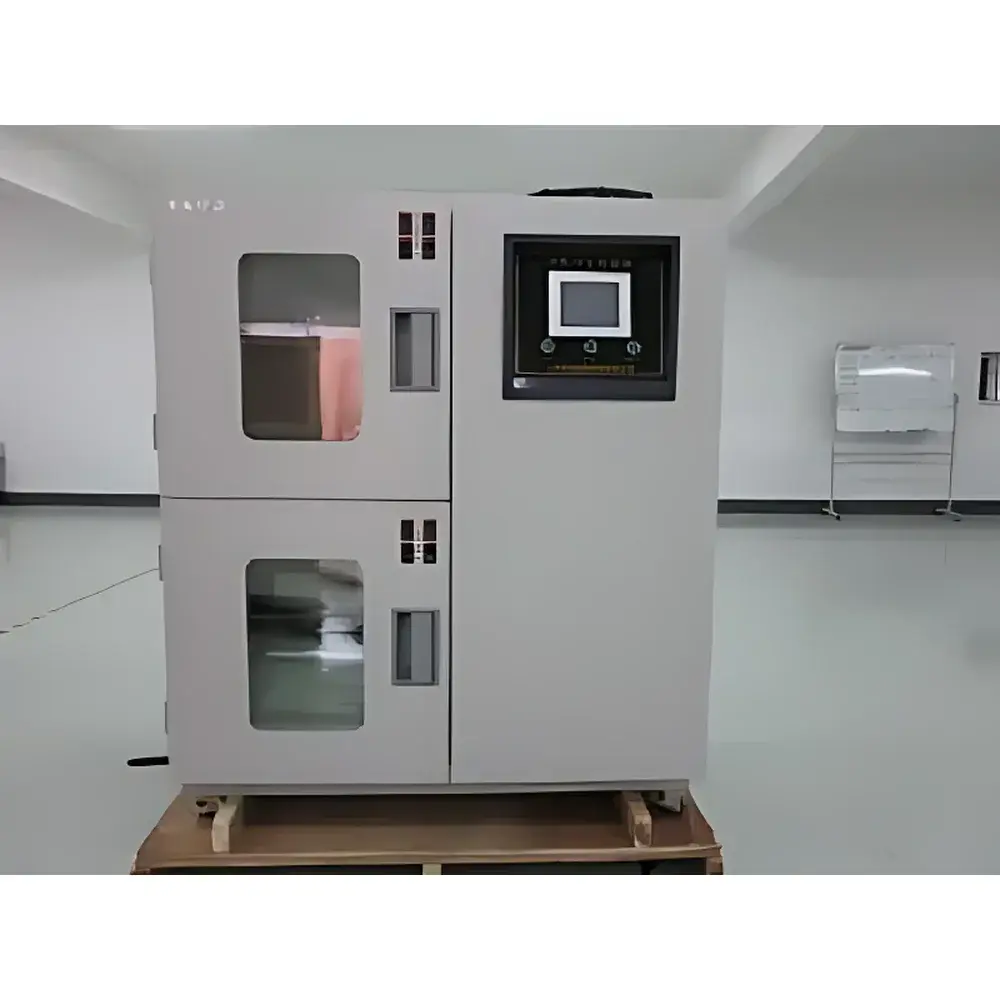
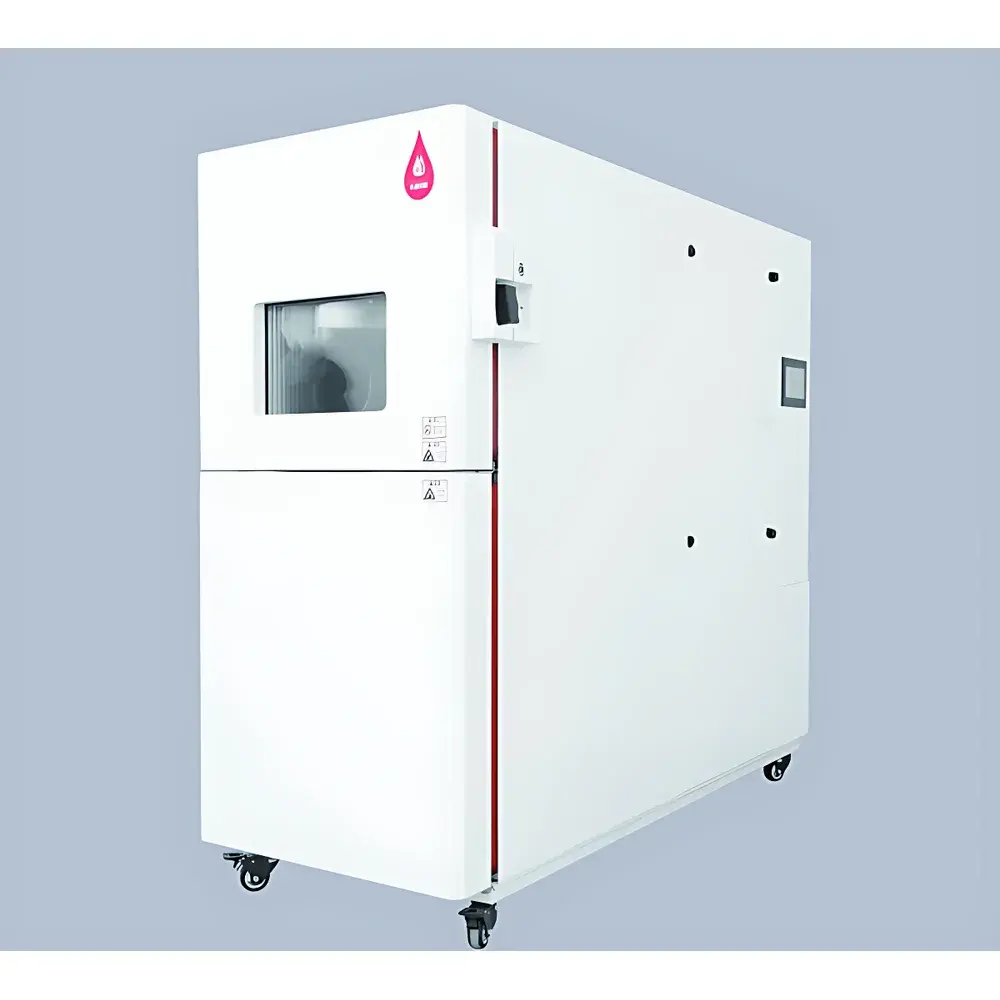
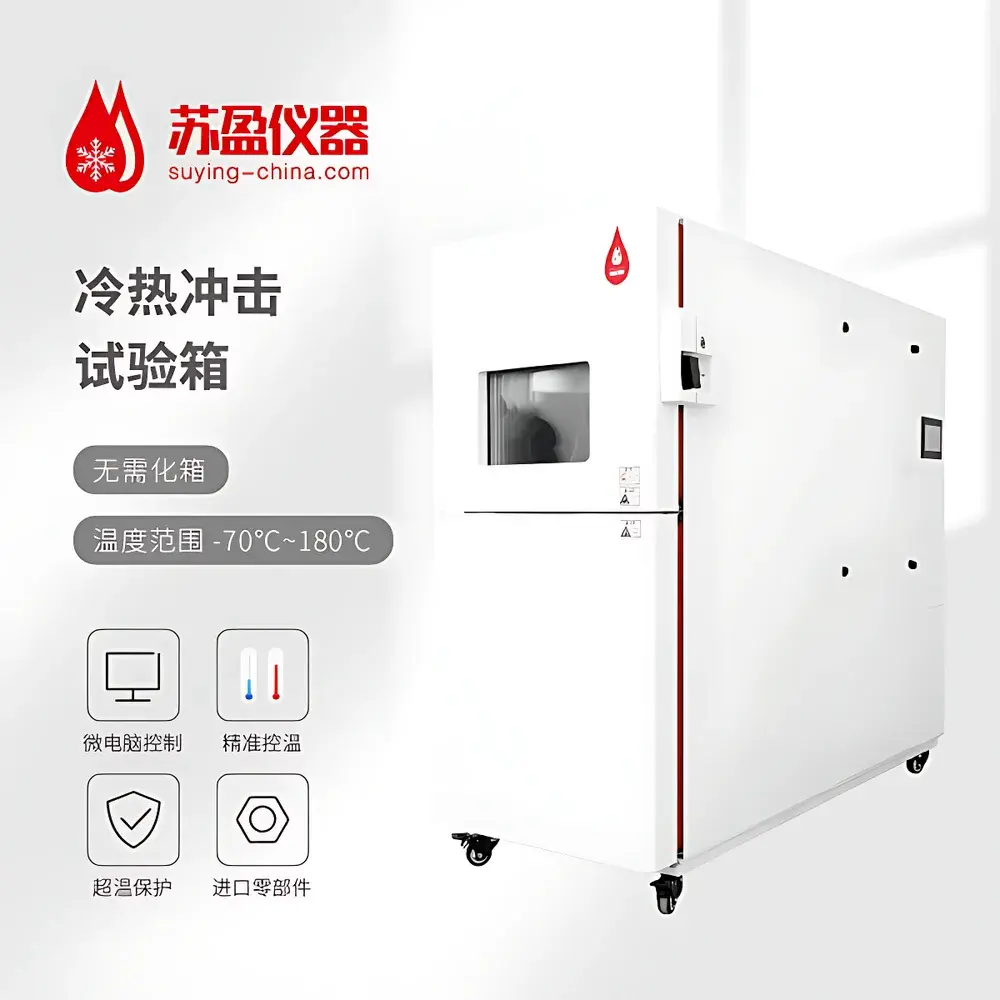
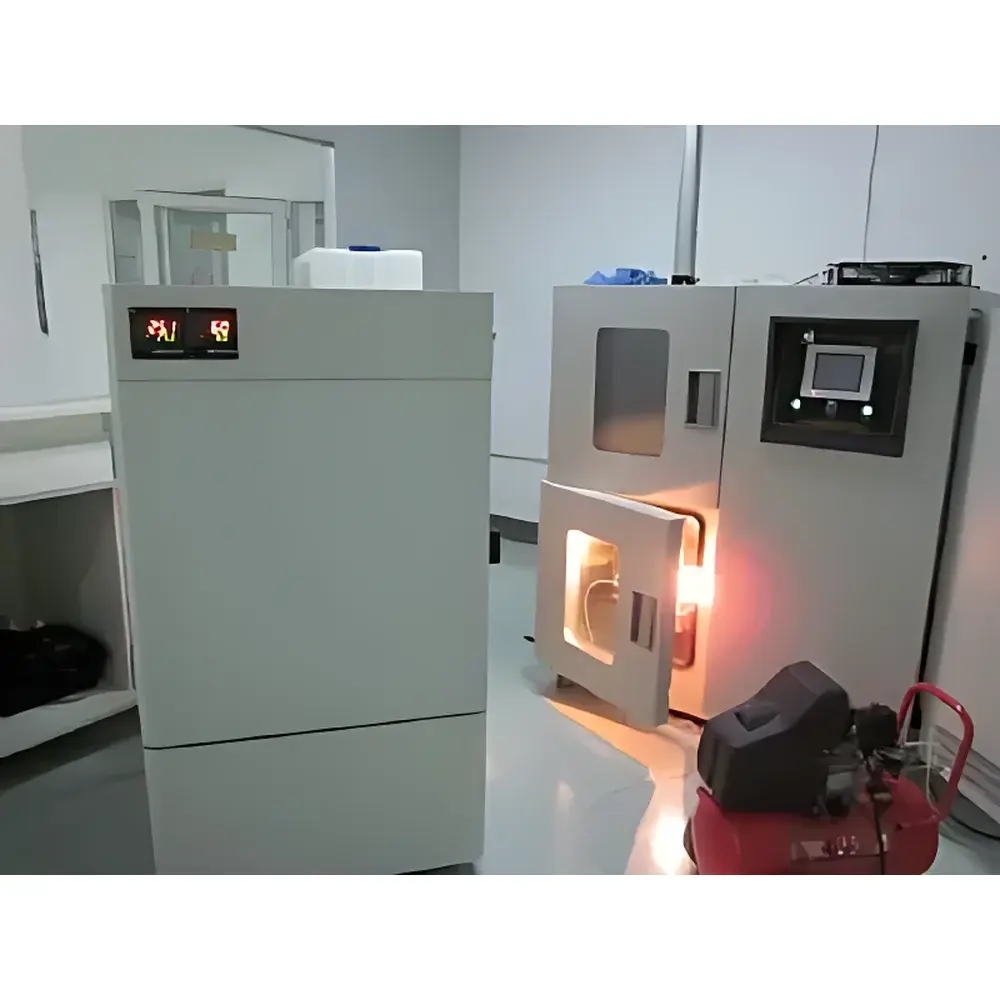
SuYing LRCJ-100/200/500 Thermal Shock Test Chamber
| Brand | SuYing |
|---|---|
| Origin | Shanghai, China |
| Model | LRCJ-100 / LRCJ-200 / LRCJ-500 |
| Temperature Range (A/B/C) | -20°C to 200°C / -40°C to 200°C / -60°C to 200°C |
| Temperature Transition Time | ≤15 s |
| Temperature Recovery Time | ≤5 min |
| Sample Zone Temp. Uniformity | ±0.5°C (at steady state) |
| Sample Load Capacity | 20 kg / 30 kg / 50 kg |
| Controller | OYO dual-loop LCD touch-panel temperature controller |
| Compliance | GB/T 2423.1–2, GB 10592–1989, GJB 150A–2009 |
| Refrigerants | R404A (high-stage), R23 (low-stage) |
| Cooling Method | Air-cooled binary cascade refrigeration system |
Overview
The SuYing LRCJ Series Thermal Shock Test Chamber is an engineered environmental test system designed for accelerated reliability assessment of electronic components, aerospace hardware, automotive modules, and advanced materials under extreme, rapidly alternating thermal conditions. It operates on the principle of two independent, physically separated temperature zones—hot and cold—connected via a high-speed horizontal or vertical specimen transfer mechanism (typically a lift basket or shuttle). This architecture enables true thermal shock testing per ASTM E1545, IEC 60068-2-14, and MIL-STD-810H Method 503.5, where specimens undergo rapid transitions between predefined high- and low-temperature extremes without exposure to intermediate ambient conditions. Unlike standard temperature cycling chambers, the LRCJ series achieves temperature transition times ≤15 seconds and temperature recovery times ≤5 minutes post-transfer—critical parameters for simulating real-world thermal stress events such as power-on surges, reflow soldering failures, or in-flight thermal gradients.
Key Features
- Triple-zone operational flexibility: Independent hot chamber (up to +200°C), cold chamber (down to –60°C), and ambient transfer zone enable “one-chamber-three-functions” capability—thermal shock, high-temperature soak, and low-temperature soak—without cross-contamination or thermal lag.
- Dual-cascade refrigeration system: Composed of two hermetically sealed compressors (imported French units), utilizing R404A for the high-stage loop and R23 for the low-stage loop, coupled via an evaporative condenser for efficient inter-stage heat exchange.
- OYO dual-loop intelligent controller: High-resolution LCD touchscreen interface with PID auto-tuning, real-time curve plotting, programmable 10×99-segment profiles, and data logging via RS-485 interface compliant with Modbus RTU protocol.
- Interlocked safety architecture: Full electrical interlock between chamber doors, lift basket drive motor, and circulation fans—power is automatically cut upon door opening to prevent operator exposure to extreme temperatures or moving parts.
- Standardized utility provisions: Top-mounted 50 mm diameter cable port with silicone gasket, pre-wired for sensor feedthroughs; optional inert gas purge inlet (N₂) available for oxidation-sensitive tests.
- Energy-regulated cooling: Adaptive expansion valve control (SPORLAN) and staged compressor sequencing minimize power consumption during partial-load operation while maintaining thermal stability and repeatability.
Sample Compatibility & Compliance
The LRCJ series accommodates samples up to 850 × 850 × 700 mm (LRCJ-500 model) with maximum load capacities ranging from 20 kg to 50 kg depending on configuration. Specimen trays are constructed from stainless steel 304 with reinforced support rails to ensure dimensional stability across thermal cycles. All models meet mandatory national and defense standards including GB/T 2423.1–2022 (cold/heat testing), GB 10592–1989 (environmental test chamber performance requirements), and GJB 150A–2009 (military equipment environmental engineering). Optional calibration certificates traceable to NIM (National Institute of Metrology, China) are available. While not inherently certified to ISO/IEC 17025, the system supports GLP-compliant validation protocols—including IQ/OQ/PQ documentation templates—and is compatible with FDA 21 CFR Part 11–enabled audit trail software when integrated with third-party data acquisition platforms.
Software & Data Management
The embedded OYO controller provides local data storage for up to 100 hours of continuous runtime logs (temperature, time, alarm status, heater/compressor duty cycle). Export is supported via USB flash drive in CSV format for post-processing in MATLAB, Python Pandas, or JMP. The RS-485 port allows integration into centralized laboratory management systems (LIMS) or MES environments using standard SCADA drivers. Optional PC-based software (SuYing TestSuite v3.2) adds features including remote monitoring, multi-chamber synchronization, statistical process control (SPC) charting, and automated report generation aligned with ISO 9001:2015 clause 8.2.4 (monitoring and measurement resources). All user-defined programs support password-protected editing and version-controlled backup.
Applications
- Electronics qualification: Solder joint fatigue analysis, PCB delamination detection, capacitor leakage current drift under thermal cycling.
- Aerospace component screening: Composite layup integrity verification, optical sensor housing dimensional stability, avionics enclosure seal performance.
- Automotive electronics: ECUs subjected to engine bay thermal transients, battery module thermal runaway propagation studies, LED headlamp thermal cycling endurance.
- Materials science: Coefficient of thermal expansion (CTE) mismatch evaluation in thin-film stacks, glass transition behavior of polymer encapsulants, intermetallic growth kinetics in Cu-Sn systems.
- Quality assurance: Burn-in screening for high-reliability semiconductors, lot acceptance testing per AEC-Q200, failure mode acceleration for HALT/HASS pre-screening.
FAQ
What is the difference between thermal shock and temperature cycling?
Thermal shock involves rapid transfer of specimens between two extreme, stabilized temperature zones (e.g., –55°C ↔ +125°C), inducing high transient thermal gradients and mechanical strain. Temperature cycling applies gradual ramp rates (typically 1–10°C/min) across a single chamber, emphasizing cumulative fatigue rather than instantaneous stress.
Can the LRCJ series perform dwell-time-controlled shock profiles?
Yes. Each segment in the 10×99-program memory supports independent dwell times at hot/cold setpoints, transfer initiation triggers, and soak durations—enabling custom profiles such as “3-min hot soak → 15-s transfer → 2-min cold soak → repeat.”
Is nitrogen purging supported for moisture-sensitive tests?
Standard models include a 1/4″ NPT inlet port on the transfer zone; optional mass flow controller and dew point sensor integration allow controlled inert atmosphere maintenance during transfer (<5 ppm H₂O achievable).
How is traceability ensured for calibration and maintenance records?
The controller logs all calibration events, firmware updates, and compressor runtime hours. When paired with SuYing’s optional Maintenance Tracker module, digital service reports—including technician ID, torque values, refrigerant charge weights, and leak-test results—are time-stamped and exportable as PDF/A-1b compliant files.
What is the typical lead time for non-standard configurations?
Standard LRCJ models ship within 6–8 weeks after order confirmation. Custom modifications—including extended temperature ranges (e.g., –70°C), larger sample ports, or explosion-proof enclosures—require 12–16 weeks and formal design review per IEC 60079-0.
Related Products



