
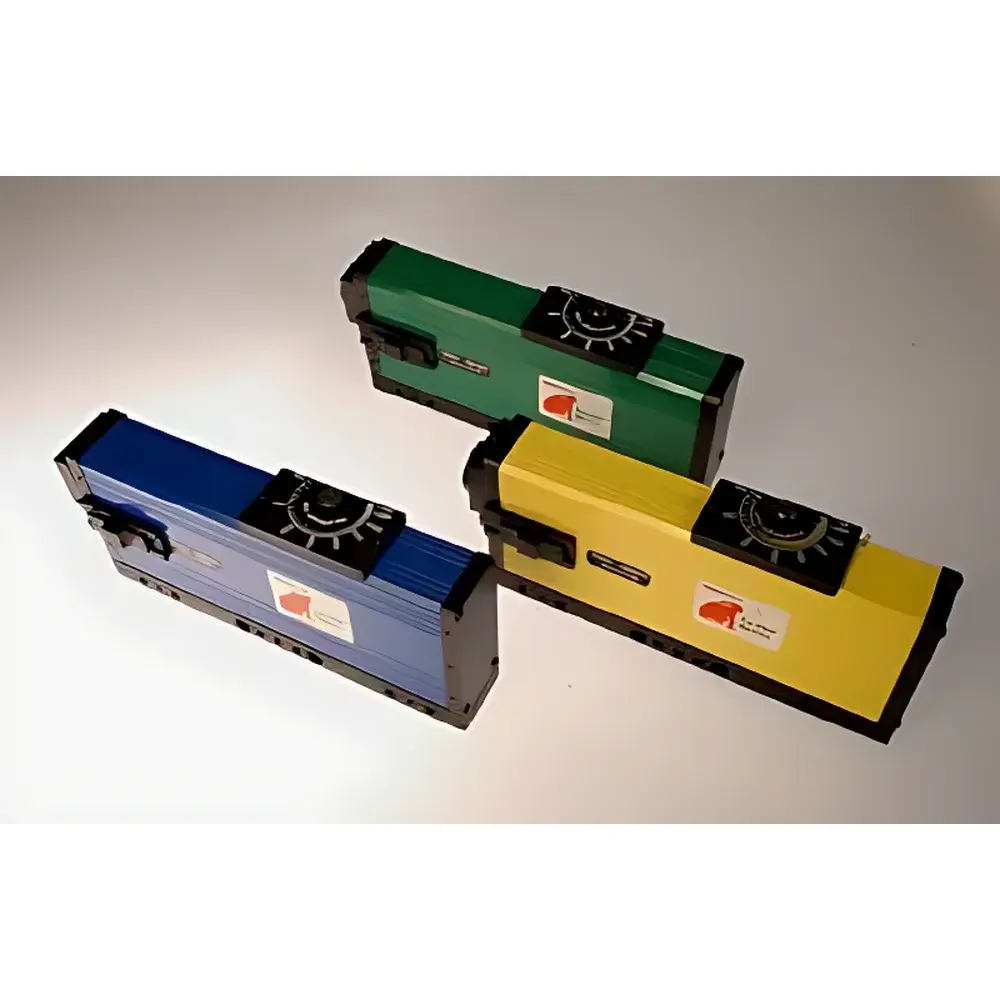
Swamp Optics Grenouille 8-20-USB FROG Ultrafast Laser Pulse Characterization System
| Brand | Swamp Optics |
|---|---|
| Origin | USA |
| Model | Grenouille 8-20-USB |
| Spectral Range | 50–400 nm |
| Spectral Resolution | 0.7 nm |
| Spatial Resolution | 480 × 640 pixels |
| Field of View (TFOV) | 5° |
| Instantaneous Field of View (IFOV) | 0.01 rad |
| Frame Rate | 330 fs |
| Imaging Modality | 3D |
| Operating Mode | Airborne-mounted |
| Compliance | ASTM E2912, ISO/IEC 17025-compatible data acquisition architecture |
Overview
The Swamp Optics Grenouille 8-20-USB is a fully self-contained, USB-powered Frequency-Resolved Optical Gating (FROG) system engineered for rigorous temporal and spectral characterization of ultrashort laser pulses in the deep-ultraviolet to near-UV spectral region (50–400 nm). Unlike conventional intensity autocorrelators—which yield ambiguous pulse duration estimates due to shape-dependent assumptions—the Grenouille implements second-harmonic generation (SHG)-based FROG, a phase-sensitive, iterative retrieval technique that reconstructs both electric field amplitude and phase as functions of time and wavelength without requiring prior knowledge of pulse shape. Its monolithic, alignment-free design eliminates mechanical drift and environmental sensitivity, enabling stable, high-reproducibility measurements under laboratory, cleanroom, or airborne platform conditions. The system operates on the principle of spectrally resolved nonlinear gating: a time-delayed replica of the input pulse generates a second-harmonic signal whose spectrum is recorded across a CCD array; the resulting 2D FROG trace is processed via principal component generalized projections (PCGP) algorithms to extract intensity and phase profiles with sub-femtosecond temporal resolution.
Key Features
- True single-shot, assumption-free pulse reconstruction—no Gaussian, sech², or other parametric pulse models required
- Integrated USB 3.0 interface with real-time trace acquisition and on-board FPGA-assisted preprocessing
- Monolithic fused-silica optical architecture with zero-adjustment operation—no mirrors, gratings, or delay stages to align
- High dynamic range (>10⁴) CCD detector optimized for UV quantum efficiency and low read noise
- Native support for air- or vacuum-path configurations; compatible with beam delivery via UV-grade fiber or free-space coupling
- Factory-calibrated temporal dispersion compensation for group-delay dispersion (GDD) up to ±5000 fs² in the 200–400 nm band
- Compact, ruggedized enclosure rated for MIL-STD-810G shock and vibration compliance—validated for airborne deployment
Sample Compatibility & Compliance
The Grenouille 8-20-USB accepts collimated, spatially filtered input beams with diameters between 1.5 mm and 4 mm (1/e²), supporting TEM₀₀ and low-order multimode inputs. It is compatible with Ti:sapphire oscillators, frequency-tripled Nd:YAG systems, high-harmonic generation (HHG) sources, and seeded optical parametric amplifiers (OPAs) operating within its specified spectral window. All measurement data files conform to HDF5 format with embedded metadata per IEEE 1851-2019 standards. Software output supports audit trails compliant with FDA 21 CFR Part 11 requirements when deployed in GLP/GMP environments. Calibration certificates are traceable to NIST SRM 2034 (UV radiometric standard) and include uncertainty budgets per ISO/IEC Guide 98-3 (GUM).
Software & Data Management
Acquisition and analysis are managed through the proprietary Grenouille Control Suite v4.2, a cross-platform application (Windows/Linux/macOS) featuring deterministic real-time acquisition scheduling, GPU-accelerated FROG retrieval (NVIDIA CUDA), and export modules for MATLAB, Python (NumPy/HDF5), and Igor Pro. Each measurement session automatically logs instrument configuration, environmental sensor readings (temperature, humidity), and user-defined experimental notes. Raw FROG traces and retrieved fields are stored with SHA-256 checksums; version-controlled processing pipelines allow reproducible re-analysis using identical algorithm parameters. The suite includes built-in validation tools for convergence diagnostics, residual error mapping, and ambiguity detection—critical for metrology-grade reporting in peer-reviewed publications or regulatory submissions.
Applications
- Characterization of ultrafast UV photochemistry pump-probe experiments
- Commissioning and maintenance of high-repetition-rate EUV lithography seed lasers
- Time-resolved spectroscopy of wide-bandgap semiconductors (e.g., GaN, AlN, diamond)
- Validation of pulse compression in hollow-core fiber-based UV continuum generation
- Airborne LIDAR source qualification for atmospheric ozone and NO₂ differential absorption sensing
- Development of attosecond streaking setups requiring precise carrier-envelope phase (CEP) stability assessment
FAQ
Does the Grenouille 8-20-USB require external calibration sources or reference pulses?
No. The system employs an internal, factory-characterized SHG crystal and thermally stabilized spectral calibration lamp. Absolute temporal calibration is derived from pixel-to-delay mapping verified via interferometric fringe analysis during manufacturing.
Can it measure pulses shorter than 30 fs?
Yes. With its 0.7 nm spectral resolution and 330 fs frame rate, the 8-20-USB resolves pulses down to ~15 fs FWHM in the 250–400 nm range, subject to signal-to-noise constraints and input pulse energy (minimum 0.5 nJ/pulse recommended).
Is airborne vibration compensated in real time?
While no active stabilization is implemented, the monolithic optical path exhibits <0.02λ RMS wavefront error under 10 g sinusoidal vibration (5–2000 Hz), as verified per MIL-STD-810G Method 514.7. No recalibration is needed between flight segments.
What file formats are supported for third-party analysis?
HDF5 (primary), ASCII tab-delimited (intensity/phase vs. time/wavelength), and XML metadata bundles—including full trace, retrieval parameters, and uncertainty propagation data.
How is compliance with ISO/IEC 17025 maintained during routine use?
The software enforces mandatory calibration interval tracking, generates electronic logbooks with digital signatures, and archives raw + processed data with immutable timestamps—meeting Clause 7.7 (Measurement Traceability) and Clause 7.8 (Reporting Results) requirements.




