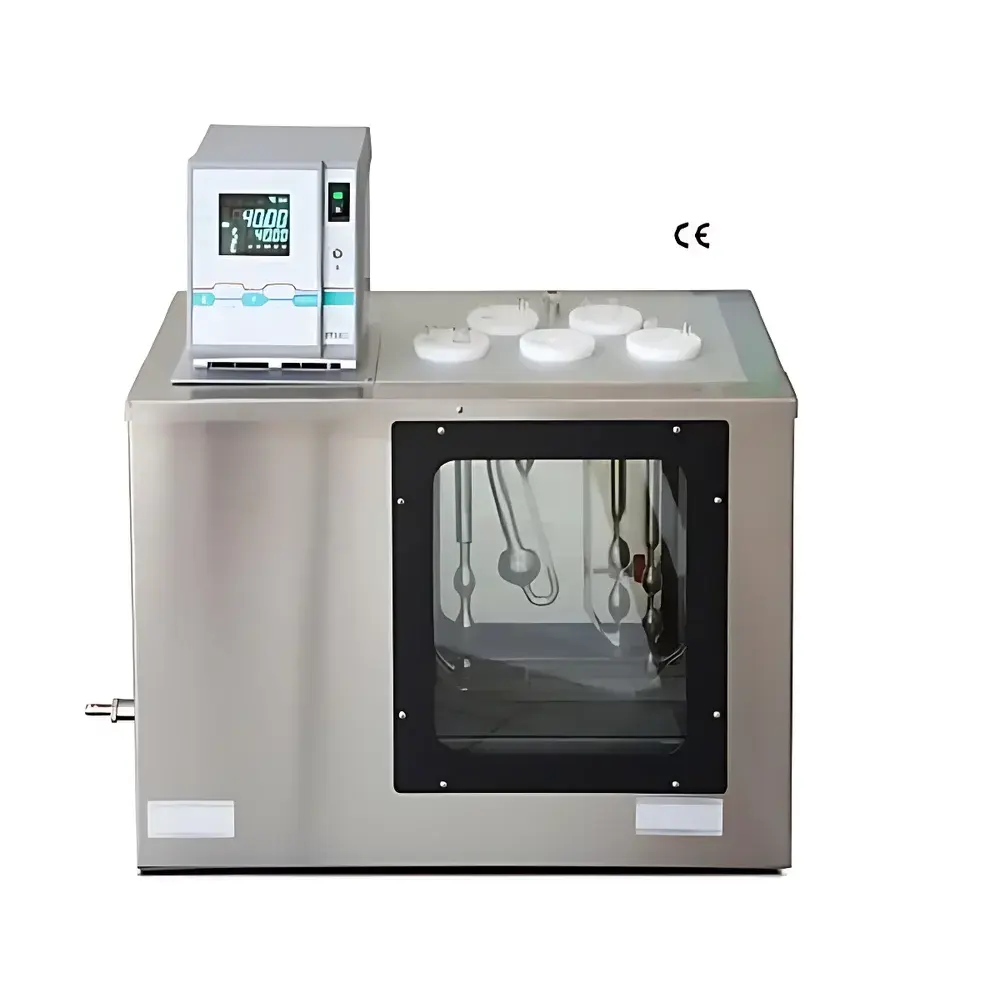
Swiss-Made ASTM D445 Kinematic Viscosity Bath – Model D445
| Origin | Switzerland |
|---|---|
| Type | Kinematic Viscosity Bath |
| Compliance | ASTM D445, IP 71 |
| Capacity | 20 L |
| Temperature Range | Ambient +5 °C to 150 °C |
| Temperature Resolution | ±0.01 °C |
| Temperature Stability | ±0.02 °C at 100 °C |
| Chamber Construction | Stainless Steel |
| Sample Ports | 5 × Ø51 mm |
| Control System | PID Digital Temperature Controller |
| Safety Features | Over/Under-Temperature Protection, Low-Level Fluid Detection |
| Sensor | PT100 Platinum Resistance Thermometer |
| Cooling | Integrated Helical Cooling Coil |
| Lid | Removable Stainless Steel Cover |
| Viewing Windows | Dual-Sided Double-Glazed (20 mm Air Gap) |
Overview
The Swiss-made ASTM D445 Kinematic Viscosity Bath – Model D445 is a precision-engineered thermal bath system designed explicitly for kinematic viscosity determinations in accordance with ASTM D445 and IP 71 standards. It operates on the principle of capillary viscometry, where the time required for a fixed volume of liquid to flow under gravity through a calibrated glass capillary tube is measured at precisely controlled temperatures. Accurate kinematic viscosity data—expressed in mm²/s (cSt)—is critical for quality assurance, specification compliance, and process optimization across petroleum refining, lubricant formulation, biodiesel production, and aviation fuel certification. The D445 bath provides the thermally stable, vibration-damped, and optically accessible environment essential for reproducible capillary timing measurements, especially when used with Ubbelohde, Cannon-Fenske, or Zeitfuchs viscometers. Its dual-sided double-glazed viewing windows—separated by a 20 mm air gap—minimize thermal bridging while enabling real-time visual monitoring of sample flow, meniscus position, and bath fluid level without compromising temperature uniformity.
Key Features
- Stainless steel construction ensures long-term corrosion resistance against mineral oils, solvents, and glycol-based heat transfer fluids.
- Five standardized Ø51 mm sample ports accommodate multiple capillary viscometers simultaneously, supporting parallel testing and inter-laboratory comparison studies.
- PID digital temperature controller delivers rapid thermal equilibration and sustained stability of ±0.02 °C at 100 °C—meeting the stringent thermal uniformity requirements of ASTM D445 Section 6.3.
- Integrated helical cooling coil enables efficient heat dissipation during high-temperature operation or rapid cooldown cycles, reducing turnaround time between tests.
- Dual safety architecture includes independent over/under-temperature cutoffs and low-bath-fluid-level detection, preventing heater dry-firing and ensuring operator and instrument protection.
- PT100 Class A platinum resistance thermometer provides traceable, NIST-compatible temperature measurement with inherent linearity and long-term drift stability.
Sample Compatibility & Compliance
The D445 bath is validated for use with all standard ASTM D445-compliant capillary viscometers and is routinely employed in laboratories accredited to ISO/IEC 17025. It supports testing of transparent and opaque petroleum products—including base oils, finished lubricants, jet fuels (Jet A-1, JP-8), diesel fuels, and residual fuel oils—as well as non-petroleum fluids such as silicone oils and synthetic esters. The bath’s temperature uniformity profile across the 5-port array conforms to ASTM D445 Annex A1, ensuring that spatial thermal gradients remain within ±0.02 °C over the full immersion depth of standard viscometer bulbs. Its stainless steel interior and sealed electrical components meet IP54 ingress protection requirements for laboratory environments handling volatile hydrocarbons.
Software & Data Management
While the D445 operates as a standalone analog-controlled thermal platform, it is fully compatible with external digital data acquisition systems. When integrated with PC-based timing modules (e.g., automated viscometer timers compliant with ASTM D445 Section 9.2), the bath supports GLP-compliant audit trails, electronic signature capture, and 21 CFR Part 11–enabled data archiving. Temperature setpoints, actual bath readings, and event logs (e.g., safety trips, lid-open alerts) can be streamed via RS-232 or optional 4–20 mA analog output for integration into LIMS or MES platforms. All firmware and calibration records are maintained per ISO/IEC 17025 clause 6.4.10, with documented traceability to national metrology institutes.
Applications
- Quality control of crude oil fractions and refined distillates in refinery QC labs
- Viscosity grading of engine oils (SAE J300), gear oils (SAE J306), and hydraulic fluids (ISO VG classes)
- Batch release testing of aviation turbine fuels per ASTM D1655 and DEF STAN 91-91
- Research into temperature-dependent rheological behavior of biofuels and alternative lubricants
- Calibration verification of reference oils and certified viscosity standards (e.g., NIST SRM 2783)
- Supporting ASTM D7042 (HTHS viscosity) and ASTM D445–based density-viscosity correlations
FAQ
Does the D445 bath include a built-in timer or viscometer?
No—the D445 is a thermal bath only; it does not incorporate timing electronics or capillary viscometers. It is designed to host externally supplied ASTM-compliant viscometers.
Can the bath operate continuously at 150 °C for extended periods?
Yes—its reinforced stainless steel tank, optimized insulation, and active cooling coil support uninterrupted operation at maximum temperature, provided ambient conditions remain within 15–30 °C and relative humidity ≤70%.
Is third-party calibration documentation included with shipment?
A factory-issued calibration certificate traceable to Swiss METAS standards is supplied, covering temperature accuracy and stability at 40 °C, 100 °C, and 150 °C.
What heat transfer fluid is recommended for operation above 100 °C?
Silicone oil (e.g., Dow Corning 200 Fluid, 50 cSt) or polyalkylene glycol (PAG)-based baths are recommended; mineral oil is restricted to ≤90 °C per ASTM D445 guidance.
How is thermal uniformity verified across the five sample ports?
Uniformity is validated using a multi-point PT100 probe array during factory acceptance testing; deviation across ports remains ≤±0.015 °C at 100 °C, exceeding ASTM D445 Annex A1 requirements.