
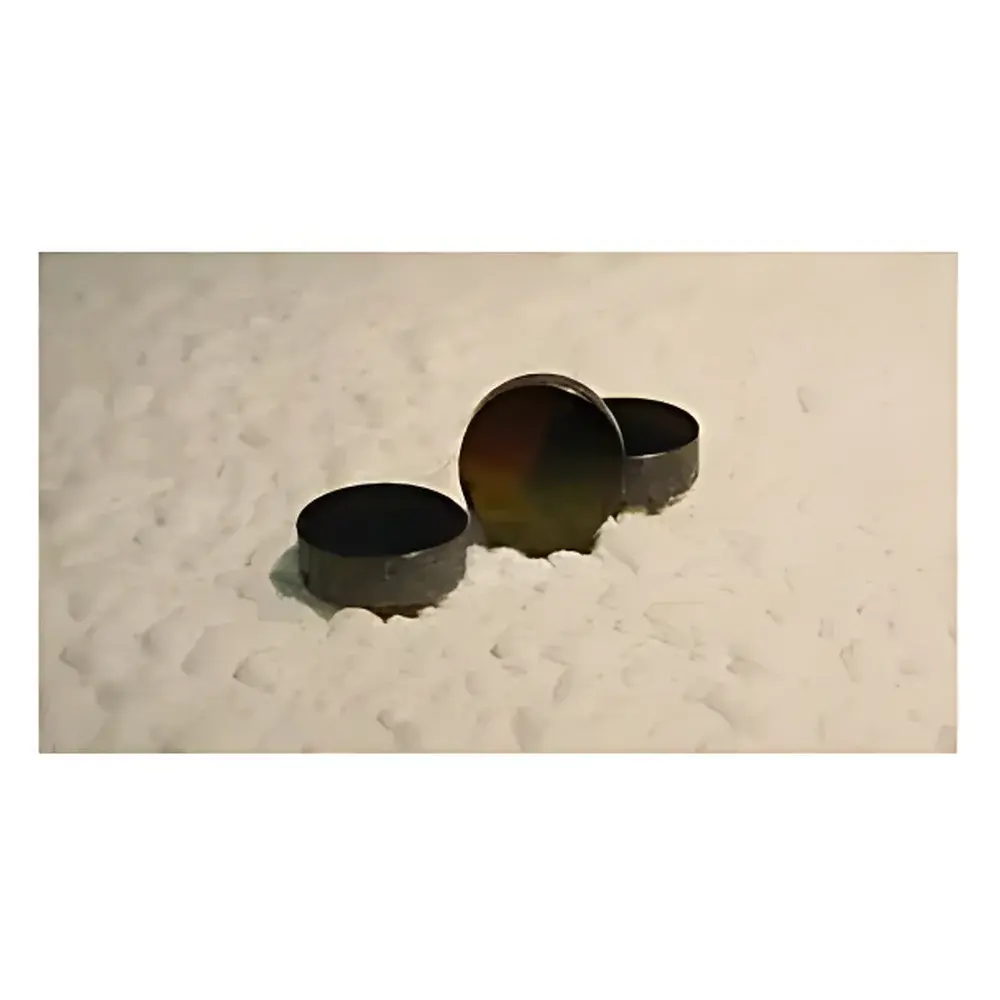
Synoptics Cr4+:YAG Passive Q-Switch Crystal
| Brand | Synoptics |
|---|---|
| Origin | USA |
| Manufacturer Type | Authorized Distributor |
| Import Status | Imported |
| Model | Cr4+:YAG |
| Wavelength Range | 500–3000 nm |
| Crystal Orientation | <100> |
| Surface Finish | Flat/Flat |
| AR Coating | R < 0.2% @ 1064 nm |
| Laser-Induced Damage Threshold (LIDT) | >500 MW/cm² (10 ns, 10 Hz, 1064 nm) |
| Diameter | 3–10 mm |
| Thickness | 1–5 mm (customizable) |
| Optical Density (OD) Options | 0.30, 0.40, 0.50 ±10% @ 1064 nm |
| Absorption Coefficient (α) | 1.5–6.0 cm⁻¹ @ 1064 nm |
| Uniformity | High spatial homogeneity of Cr⁴⁺ distribution |
| Compliance | ISO 9001:2008 certified manufacturing and QA process |
Overview
The Synoptics Cr4+:YAG passive Q-switch crystal is a solid-state saturable absorber engineered for reliable, compact, and high-repetition-rate nanosecond pulse generation in 1.06 µm Nd-doped laser systems. Based on yttrium aluminum garnet (Y3Al5O12) doped with chromium in the tetravalent oxidation state, this crystal operates via ground-state absorption saturation at 1064 nm—enabling passive Q-switching without external electronics, high-voltage drivers, or electro-optic modulators. Its intrinsic thermal stability, radiation hardness, and absence of photodegradation mechanisms distinguish it from organic saturable absorbers (e.g., dyes) or color-center crystals. The Cr4+ ions substitute for Al3+ sites in the YAG lattice, stabilized by charge-compensating co-dopants such as Mg2+ or Ca2+, yielding controllable and reproducible absorption coefficients (α = 1.5–6.0 cm−1). All Synoptics Cr4+:YAG crystals are grown using the Czochralski method under controlled redox atmosphere, followed by precision orientation along the axis, double-side polishing to λ/10 surface flatness, and broadband anti-reflection (AR) coating optimized for minimal residual reflectivity (<0.2% @ 1064 nm).
Key Features
- High laser-induced damage threshold (>500 MW/cm², 10 ns pulse width, 10 Hz, 1064 nm), validated per ISO 21254-1
- Precisely tunable optical density (OD = 0.30, 0.40, 0.50 ±10% @ 1064 nm) achieved via controlled thickness (1–5 mm) and Cr4+ concentration gradients
- Exceptional spatial uniformity of Cr4+ ion distribution—critical for stable pulse build-up and low-amplitude noise
- Wide operational transparency window (500–3000 nm), supporting applications beyond 1064 nm including OPO pumping and mid-IR generation
- Full in-house process control: crystal growth, orientation, cutting, polishing, AR coating, spectral characterization, and ISO 9001:2008-compliant final inspection
- No thermal lensing or recovery-time limitations typical of semiconductor saturable absorber mirrors (SESAMs)
Sample Compatibility & Compliance
Synoptics Cr4+:YAG crystals are compatible with continuous-wave (CW) pumped Nd:YAG, Nd:YVO4, Nd:GdVO4, and Yb-doped fiber lasers operating near 1064 nm. They integrate seamlessly into folded cavity, linear cavity, and microchip laser architectures. All crystals undergo rigorous metrology—including spectral absorption mapping (UV-Vis-NIR spectrophotometry), wavefront distortion analysis (Zygo interferometry), and surface defect inspection (per MIL-PRF-13830B). Manufacturing adheres to ISO 9001:2008 quality management requirements; documentation supports GLP/GMP traceability for regulated environments. While not classified as medical devices under FDA 21 CFR Part 820, full material certifications (RoHS, REACH) and lot-specific test reports are provided upon request.
Software & Data Management
Synoptics delivers comprehensive technical documentation with each crystal shipment: calibrated absorption spectra (1000–1100 nm), OD verification report (measured via calibrated photodiode + reference cavity), surface flatness map, coating reflectance curve, and LIDT validation summary. No proprietary software is required for integration; however, Synoptics provides MATLAB- and Python-compatible spectral data files (.csv, .txt) for modeling pulse dynamics using standard rate-equation solvers (e.g., Haus master equation formalism). Traceability logs include furnace batch ID, crystal boule number, orientation verification timestamp, and metrology technician signature—all archived for ≥10 years per internal QA policy.
Applications
- Compact passively Q-switched microchip lasers for lidar, rangefinding, and time-of-flight sensing
- Industrial marking and micromachining systems requiring high peak power (>10 kW) and sub-10 ns pulses
- Medical aesthetic platforms (e.g., tattoo removal, pigmented lesion treatment) leveraging 1064 nm nanosecond pulses
- Military-grade target designators and countermeasure emitters compliant with MIL-STD-883H
- Scientific pump sources for optical parametric oscillators (OPOs) and difference-frequency generation (DFG) in spectroscopy
- Ultrafast amplifier seeding where low-jitter, self-starting pulse trains are essential
FAQ
What determines the optimal optical density for my laser cavity?
Optimal OD depends on gain medium small-signal gain, cavity round-trip loss, and desired pulse energy. OD ≈ 0.4 is typical for Nd:YAG end-pumped microchip lasers; lower OD suits high-gain cavities, while higher OD improves pulse contrast at the expense of threshold increase.
Can Synoptics provide custom AR coatings outside 1064 nm?
Yes—custom coatings for 946 nm, 1319 nm, or dual-band (e.g., 1064/1342 nm) are available upon specification of incidence angle, polarization, and environmental class (e.g., humidity-resistant SiO₂/Ta₂O₅ stacks).
How is Cr4+ concentration verified non-destructively?
Via quantitative UV-Vis-NIR absorption spectroscopy calibrated against NIST-traceable standards; α is extracted from Beer-Lambert fits across multiple wavelengths, with cross-validation using photothermal deflection spectroscopy (PDS) on representative samples.
Is post-polishing annealing performed?
Yes—crystals undergo controlled reoxidation annealing after polishing to stabilize Cr valence states and minimize surface-related absorption losses.
Do you supply mounted or heat-sink-integrated versions?
Standard delivery is unmounted, bare crystals. Custom copper or OFHC mounts with indium solder bonding and thermal interface characterization (≤0.5 K/W resistance) are available under engineering collaboration agreement.





